




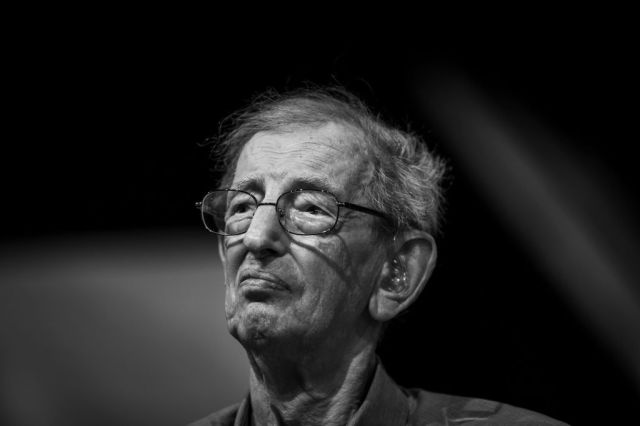
Eric Hobsbawm at the Hay festival in 2009. (David Levenson/Getty)





For most academics, professional success extends to citations and conference invites. Eric Hobsbawm was different. His towering Ages series of books remains among the most celebrated and widely read works of historical scholarship to have been published in this or any era. Beginning in 1962, with The Age of Revolution, and comprising four volumes spanning from the French Revolution to the fall of the Berlin Wall, they have been eagerly consumed not only in his native Britain but across the world. Translated into dozens of languages — The Age of Extremes has sold an almost unbelievable 265,000 copies in Brazil alone — they helped make Hobsbawm a global celebrity.
It is difficult today to think of any comparable figure, not least another historian: a scholar who, as well as producing a number of innovative essays, wrote a series of major mass-market history books alongside vast amounts of politically engaged journalism, all while communing with politicians and members of the cultural and intellectual elite. Yet Hobsbawm managed it, along the way offering a vital window onto the momentous, world-changing developments of the past two-and-a-half centuries, structuring how millions see both the past and, often, the future too.
And yet, as I discovered while reading his books again over recent months, set against the standard of contemporary historical writing they are also curious works. The historical blockbuster of the 2020s is likely to be a work of narrative writing, focusing on the texture as well as the structure of life in the past. If not the story of a single individual or of a small group, it will nonetheless be extensively peopled, peppered with quotes from diaries or journals, and all hanging on a dense web of narrative.
Not so the Ages books. The Age of Revolution, for instance, starts not with people but with an analysis of the “agrarian problem” of the late 18th century. “From the point of view of agrarian property relations,” we read only a few pages in, “we may divide Europe — or rather the economic complex whose center lay in Western Europe — into three large segments.” And on it goes: hardly barnstorming stuff, even if it is written in Hobsbawm’s distinctively crisp and limpid prose and sprinkled throughout with wonderfully telling details (a page later we are quoted a Russian advert selling “three coachmen, well-trained and very presentable, and also two girls, aged 18 and 15, both of good appearance”).
As Emile Chabal writes in his superb new intellectual biography of Hobsbawm, “this was pedagogy of the old-school fashioned lecture hall, in which a man stands on a podium and explains what the audience should think”. Driven not by narrative or chronology, the Ages books are instead works of deep synthetic and analytical scholarship, written from an Olympian height rather than the perspective of the common man or woman. There are, of course, risks in such a style, not least a seeming lack of intellectual or epistemological humility, carrying as it does the distinct whiff of omniscience. But, Chabal notes, in the hands of a master historian like Hobsbawm, it can be intoxicating. The reader, he writes, approaches the books “searching for explanation but left in awe of [Hobsbawm’s] encyclopedic knowledge”.
If there were a model for this sort of historical writing, it was provided by the Annales school of French historians, particularly its leading figure, Fernand Braudel. Clustered around an eponymous journal, this set of postwar historians pioneered writing over what they called the longue durée, privileging deep structures such as climate or geography, or the broader forces of economic and political change, over what they contemptuously termed “event-based history”.
In Hobsbawm’s case, of course, there was another influence too: Marxism. A lifelong Marxist, Hobsbawm would tell an interviewer in 1985 that those like him who were influenced by Marx will always be “interested in the large-scale totalizing history”. “The basic Marxist question”, he added, is how “culture, ideology, politics and so on” fit in with the economic development of a society. What is key, in other words, is interconnection, or the question of how each of the constituent parts of history fit together into what Hobsbawm likened to a “web”, as opposed to a single unidirectional “thread”.
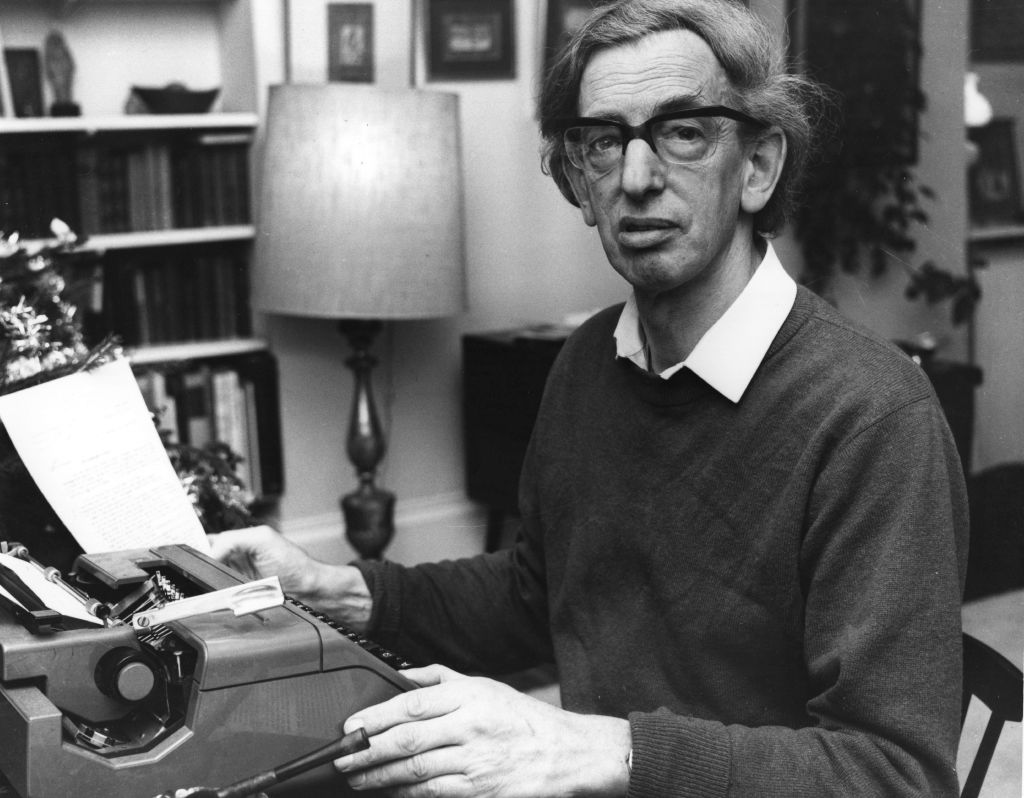
If his Marxism helped give shape to his historical writing, it would also become one of the most contentious aspects of his life and work. Even those with only a passing familiarity with Hobsbawm’s work will know that he was a member of the Communist Party of Great Britain from his undergraduate days at Cambridge to the party’s dissolution following the collapse of the Soviet Union. Trailed through much of his life by the security services, on his death in 2012, at the age of 95, he attracted the ire of the kind of anti-communist who, like those Japanese soldiers in the jungles of South East Asia, were seemingly unaware that the Cold War was over and that their side had won. As A.N. Wilson (quite wrongly) predicted in the Daily Mail: “Hobsbawm himself will sink without a trace. His books will not be read in the future. They are little better than propaganda”. Wilson even went so far as to accuse Hobsbawm of being a possible “traitor” like his Cambridge near-contemporaries Philby and Blunt. Michael Gove, for his part, went further still. At the 2008 Conservative Party Conference Gove declared: “only when Hobsbawm weeps hot tears for a life spent serving an ideology of wickedness will he ever be worth listening to.”
Even those who came to praise him seemed uncomfortable with Hobsbawm’s politics. Tristram Hunt, while celebrating “the breadth of his work and the reach of his intellect”, could regard him only as a slightly neutered “Enlightenment giant”, while his official biographer, Richard Evans, passed over in a slightly embarrassed manner the extent and nature of Hobsbawm’s radical commitments. This is particularly apparent in Evans’s treatment of 1956, the annus horribilis for communist parties worldwide, when the dual shock of Khrushchev’s “secret speech” and the Hungarian Revolution, brutally suppressed by Soviet troops after 12 days, led to mass resignations and public recriminations. Unlike many of his contemporaries, not least his fellow historian E.P. Thompson, Hobsbawm chose to remain in the CPGB, a decision he would be repeatedly asked to account for later.
Evans, explaining Hobsbawm’s decision, emphasizes that his “loyalty was not so much to the Communist Party as to the cause of socialism in general”, a position driven by his childhood in Thirties Berlin. Which rather seems to leave the question begging. Chabal, on the other hand, tackles it head-on. For Chabal, Hobsbawm was what the French would call an “intellectual engagé”: a committed intellectual. He was, Chabal writes, “a communist, and, from the age of about fourteen, communism acted as the guiding thread for his life and work”. Unless we understand this fundamental aspect of his life, we will not be able to appreciate either Hobsbawm’s work or what endures of his contemporary appeal.
Of course, Evans wasn’t wrong in tracing Hobsbawm’s communism to his upbringing. Born in 1917 in Alexandria, then part of the British protectorate of Egypt, to a father from the East End of London and an Austrian mother, Hobsbawm’s early years were spent as a member of the secular Viennese Jewish middle class, albeit one constantly on the verge of tipping into poverty and destitution. He would later recall his sense of “embarrassment” at being given an old second-hand bike, its frame visibly bent, as a gift by his mother, as well as at his threadbare shoes which barely withstood the harsh Central European winters. Although he makes little of it, it seems clear that this sharp early awareness of material privation was pivotal in the early development of his political commitments.
After his parents died young, the 14-year-old Eric moved to Berlin to live with an aunt and uncle. As he would later stress, there were few better places to be a politicized teenager. “The months in Berlin made me a lifelong communist,” he wrote in his autobiography Interesting Times, “or at least a man whose life would lose its nature and significance without the political project to which he committed himself as a schoolboy.” Published when he was 85, the book is a curiously impersonal document, but the sections on the death throes of the Weimar Republic hum with life. It is there that we hear of his first exposure to mass communist demonstrations in the twilight of German democracy, and how Hobsbawm learned of Hitler’s appointment as chancellor as he walked his sister home from school.
Soon after, Eric was moved again, this time to the apparent calm of North London, before he went up to Cambridge, where he read history. Hobsbawm chose the subject, he says, mainly because he was good at it, though there must have been something of the young communist in the decision too. After all, the materiality of history is both the key to understanding the world — and to changing it.
Never an organizer, Hobsbawm’s political commitments remained primarily intellectual even after he joined the CPGB, brief forays into the world of political protest notwithstanding. This limitation is something he was long aware of. His teenage diaries are filled with an ecstatic, even quasi-sexual, longing to throw himself into the cause. He wanted, he wrote, to “dive” into Marxism, to “love it, both sensually and yet spiritually, like one loves a woman”, to “melt into it like a snowflake in the snow”. It is tempting to read a lot, perhaps too much, into the overwrought private scribblings of a pubescent boy. But within them is a glimpse into the Janus-faced nature of his political self. Marxism, Hobsbawm was sure, could provide him with the key to unlock the meaning and working of the world, but he was instinctively aware of the limitations of his faith in the cause. As a bookish and awkward young man, he could never live the revolution like the working-class KPD toughs he saw in Berlin.
This, too, may hint at why Hobsbawm was able to weather the turbulence of 1956 more easily than his peers. If his political engagement was lived predominantly via the mind — “we were communists in the way in which, in other places, we should have read each other poetry,” he wrote in an autobiographical story while at Cambridge — that was in marked contrast to someone like Raphael Samuel, another pioneering historian whose apprenticeship was served in the Party. In his memoir-cum-study of the culture of communism, Samuel writes of his family, steeped in the cultures of the Left. Both his mother, the composer Minna Keal, and his uncle, the historian Chimen Abramsky, were party members, as were many other members of his family, and much of his childhood was spent engaging in party activities. Samuel even became, he writes, “a kind of juvenile commissar of the family”.
For Samuel, in other words, communism was then both a mental and a bodily form of commitment. It was the intellectual sea in which he swam, but also the lifeworld in which he was formed. So when Soviet T-54s rolled into Budapest, and the crisis came, Samuel experienced it as a profound and destabilizing break. He threw himself into the New Left, editing Universities and Left Review and later New Left Review. As the intensity of the New Left dissipated, however, Samuel found it increasingly difficult to continue as he had. Not long after, he would move to Ireland and had a nervous breakdown — the long-delayed after-effects, perhaps, of 1956.
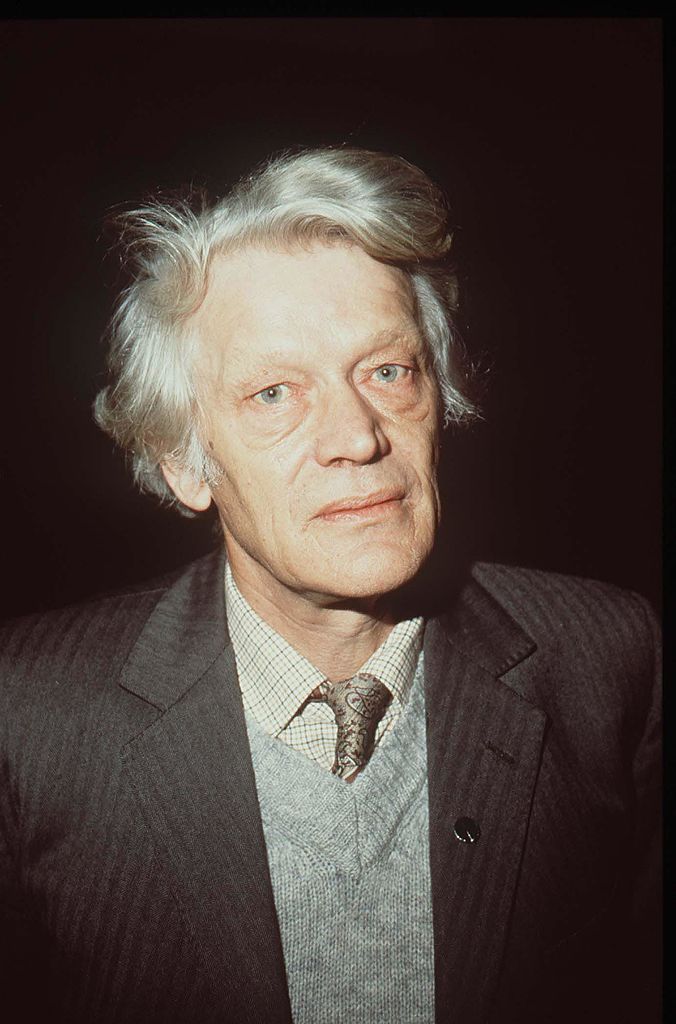
Yet Hobsbawm, from what we know, suffered nothing so drastic. Could this mix of commitment and detachment have served to keep him in the fold? It certainly helped that he had a hinterland beyond the expectations of the CPGB to fall back on. Cambridge opened Hobsbawm to the taste of real intellectual excitement, but it was also where, as Tony Judt later wrote, he “began his lifelong ascent into the British elite”. Judt’s comment is not without merit, even if it has the distinct tang of vinegar. For it was at Cambridge that Hobsbawm joined the elite debating society, the Apostles, whose other members included Wittgenstein, Forster, Keynes and the Cambridge spies. Later, in the Eighties, Hobsbawm would become a member of the exclusive Athenaeum Club, while in 1998 he was honored with appointment to the Order of the Companions of Honor. If, because of his communism, Hobsbawm was always something of an outsider, then he was very much an insider’s outsider.
Yet Cambridge offered more than simply a passage into the upper echelons of British society. In fact, as Chabal notes, much of the next few decades of Hobsbawm’s life can be read as an attempt to return to the intense intellectual atmosphere of the interwar Cambridge Left. We can see this, for instance, in the way he threw himself into the Communist Party Historians Group in the decade after 1946. This group, which would gather in the inauspicious surroundings of the Garibaldi restaurant in Clerkenwell, or in the Marx House nearby, would come to include some of the most celebrated British historians of the 20th century: Thompson, Samuel, Christopher Hill, and Rodney Hilton, who, alongside Hobsbawm, redefined what was until then a rather stuffy subject dominated by aloof political narratives. That all of these historians were incubated not only in the CPGB, but over meatballs and plonk at Garibaldi’s, is surely testament to the intellectual ferment of postwar British communism.
The Historians Group would, however, be another victim of the Hungarian Revolution and its aftermath. Over the next six months, many of its most able members left the party. Yet in a strange twist, Chabal suggests that whatever the emotional effects of the dissolution of the Historians Group, in the long run it may actually have helped Hobsbawm’s career. As Chabal explains, Hobsbawm was always a “highly effective networker”; more than that, he was something far more easily recognized today than in mid-century: an “academic entrepreneur”. Possessed of a hard-nosed commercial instinct, throughout his career he had a strong sense of who his intended audience was. Not just other academics, or even communist converts, Hobsbawm wanted to write for a wide general readership. This aim was only heightened by the dissolution of his close party network.
As universities increased their intake through the Sixties and Seventies, and with a burgeoning middle class with new consumer appetites to satisfy, there arose a massively increased audience for serious works of non-fiction. Hobsbawm, with his genius for simplifying complex processes and an encyclopedic knowledge of 19th-century history, as well as his terse English prose and his keen sense of the market, was perfectly positioned. Between 1970 and 1990, Hobsbawm’s books earned around £20,000 a year on average in royalties in today’s terms. On top of that came ever-larger advances for his work and royalties on foreign editions. Not only did these years see Hobsbawm become a very well paid writer, they also allowed him to bring Marxism to the masses like never before.
There was, however, a tension between the cosmopolitan writer and the committed intellectual. Then again, his was a life of contradictions: Hobsbawm was the loyal party man who wrote sympathetically of peasant revolutionaries; the aficionado of jazz who castigated the deadening effects of mass culture; the refined intellectual who helped open up the study of working-class organization. His communism, however, was the guiding thread throughout. Yet it also poses problems for us in receiving his work today. What, for one thing, does it mean to be a writer who was publicly committed to a cause that’s now more-or-less extinct? More than that, how should we, in our hyperpolitical age, when political causes are backed and discarded at the click of a button, understand someone who dedicated their life to a political project that ended in failure — or worse?
It certainly helps that he wrote so well. Avoiding the kind of jargon that can easily overwhelm even the most lucid Marxist writing, history under Hobsbawm’s pen begins to take on a new clarity and sense of movement. Nowhere is this more apparent than in Age of Extremes, a book which in many ways was a very personal attempt to account for his faith in the cause of communism as a world-historical force. The book presents a riveting picture of the 20th-century “age of catastrophe”, framed on either side by the Great War and the fall of the Berlin Wall and punctuated in the middle by the horrors of the Forties. What adds power to this framing is the centrality of the communist experiment. The vital fact of the short 20th century was that there existed an organized alternative to capitalism, even if it wasn’t in the end a more appealing one. And the defeat of that grand experiment, in Hobsbawm’s hands, turns the story of the century into a tragedy. There is no liberal triumphalism of the kind that became so dominant in the Nineties here.
Today, as Lea Ypi writes in a searching recent essay, the status of the Soviet Union in public memory is still not settled. For those who remain committed to the political project of socialism, neither of the dominant stories we are told about the history of actually existing communism are particularly satisfying. “On the one hand,” she writes, “we have the liberal account in which communism was a totalitarian disaster from start to finish, and every emancipatory aspiration of the twentieth century was an early sign of the catastrophe to come. On the other hand we have the defensive view that state socialism was a deformation or betrayal of a model that is thought to remain philosophically intact.” We could add to that the Govian mode we saw earlier, which would force anyone who wishes to make the world anew to account for the sins of those who came before. What we need instead, Ypi insists, is a new form of narrative, one which can reopen “the past as morally contested rather than closing it off as nothing more than the slaughter bench of history”.
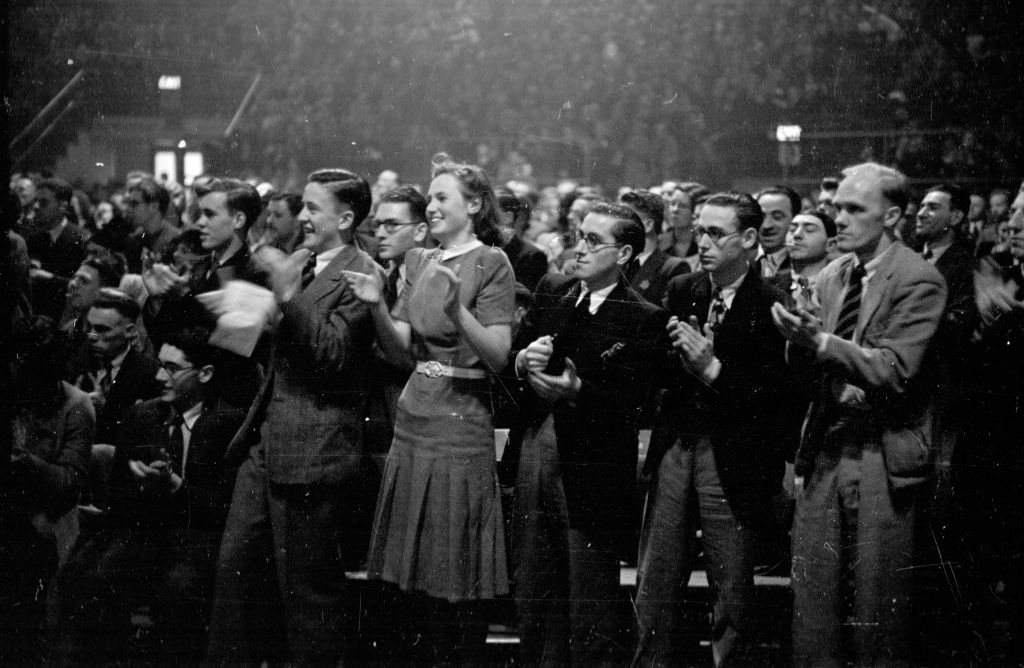
One model for this can be provided, I would argue, by the work of Eric Hobsbawm. As he wrote in the famous final lines of Age of Extremes:
“We do not know where we are going. We only know that history has brought us to this point and—if readers share the argument of this book—why. However, one thing is plain. If humanity is to have a recognizable future, it cannot be by prolonging the past or the present. If we try to build the third millennium on that basis, we shall fail. And the price of failure, that is to say, the alternative to a changed society, is darkness.”
The past cannot be a dead weight around our necks. But, just as vital, it cannot be forgotten either. The darkness that Hobsbawm predicted in 1994 seems ever closer.
Yet history, for much of the contemporary Left, is merely one moral disaster after another. This is Ypi’s “slaughter bench of history”. When the Left writes history, it is often done in the denunciatory mode, as a kind of a morality play, where good guys are set against bad guys, and which is hamfistedly shaped by contemporary concerns. Or, on the other hand, it is a simplistic “red thread” kind of history: a tale of Left-wing heroes meant merely to invigorate the faithful.
Of course, there is much value in this form of history, when it is done well. But, as Hobsbawm and Chabal both know, history can also teach us where we’re going. It can give us the tools to understand the world around us, and perhaps even to begin to change it. The retreat to the small, and the jettisoning of grand metanarratives of the kind that Hobsbawm excelled at, has reduced our understanding of who we are. As Hobsbawm wrote in the late Eighties, in a letter to a doctoral student:
“I am not particularly interested in ‘reconstructing a narrative in which gender, ‘race’, sexuality and subjectivity are central rather than adjuncts to the [grand narrative].’ …Anyway the sort of history you propose is not my kind of history, I don’t think it is Marx’[s] ‘kind’ either… In my view, the project you are engaged in is just another symptom of the retreat of [the] Left.”
We can forgive, perhaps, the cranky tone in which this letter was written, if not his often-curt dismissals of feminist history. But his diagnosis of the retreat to identity as a symptom of a historic defeat feels especially acute today.
How, then, in the wake of the Left’s historic defeat, can one begin to rebuild a shared collective project of emancipation? History does not offer easy answers. Then again, nor does the fragmentation of the past into a series of seemingly discrete moments, not least when the public status of historical memory is more unsure than ever. As Hobsbawm noted: “the destruction of the past, or rather of the social mechanisms that link one’s contemporary experience to that of earlier generations, is one of the most characteristic and eerie phenomena of the late 20th century.” And if, as the old cliché goes, those who forget their past are doomed to repeat it, then what amounts to the wholesale destruction of the link between history and the present goes far further still. “Most young men and women at the century’s end,” Hobsbawm continued, “grow up in a sort of permanent present lacking any organic relation to the public past of the times they live in”, producing the spread of “an absolute a-social individualism”. Against this, historians must be “chroniclers, remembrancers and compilers”. To do so means being the kind of engaged historians who can make sense of the mess of the historical record. They must, in short, be like Eric Hobsbawm.
Yet, those of us who would wish to write the kind of wide-angled history that can once again ask the big questions of our past and our future cannot simply replicate the work of writers like Hobsbawm. The historical moment for that has passed. We need new histories. But the questions he asked must once more take center stage: what forces have shaped the present moment, bringing us to where we are today? And what tools can we find in them to remake the world in a fairer and just manner? In this, there is still much to learn.