




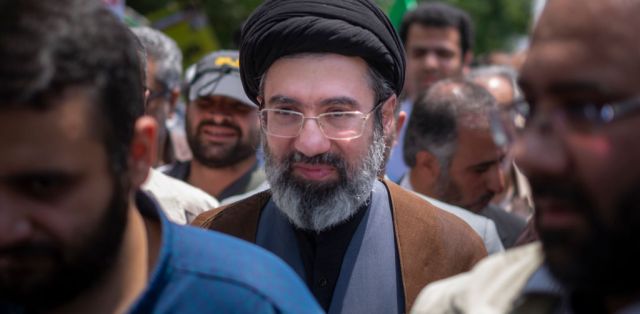
Iran’s new supreme leader is shifting away from the regime’s technocratic faction. Credit: Getty





This week, Iranian Supreme Leader Ayatollah Mojtaba Khamenei reshuffled the Islamic Republic’s security apparatus as his country entered its sixth month of war with the United States. Given the byzantine nature of the Iranian regime, the full picture — including Khamenei’s exact motives and the internal balance of forces — is hard to discern. Yet a broad theme is emerging: the new supreme leader and his inner circle are preparing to unveil the third iteration of the Islamic Republic.
This new state, forged in the crucible of conflict with two nuclear powers, pursues a militarized sovereignty that renders it simultaneously insular and strategically aggressive. Paradoxically, however, this emerging Iran presents President Trump with a workable chance to exit the Middle East to focus on rebalancing the US-China relationship, promoting domestic industrial renewal, and securing the Western Hemisphere — priorities laid out in Trump’s 2025 National Security Strategy.
Khamenei’s most notable move is the elevation of Mohsen Rezaei as secretary of the country’s Supreme National Security Council, which coordinates decision-making across the state’s various security and military agencies. Rezaei is a close adviser to Khamenei, and is the longest- serving commander of the Islamic Revolutionary Guard Corps, having overseen Iran’s war with Iraq in the 1980s. The council was most recently headed by Mohammad Bagher Zolghadr after an Israeli air strike killed its high-profile secretary Ali Larijani in March.
While Zolghadr has taken on a new role as Khamenei’s political adviser, his removal is a blow to the pragmatic-conservative bloc that has coalesced around the speaker of the Parliament, Mohammad Bagher Qalibaf, since Larijani’s assassination. Qalibaf, of course, has been Vice President JD Vance’s chief interlocutor in the stalled effort to bring the war to a negotiated settlement. Zolghadr’s replacement by the hard-line Rezaei is a telling indicator of the new supreme leader’s views on how the US-Iran talks were handled.
The previous arrangement — which empowered Qalibaf and Zolghadr — had effectively sidelined Khamenei from direct oversight over Iran’s deep state: his passive role repeatedly became a source of controversy in the negotiations. Khamenei’s hiding (due to fear of assassination) didn’t help the situation. In appointing Rezaei to lead the security council, Khamenei is now seeking to regain control and diminish what he likely sees as Qalibaf’s excessive influence in the system.
The Rezaei appointment is coupled with a run of high-level appointments in the Iranian military. These include Maj. Gen. Ahmad Vahidi as commander in chief of the IRGC and Maj. Gen. Ali Abdollahi as chief of staff of the armed forces. Both men are IRGC commanders who played leading roles in the Iran-Iraq War.
Not all of the appointments are anti-Qalibaf. Having led Iran’s primary operational command in the current war, Abdollahi is a close ally of Qalibaf’s, having served as his deputy in multiple positions. Vahidi, meanwhile, is Rezaei’s protégé going back to the ’80s. Seen in tandem, the appointments represent a careful balancing act aimed at preempting potential internal power struggles and stamping the new supreme leader’s authority on the security state as a whole.
At the same time, the appointments underscore Khamenei Jr.’s tightening grip on power and Tehran’s hardening — if audacious — strategic trajectory.
At first glance, the appointment of “security-first” veterans ensures that while the state’s military and logistics are run with efficiency, its overarching direction remains uncompromising. The Islamic Republic’s leadership views the conflict with Washington through an existential lens. This perspective turns the state’s red lines into rigid, non-negotiable realities for the nation as such. After all, when survival is at stake, any regime’s internal fractures yield to a unified front, as dictated by necessity and shared strategic priorities.
Yet, this defensive consolidation and rallying around the flag in the face of war doesn’t mean that internal politics have gone away. Nor does it imply that long-term institutional and ideological rivalries have ceased. Rather, beneath the surface of wartime unity, Iran’s deep state remains locked in a fierce, quiet civil war between two competing factions — not over the Islamic Republic’s desired end state, but over how to get there. The resolution of this internal struggle, combined with Mojtaba Khamenei’s evolving leadership strategy, could also determine the fate of the Middle East.
The internal schism splits Iran’s security establishment between those who advocate for a technocratic Islamic Republic with normal ties with the rest of the world; and those who believe the only way to safeguard Iran’s sovereignty and national security is by turning the country into an autarkic fortress capable of fierce power projection in its near abroad.
The first faction is composed of technocratic-military elites and conservative clerics. Qalibaf is their most visible representative. But there are many others, including the cleric Ali Asghar Hejazi, the network’s main powerbroker, who served as an intelligence consigliere to Khamenei Sr., and who remains the deputy chief of staff at the Office of the Supreme Leader. This camp views the state through the lens of (Islamic) legitimacy and bureaucratic rationality. Having witnessed the devastating economic and physical toll of protracted conflict, its members advocate a “smart authoritarianism” — a model akin to Putinist Russia or post-Mao China. For them, Iran’s military and nuclear leverage aren’t holy relics, but strategic bargaining chips to be traded for sanctions relief, economic stabilization, and regime survival.
Opposing them is the regime’s old-guard intelligence and military network, spearheaded by Rezaei, Vahidi, and former IRGC chief Yahya Rahim-Safavi. The faction’s most critical internal enforcer is the ruthless shadow operator Hossein Taeb, Mojtaba Khamenei’s confidant and the former chief of the IRGC Intelligence Organization, now appointed to head the Basij paramilitia that operates as an auxiliary branch of the IRGC. This faction is unyielding about defending what it regards as the true principles of the 1979 Islamic Revolution and subscribes to a doctrine of permanent mobilization and attritional warfare. Members view any diplomatic overture or concession on the nuclear dossier not as statesmanship, but as an existential trap designed by Washington to trigger systemic collapse. To them, the Strait of Hormuz and the country’s uranium stockpiles are vital instruments of deterrence, never to be bargained away.
When Mojtaba Khamenei assumed power following the death of his father, many anticipated an immediate purge of the establishment. Instead, Khamenei bided his time in the shadows and honored his father’s appointees, exercising a remarkable degree of strategic patience. Most notably, he chose to retain Ali Asghar Hejazi at the apex of the security apparatus, despite reports that Hejazi had actively sidelined Mojtaba in the final years of the elder Khamenei’s life and had lobbied against a hereditary succession.
This decision was not born out of affection, but systemic necessity. The new leader understood that in a period of intense external threat and internal transition, sacrificing his own personal agency and desire for vengeance was the price of preserving state stability. He needed Hejazi’s institutional memory and control over the vast web of state bureaucracy to prevent systemic paralysis during an existential war.
The upshot is that, despite the monumental shift in leadership brought about by the US-Israeli assassination of Mojtaba Khamenei’s father, up until now, little has changed in Tehran since the war politically or structurally. The regime’s characteristic dual-track approach remains intact: Tehran brandishes its sword (Vahidi and the IRGC drone and missile attacks), even as it shows a diplomatic face to the world in the form of Qalibaf’s Cheshire Cat grin.
But the continuity wasn’t destined to last. As Mojtaba Khamenei consolidates his power, he is systematically building a parallel architecture to dictate his own distinct authority and vision — one that marks a sharp departure from his father’s era and its strategic ambiguity. The reshuffling of the SNSC to install Rezaei is a signal to the technocrats: the regime has entered a state of permanent warfare.
Put another way: the Western fantasy of a sudden internal collapse has failed. External aggression has instead hardened the state, expanding its domestic control and revitalizing its elite cohesion — a case study in the remarkable resilience of regimes that fully embrace the structures of the modern total state. Unlike the ideological rigidity of civilian hard-liners like Saeed Jalili, Mojtaba Khamenei’s rising faction is deeply pragmatic and militaristic about state survival. Yet, this is a pragmatism entirely divorced from Western integration or liberal norms, using autarky not as a temporary shield, but a structural choice (as long advocated by Rezaei himself).
Where Qalibaf’s technocrats seek survival through a win-win diplomatic deal or a grand bargain with Washington, Mojtaba Khamenei’s camp — bolstered by Rezaei’s uncompromising stance on Iran’s absolute sovereignty over the Strait of Hormuz — seeks to translate raw military defiance and the ethos of resistance into permanent strategic gains. The latter group views Iran’s nuclear and military capabilities as critical levers to achieve the maximum deterrence needed to avoid the historical fates of disarmed states like Libya.
With the security-first crowd at the helm, the future of Iran is, in short, an autarkic, anti-American fortress that refuses to surrender its security assets or exchange its sovereignty for Western promises or economic incentives.
The autarkists are convinced that Donald Trump is constitutionally erratic, aggressive, and untrustworthy; and that the only language his administration understands is that of strength. Consequently, they believe that the only way to free Iran from the looming shadow of war is if Washington comes to recognize and accept its defeat and is publicly humiliated — underscoring the futility of future military action. It’s a risky strategy, to be sure, but one they feel is the only solution to re-establish Iranian deterrence given Trump’s particular psychology.
Paradoxically, this intensely inward-looking and sovereigntist Iran presents Trump with a realistic opening to fundamentally redraw the Middle Eastern landscape. A true realist foreign policy framework must reject the failed dogmas of regime change and endless “forever wars.” Instead, it must embrace a ruthless pragmatism centered on America’s core national interest alone: avoiding protracted entanglements in a region that is of secondary importance (at best). Realism doesn’t require trust; it requires predictable, self-interested state actors; and an insular, survival-focused Iran is far more predictable than a desperate, collapsing state driving a regional civil war.
By abandoning its penchant for primacy and military intervention in the Middle East, Washington can shrewdly leverage Iran’s consolidated, predictable power structure to enable the region’s (long-disrupted) natural balance of power to return. The emerging regional alignment — reinforced by the landmark Mecca defense pact that Egypt and Iran can eventually join — has already underscored the rise of the ME5 (Turkey, Saudi Arabia, Pakistan, Egypt, and Iran) in a post-American Middle East.
These five sovereign regional heavyweights are increasingly demonstrating a desire to manage their own neighborhood, explicitly rejecting being dragged into an unwanted regional war or serving as platforms for unilateral American military adventures, as seen in the Persian Gulf states’ recent resistance to assisting US naval blockades. In fact, a major motivating factor behind Riyadh’s and Tehran’s détente since 2023 remains their shared, pragmatic exhaustion with being used as proxies in strategic rivalries of external great powers. This is why the Saudi-Iranian reset has survived nearly six months of regional war — even military strikes on Saudi ports in the Red Sea by the Iran-aligned Houthis in Yemen.
But such a strategic reset can’t be brought about unless Trump alters his perception of Iran. He must give up the pipe dream of liberalizing the Islamic Republic, and end America’s decades-long pursuit of a “grand bargain” aimed at transforming Iran’s domestic society. Instead, Trump must heed his own vice president’s counsel, abandon containment strategies that prioritize the interests of foreign states like Israel and the United Arab Emirates over the American people, and swap Cold War-era Manichean mentalities for a transactional recognition of a bounded Iranian sphere of interest in a polycentric world.
Unlike Nixon’s opening to China, shifting Iran policy wouldn’t hinge on a formal deal or bilateral treaty between Washington and Tehran. By merely accepting Iran as an enduring regional power that will neither relinquish its sovereignty nor tolerate foreign meddling, Trump has a unique Nixonian opportunity to withdraw from the Middle East and offload regional security onto the ME5 themselves.
This nascent regional equilibrium, sustained by a balance of indigenous powers, rather than an expensive and deeply resented American military umbrella, would finally provide Washington with the strategic off-ramp it has sought for a generation — freeing the United States to retrench, preserve its great-power status, and focus on its most vital priorities at home and abroad.
Arta Moeini is the Director of Research at the Institute for Peace and Diplomacy and founding editor of AGON.
 artamoeini