




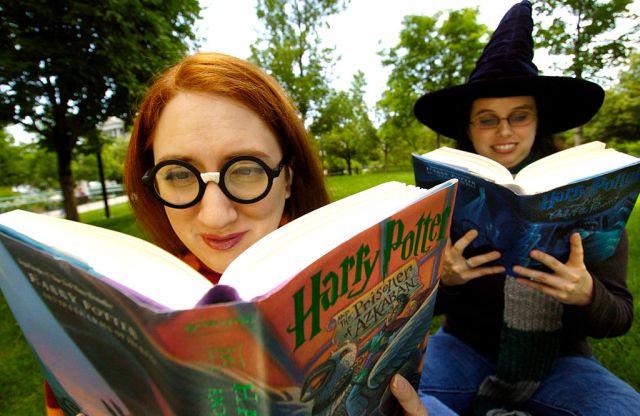
“We know that adult Harry Potter fans can be, well, fanatical.” (Helen H. Richardson/The Denver Post/Getty)





I have a confession: as a child I was the biggest Harry Potter fan in the muggle world. I had the books in special-edition hardback. A Gryffindor cloak. A collection of fiberglass wands, for Christ’s sake. My older sister would read the books to my twin and I before bed; eventually they were the first books I read on my own. I wept on Lincoln high street when I came out of the final film. I tend to keep these details under my hat; it wouldn’t do to be tarred with the brush of the unreformed adult Potterheads, whose earnestness and enthusiasm for roleplay deeply disturbs me.
But it means I do understand the power of J.K. Rowling’s childhood-shaping novels. And so I wasn’t entirely surprised to learn about the shrine on Freshwater West beach in Pembrokeshire. Here, a tumble of painted rocks remembers Dobby the house elf, a squeaky-voiced magical creature from the Harry Potter series who was stabbed in a good-versus-evil battle before teleporting (stay with me) to the sand dunes to die. Fans found the spot after the theatrical release of Harry Potter and the Deathly Hallows: Part 1 in 2010; in the intervening years, mounds of pebbles and odd socks (long story) have been stacked along the shore around a simple wooden cross.
We know that adult Harry Potter fans can be, well, fanatical. They tote tattoos or necklaces bearing the sign of the Deathly Hallows, hold Hogwarts-themed weddings, name their dogs Sirius Black. They are cringe but they are harmless. Unless you’re in the energy sector, that is. Simon Ludlam, director of a £430 million cabling project, knows exactly the damage they can do. He was recently inundated with “hundreds” of calls from Potterheads over a project he was leading, the Greenlink interconnector, which would thread underneath the dunes of Freshwater West — right through Dobby’s grave — all the way to County Wexford. Ludlam, who looks to be a normal and well-adjusted man in his sixties, very reasonably asked “who?” before being informed that the house elf’s resting place was a “very, very serious matter”. In the end, the fans won: a 504-megawatt interconnector between Britain and Ireland had been made to negotiate with the imagined remains of a house elf.
It has become depressingly fashionable to distance oneself from the supposedly heinous views of Harry Potter’s creator. Rowling’s advocacy for women and children in the gender debate, at great personal cost to herself, has awakened all the fury and poisonous misogyny of those living in their own fantasy worlds. Hundreds of scribblers and social-media screamers have been keen, over the years, to highlight the “irony” of the offense emanating from one of the figures in British life most celebrated for promoting warm and fuzzy values. How can this woman going to bat for single-sex spaces on X be the same dreamweaver of our childhoods — the creator of a world in which the oppressed triumphed? The implication is of a national treasure turned witch — a fallen angel. And, for many, it’s personal: some of the biggest evangelists for the cult of gender were once the biggest fans of Harry Potter.
The pipeline here should be self-evident. Many of the most vocal apostles for “trans resistance” are part of an arrested cohort: their generation festers in fandoms, hoards Funko Pops, indulges in parasocial relationships with celebrities and fictional characters. They assimilate the moral frameworks of imagined worlds and bluntly apply them to complex grown-up politics. Gender evangelism being a distinctly dweeby movement is not incidental: it directly relates to the baked-in credulousness, magical thinking and outsiderdom which has come to define their generation.
Nor is it incidental that these themes are the very foundations of the Harry Potter novels. The series’ inciting incident is the sacrifice of Lily Potter, Harry’s mother, to shield him with the simple “old magic” of love. For Rowling, noble is the acceptance of death in the face of persecution — Harry’s parents, many of his peers and ultimately the boy himself model this. The novels’ “wizarding wars” mirror our own, particularly the Second World War: the creed of Voldemort’s gang (the Death Eaters) is a cognate for white supremacy — a murderous preference for pure magical blood over the “mudblood” dilution of non-wizard muggles. Toleration, parity and sympathy for the weak: these are tenets not just of the Potterverse but of the Christian world, too. And just as the beneficiaries of Christianity in the modern, skeptical West have turned on the Church in the Tom Holland model of secularism, so too did Rowling raise a generation of readers to turn on her for criticizing the ultimate monopoly-holder of modern-day oppression: the transgender movement. The force — the creed, the author — which shaped our values also handed us the tools to dismantle them. Harry Potter’s Christian skeleton (intentional or otherwise) put the novel’s author on a familiar track: it seems inevitable now that she’d be ridiculed by those who were raised in the cozy, tolerant atmosphere which both Christianity and Rowling, in their own ways, ushered into being.

The Potter novels also place enormous emphasis on the mendacity of institutions and the untrustworthiness of official language: the Ministry of Magic, the magical government, is a den of mealy-mouthed apparatchiks and becomes, after Voldemort’s return, a sort of butterbeer-swigging Vichy. Journalists like Rita Skeeter are incorrigible tabloidy liars; authority figures like headteacher Dolores Umbridge are corrupt sadists in league with forces of evil. Even public speech is boobytrapped in Rowling’s world: nobody dares name Voldemort, and speaking obvious truths — for example, about the fact of his resurrection — is met with utter contempt and castigation (a state of affairs Rowling has now come to experience herself).
Of course, the laudable moral messaging of the Harry Potter novels does not map directly on to real-world political disputes. These books are about heroes and villains: the good, the redeemed and the bad. In real life things are much more messy: rights conflict, language cannot dissolve material trade-offs, and sincerity does not equate to truth. And so, Rowling’s fantasy-steeped children came of age with both an unusually vivid appetite for moral sorting and a drilled-in obsession with oppression and empathy. Frustrated by the complexity of our strange political world, they turned on their maker; transcending upwards into ever purer believers, they labeled their founder a heretic.
So the debacle surrounding Dobby’s grave isn’t a silly-season news quirk. The moving of a real half-a-billion-pound infrastructure project around a fictional character encapsulates the entire story of Rowling’s place in public life. Hundreds of furious adult fans gave Dobby the house elf a real-world moral constituency and appointed themselves guardians of his final resting place. When that was threatened, they leapt up to do battle with an evil bureaucratic body which, like the ministry in Rowling’s novels, are maleficent killjoys picking on the plucky little guy. They were acting, in other words, like characters from Harry Potter — the tenacious schoolchildren fighting against the odds, the motley Good Ones plotting against dark forces in the tumbledown Weasley cottage.
I understand why grown adults came out swinging on Dobby’s behalf; I also understand why other former Potter readers cling to an absurdly trenchant moral framework and deranged obsession with victimhood. What was meant to be a refuge — a fictional world with its impossible narrative logic — has hardened into reality for a generation of perennial superfans prepared to elbow children out the way to spend grown-up pocket money on chocolate frogs at theme parks. For the fact is that these are simply cracking stories, vivid worlds with plotlines that inspire a sense of justice even in small children. Because these plotlines were so wonderfully woven, a small number of vocal adults will do whatever they can to cleave to the Potterian schema — whether it’s calling up energy execs or turning on their founding mother for being a little too of reality. In the end, the lure of this fiction was too strong for a readership who cannot seem to put childish things away.
