




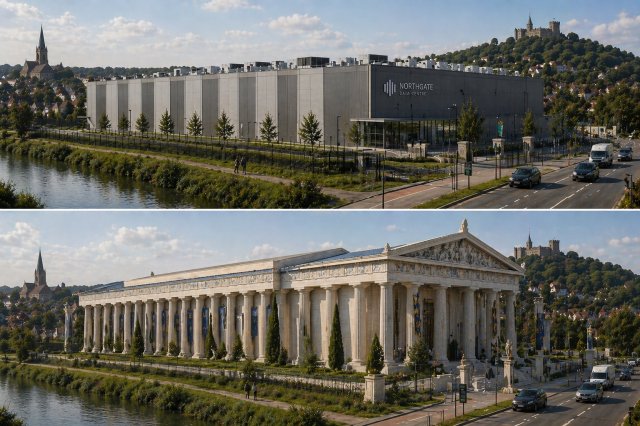
The Northgate data center in Germany above a modest re-imagining. (@Birdyword)





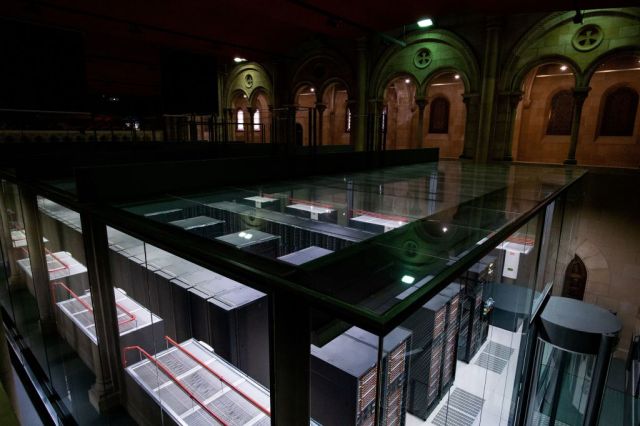
A church, traditionally, is the house of God. The chapel of Torre Girona, however, is a house of superhuman intelligence. In this quiet corner of Barcelona sits one of Europe’s most powerful computers, one whose 5,000-odd Nvidia GPUs have been turned toward tasks far beyond an unassisted human mind. It has simulated the cardiovascular system; used data to predict where deeply-buried fluids might lurk; and, most profoundly, detected the gravitational waves set in motion by the collision of two black holes. Once the chapel’s neo-Romanesque nave would have been filled with chanting; now, it hums.
And sometimes it is filled with visitors. It is the marriage of the two constructs, chapel and data center, and the unusual power of the apparatus within the stone walls, that give this site its appeal. It is something sorely lacking in Torre Girona’s rather less lovely cousins: the thousands of data centers now under urgent worldwide construction.
In Britain, America, and the West at large, data centers are loathed. So deep is this public opprobrium that, since 2023, $85bn of American data-center projects have been canceled. From Fife to Devon, similar revolts are underway in Britain. In East London, the former Truman Brewery will now, thanks to an intervention by the housing secretary, Angela Rayner, become the scene of a redevelopment that includes a data center — but not without incurring the anger of local mandarins and campaigners.
The Truman Brewery project had its own local difficulties, but any given data center development will tend to arouse a predictable set of complaints. One accusation is that data centers overuse energy, which is used to power the computing equipment and keep it cool; another is that they overuse water, which is another component of some data centers’ cooling systems.
The accusations are sometimes misleading. Data centers’ use of water is overstated, and modern cooling systems use less than older ones. Data centers are hungry for energy, but they are responsible for only a tiny proportion of Western nations’ energy use. It’s true that our decrepit and highly regulated power grids are ill-placed to increase their capacity by even 1% per year — but our paralysis has caused tech barons to invest, with notable success, in geothermal, nuclear and even fusion power. Hyperscalers’ data centers might yet spur considerable improvements in the provision of clean energy.
Protesters stand on firmer ground when they complain about noise (data centers hum incessantly, and roar when they resort to generators), jobs (once data centers are completed, they don’t need many people per square foot), slop (where did you think those AI-generated videos are made?) and their own economic obsolescence. The most powerful AI models, those that are already beginning to automate human labor, are trained, of course, in data centers. In the late-18th century, the Luddites were driven to fury by industrial looms that were human-operated. Imagine how furious they would have been if the looms needed no human hand at all — or were designed to automate all human labor entirely. That, of course, is the promise, or threat, of today’s frontier labs.
Still, the neo-Luddite pitchforks might not need dusting off just yet. The labor market currently appears more resilient, what with all the premiums it places on tacit knowledge and in-person competence, than pessimists might have feared — at least for now. The defenders of data centers can also argue that their output isn’t entirely slop. Data centers are also important infrastructure in humanity’s endeavors to discover new industrial materials, improve computational biology, and maintain miraculous but quotidian services such as Google Maps, cloud storage, and accurate weather forecasts. They will also be central to the brewing revolution in robotics. Finally, there is the more Molochian argument that if someone’s going to build the data centers, and therefore collect the tax receipts and seize some geopolitical leverage, it might as well be the British.
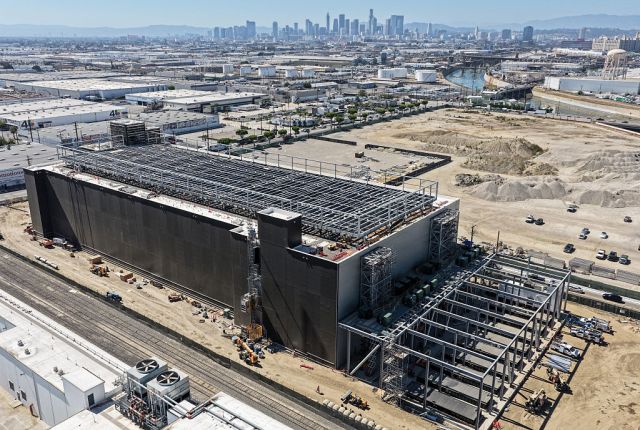
But it is understandable that the public has reservations — and if Big Tech is worthy of the public’s suspicion, then one clue is in the data centers’ aesthetics. Torre Girona is one of a tragically small band of data centers that are anything other than appalling eyesores. There are enchanting examples of this category: a former coal mine in Svalbard, a converted chapel in Leeds, and a supervillain-style bunker in the bedrock beneath Stockholm. But these are irreproducible at best, gimmicks at worst. To call the average data center a carbuncle would be unduly flattering; at least carbuncles have some color in them. A typical data center, however, is a vast and windowless gray box. The exterior of such a building says nothing about its locality and history, nothing about what services they seek to render humanity. Instead, most data centers look like blank statements of disinterested cheapness, embodiments of the attitude that might condemn most of humanity to the status of, as it is sometimes described, the “permanent underclass”. To make their point, the enemies of data centers need do little more than share pictures. “Is this what we want for our country?” they ask.
Ironically, data centers enable the very capabilities that can be used to reimagine them. Every now and then, someone goes viral on X for posting a mockup of, say, a data center that looks like a castle; or for arguing that data centers, since they produce so much heat, “should obviously be built in the style of Georgian and Victorian glass houses, filled with citrus trees and other exotic plants”. Infused with Anglofuturist zeal, the Government recently announced the creation of a data center design contest. Data centers, argued Kanishka Narayan, the AI minister, ought not to be “anonymous, gray buildings that our communities are asked to simply tolerate. Infrastructure should say something different. It should say your community matters, that you are part of the national story that you are helping to power into the future.”
Whether the Royal Institute of British Architects (RIBA) is the right partner for this prize is debatable. RIBA’s Stirling Prize generally rewards architecture that, in its placeless modern blandness, pleases architects rather than stirs the public. This new partnership, one suspects, is less likely to produce noble new cathedrals than a few larch-clad eco-warehouses. Yet the Government has little option but to try to get the public onside, for there is an international bidding war for data centers. Apart from generating tax revenue for their hosts, local data centers facilitate activity that requires a quick and ideally proximate connection between one computer and another. If you’re using AI to help maintain the National Grid, or you’re running a factory production line that uses robotics, or you’re about to go under the knife of a robot surgeon, then you’ll want a data center near you rather than in, say, Virginia. And if you dislike the idea of Britons’ health data being stored abroad, then the corollary of that view is that the data should be stored on British soil. Whether we are trying to achieve sovereignty or, more humbly, solvency, we need data centers.
And we are behind. The US has three times as much data-center capacity as Britain, with much more planned. But the American public’s more organized opposition to data centers, with Erin Brockovich playing a prominent part, gives middle powers an opportunity to take up a larger share of the global AI economy. All parties, though, face a menacing competitor, for the migration into space has already begun. Elon Musk plans to send xAI data centers into orbit, thus circumventing — or rather, soaring far above — the physical and regulatory obstacles one finds on Earth. In this case, the immediate benefit to the general public is significantly lessened. Devon County Council stands little chance of collecting tax revenue from an xAI orbital cluster.
This makes the task of improving data centers, and winning round a skeptical public, even more pressing. It is unfortunate for Britain, as for most of the West, that this challenge presents itself after several decades in which cheap nuclear energy has been neglected, Big Tech has alienated the public, and oikophobic architects and regulators have made crowd-pleasing civic design a modern rarity.
And yet it is possible to at least remember civic infrastructure capable of provoking enthusiasm. Shipbuilding towns were proud of the vessels they built together: many years after the shipyards closed, local newspapers still wax nostalgic. Battersea Power Station, that brooding brick hulk, was designed by Giles Gilbert Scott as an art deco cathedral to industry. It was not universally popular at the time of its inception, but it has been preserved long after it was decommissioned. Even sewage infrastructure can be resplendent: Joseph Bazalgette’s Crossness Pumping Station is a remarkable feat of colorful neo-Gothicism. Other buildings of a similar age — the V&A, the Natural History Museum — use statue and ornament to trumpet their contents. Perhaps, given this history, there is a version of the future in which people are excited to welcome new infrastructure, even data centers, safe in the knowledge that it will benefit their town visually, financially, and even spiritually.
The problem is that, as economies advance, much of life becomes further divorced from what we naturally find meaningful. Few in the West work together, with their hands, on products as tangible as a ship. Checking a data center’s air con system somehow lacks the romance of shipbuilding. And on the rare occasions that we build railway stations, or anything else, cheap materials and gloomy designs are almost universally preferred to characterful local alternatives. Data centers, in their lonely, empty ugliness, are a symptom of these trends rather than a particularly egregious example of them.
That makes the challenge even harder. Welcome though more attractive designs might be, it is not enough to plaster the planet with data centers that happen to be housed in ersatz chapels or plastic castles. Instead, the designers of genuinely publicly-spirited data centers, with hyperscalers and governments taking particular responsibility, must find some way of expressing, through architectural form, what these buildings could mean for humanity. In this respect, Battersea Power Station and the V&A are more inspiring templates than an Amazon fulfillment center.
The apparently trivial matter of data center aesthetics therefore cuts to the heart of what AI is really for. Often, what the opprobrium towards data centers really signals is public fear of impotence, uselessness, and exploitation of the commons. If AI is to transform the world, then the default outcome is not necessarily one that puts human dignity at its heart. Yet it is the role of aesthetics, even in the disembodied realm of AI, to remind us what to strive towards. And in a time of acceleration, disenchantment and disorientation, that role could scarcely be more important.