




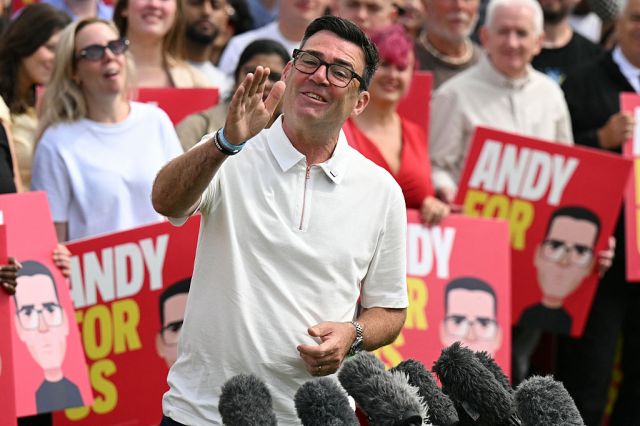
'He isn’t a miner, a farmer, a factory worker or even an entrepreneur. He is, to his core, a politician.' (Oli Scarff/AFP/Getty)





“Too Northern”; “Not really Northern at all”; “Strategically Northern”; “A plastic Northerner”; “A professional Northerner”; “A Northern soul populist.” Not since Jon Snow rode South in Game of Thrones has anyone received quite as many column inches simply for being “Northern” as Andy Burnham. As a dyed-in-the-wool, pitchfork-carrying Northerner myself, I rather like the idea that we might send someone down to sort the mess out. God knows the country is in a terrible state, and perhaps we have finally exhausted the theory that Southern private-school-educated posh girls and boys are uniquely qualified to run it.
But the word “North” still rolls from the tongues of political journalists with barely concealed contempt, as if it were some minor impoverished province of an ancient empire. You’d think Burnham was coming with a pre-formed cabinet that included the Gallagher brothers, or was leading an army of zombies dressed in JD Sports gear. It feels as though Westminster journalists and politicians have suddenly discovered something they spent years ignoring: place.
And that is what is really going on here. The fascination is not with Burnham being Northern, but with how he wins. Three mayoral victories, a return to Parliament and an ability to outperform Labour nationally and limit the advance of Reform have left Westminster asking what he has that other Labour politicians don’t. They are trying to work out whether the North is acting as a laboratory for a new kind of center-left politics, or whether Burnham is simply benefiting from the wider collapse of confidence in Westminster.
And in trying to explain that, commentators have found themselves talking about things they have long ignored: belonging, identity, roots, civic pride, accents — and the North. These are not trivial things. The future of Labour may depend on them.
In 2024, I attended my first ever political event: the Labour Party Conference in Liverpool. I went to plead with MPs from what would become the Starmer government that food, farming and the environment were vital issues that needed enlightened support. It turned out to be a complete waste of time — Rachel Reeves trashed the whole lot — but it showed me a little of how British politics works.
I got to the reception desk and collected my speaker badge. The young man that met me had a broad Scouse accent, and seemed tired of handing out passes to besuited men and women. I’d passed a couple of hundred of them on the way in, and had wondered who they were. Lobbyists? Consultants? Think-tankers? Aspiring politicians? Academics?
They all looked the same. And they all sounded the same too: modern city professionals, anything but working class. And that, frankly, is just the reality of politics. Universities and private schools are the hothouses from which a disproportionate number of MPs come from, and the industries around politics are no different.
None of these things is a crime, of course, but it was very noticeable to someone new to this world that they weren’t living working-class lives. People laugh out loud when Starmer insists his father was a “toolmaker”: he is clearly so far from any kind of working-class experience himself, and it’s painfully embarrassing seeing him try to connect to it. When he spoke to the nation it was like someone who was used to being billed out by the hour.
Starmer made me, and perhaps everyone else, nostalgic for the older kind of Labour, for politicians who had once been miners, or factory workers, or shop stewards. MPs who had strong regional accents, and who, even if you didn’t share their politics, seemed an authentic and genuine representation of their communities.
I know they weren’t all like that, but some of the great ones were — Nye Bevan, Barbara Castle, Dennis Skinner, or Alan Johnson. Hell, even their nemesis, Maggie Thatcher, was a penny-pinching grocer’s daughter from Grantham. Until recently, people belonged to a class and a profession rooted in a place. People would identify as, say, a “Shipbuilder from Tyneside”. But as working-class industrial jobs have ceased to employ hundreds of thousands of people, the occupation part of such identities has faded away, replaced with the much blander and vaguer, “Northern”.
Labour politicians were formed by their occupation, class and sense of belonging. The British people have always been quite forgiving of politicians being of a different class or status to them, as long as you don’t hide it — Jacob Rees Mogg and Boris Johnson are accepted as posh boys, because they wear it openly. But politicians being fake about their background is almost unforgivable.
In Liverpool, the young man passed me a badge with “Labour Party Conference” written on it, and I made a joke about Labour being the party of the “working man”. He laughed. “Seen many?” I asked. He grinned and shook his head.
I think that was the moment I realized how disconnected from place (and perhaps social class) a lot of politics now is. And the irony with Andy Burnham is that, at least if you read his CV, he is very much a career politician.
He is currently overplaying this image of someone Northern, rooted, local and authentic: an antidote to Westminster. Yet his biography is a textbook Westminster success story. First he went to a Catholic grammar school. Then Cambridge to read English. Then he swerved the real world and instead worked as a parliamentary researcher. From there? A special advisor, then an MP in New Labour from 2001. Then he was cabinet minister for Blair and Brown. Amid all this, he even found time to run two failed campaigns for leadership of his party.
In short, if we are looking for fresh talents, untainted by Westminster, Burnham would be an odd choice. He isn’t a miner, a farmer, a factory worker or even an entrepreneur. He is, to his core, a politician.
Why, then, isn’t he perceived as just another career politician? The answer probably tells us more about the state of British politics than it does about Burnham himself. Westminster is so insulated from place, and so dominated by a narrow professional class, that almost any politician who even appears rooted in a community now leaps out.
Burnham’s talent over the past decade, then, has not been to escape the political class — but to escape being defined by it. While Westminster was chewing through reputations, he was safely up in Manchester. From Brexit to the bond markets, Burnham sat most of it out. He could have been in the Trafford Centre drinking cans of lager for all anyone cared. And those 10 years away from London gave him something increasingly rare in British politics: a national political profile without the stain of abject national failure.
I live two hours further North than “Andy” (a massive Northern flex). And I’ve spent time with regular working people all week: farmers, plumbers, cleaners, wagon drivers, caterers, carers, and teachers. And Burnham has come up in conversation a lot. That’s not exactly polling, or a focus group, but it perhaps reveals a little of the mood. He clearly has some political capital up here. It helps, for one thing, that they know who he is (I often ask people to name five MPs, and they struggle to name more than two or three). They also like the way he talks. He sounds genuinely down-to-earth Northern in a way that disarms many people — perhaps because sounding Northern is still associated with being working class. London increasingly feels like it is another economic universe — with wages, house prices, and a general level of affluence that is bewildering to the average person in Carlisle or Hartlepool. When we sense a politician is lost in the London bubble, we tune out. What do they know about our lives?
People in the North like that Burnham was supportive of the Hillsborough families, and behaved honorably after the Manchester Arena attack. He showed character speaking for Manchester when she was hurting. They suspect he’s been quite a good mayor, though no one is exactly certain what he got done, as that’s too local and specific to make the news. The general consensus is that Andy is sensible and decent, and hopefully humble enough to carry Northern common sense with him as he returns to the national stage.
The trouble is, everyone up here knows the country is broke. They don’t need an economist to tell them. And up here, particularly in rural areas, Labour politicians aren’t universally popular. Thanks to their hapless efforts, the Starmer-Reeves government has set back the Party’s electoral prospects by about 30 years. Their 25-year Farming Roadmap was published this week to widespread derision — asking farmers to produce more food, with less help, while also restoring nature and heading off climate change, with less support and investment than ever before. Absolute bullshit (a farming term, you understand).
Andy Burnham hasn’t been costing you or me much money over the past 10 years. But that’s about to change. It’s easy to be soccer-dad Andy, playing the Smiths on a guitar, and talking about what politics should be when you are “King of the North”. It’s altogether different when you are the prime minister.
His big idea of a “land tax” sounds scarily like it might include farmers — if it does, he will be continuing the politically disastrous culture war started by his predecessors. Will he reset the relationship with rural businesses, or make things worse for them? A lot of people up here are waiting nervously to find out.
But the media misses something else. The North is real — but it is not one thing. The “North” that Burnham represents is fundamentally metropolitan: a product of big industrial cities and their hinterlands. This is clear enough in his language, in his talk of “growth”, “infrastructure”, “investment”, “transport”, “productivity”. Close your eyes and we could be back in 2001; he is, in fact, the last survivor of New Labour.
Yet that reflects only one version of Northern identity. It is worth remembering there is as much of England north of Manchester as there is between Manchester and London. And many of us living up here are no more convinced that Manchester speaks for us than London does. Up here the economy is on its knees — people need manufacturing, energy, farming, tourism, forestry and the food and drinks sector to thrive, and right now, things are dire. For years, our political class has preferred to talk in abstractions: growth, productivity, migration, public services. But voters experience those things somewhere. They experience them in places.
That is one reason Reform has been so successful. The populist Right instinctively takes the side of people who feel attached to place against the forces they believe are changing it. They understand that identity is local before it becomes ideological. The center often delegitimizes these grievances, as it did by labeling negative experiences of immigration as “racism”. This is good for shaping a Westminster/BBC narrative about ignorant Northern communities, yet fails utterly to address the long-term issues, let alone retain the political loyalty of the accused.
Right now, Westminster appears incapable of solving the problems of our age — creating a strange moment of weakness and opportunity. Burnham is trying to seize it. He represents an idea of how that status quo might be challenged. But a Northern accent, a dark blue t-shirt, and fluttering your eyelashes will only get you so far in Westminster.
The fantasy of the North is an imagined one, but it has a moral power. It’s an old story, one with roots far older than Barbara Castle. The North, or really the hinterland, possesses virtues that have been lost or squandered in the corrupted and decadent capital — honor, loyalty, duty and plain speaking. And Burnham is riding in to Westminster brandishing them all. How long he can retain them remains to be seen. For the South is powerful; it rarely rolls over for a northerner. And in the days since the King of the North pulled into Euston on his Avanti West Coast, you can sense it arming itself again — almost irritated that someone had the audacity to pull off this Labour coup.
James Rebanks is a fell farmer and the best-selling author of The Shepherd’s Life. His latest book is The Place of Tides.
 herdyshepherd1