




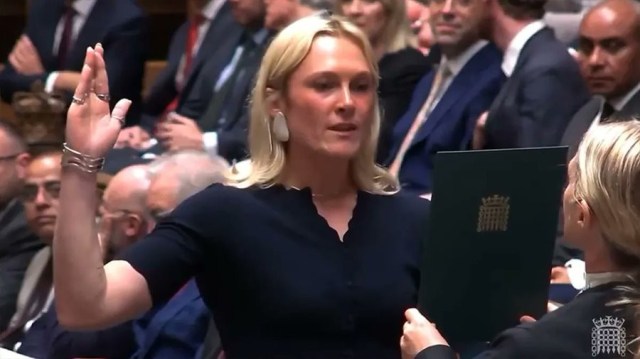
The SNP MP Lara Bird has been mocked for changing her accent.





Everyone knows there are certain things in life that politicians should never own two of: kitchens, romantic partners, bean-to-cup coffee machines. To this list it seems we can now add regional accents. Old videos have emerged of the SNP MP Lara Bird talking in pure Received Pronunciation, comically contrasting with the gently rolling Rs heard in the Commons as she took her parliamentary oath this week. Though the former PhD student also performatively crossed her fingers while feigning allegiance to the King, the press seemed to think that having a geographically wandering accent was the more outrageous pretense.
Given her elaborate full name — Pyla Lara Bird-Leakey — and distinguished family history, the assumption seems to be that the incoming representative for Arbroath and Broughty Ferry is a deeply middle-class English person, tartan-signaling for authenticity points. Equally, though, she might just be a deeply middle-class Scottish person who inadvertently picked up two distinct accents early on. I should know: I come from a town 12 miles along the coast from Arbroath, and am similarly afflicted.
Growing up in this heavily nationalist area, I quickly discovered that to talk as my English parents did at home was not going to make me very popular. Ancient family lore has it that my four-year-old self came back from her first week at an Angus primary school, proudly recounting that a fellow pupil had fallen down and splat his heid open. Though my eventually settled accent was relatively muted, unable to pull off the foos, fits, fars, and kens of other Doric-adjacent locals, for the purposes of blending in it was still better than nothing.
Unfortunately, the cure for self-consciousness later became the disease, for it turns out that having accents in duplicate also makes you seem weird. Moving to England, my vowels and consonants started to turn on a hair trigger: Southern English when talking to the natives, but taking the high road North at the first hint of an och or an aye. For this reason, I once confused the hell out of Lorraine Kelly viewers. Worse, my early linguistic splitting seems to have made me porous to accents generally. After four years of living in Leeds in the late Nineties, I sounded a bit like Alan Bennett. Whenever I go on holiday to Wales, I become inadvertently possessed by the spirit of Charlotte Church.
The popular term for this sort of thing is code-switching, and it is not unusual for those who regularly cross borders, be they regional or national. In the popular imagination there seem to be two versions, one of them much more socially acceptable than the other. It’s fine, say, for people already basically badged as working-class Scots — John Martyn, say, or Lulu — to radically change their accents to fit in with some middle-class English environment. Here the switch can be sympathetically understood as just another way to mitigate a tragic outsider status. To adapt the terminology of David Goodhart: at heart, you still count as a Somewhere, pretending for temporary reasons to be an Anywhere until you can hurry back home to your more authentic roots.
But if your overall brand is middle- or upper-class to begin with, moving seamlessly between linguistic worlds looks like more duplicitous shape-shifting, signaling embarrassing instability at your core. The only thing worse than being a rootless Anywhere is being a rootless Anywhere with two amusingly mismatched Somewheres stuck inside you, fighting it out for public appearances as if they were in a class-themed sitcom.
This is perhaps especially true for politicians. Detractors will easily seize upon perceptible cultural meandering by a public representative as evidence of untrustworthiness and phoniness. They did it with Kamala Harris, and they are now doing with Bird. The charge is usually that the politician must be using one particular cultural persona deliberately for personal gain. But that’s a bit like complaining of a bilingual Frenchman that his saying “oui” rather than “yes” is a cynically self-interested move.
As a speaker, you have both means of expression in your everyday repertoire. If you work hard mentally, you can ignore the social cues prompting you in one verbal direction, and consciously choose to go in the other. Equally, you can choose to stick with what is coming semi-automatically anyway. Obviously, where it matters you will go with the accent that works best for your particular context. The idea that Bird would have been sworn into parliament as a Scottish nationalist MP, whilst studiously avoiding using her own Scottish accent, is mad. But presumably, to speak as she did was barely an effort. She was not doing a laborious impression; it feels much more like turning on an inner tap.
Anyway, sometimes even the most blatant code-switching for political ends is better than the alternative. If you don’t believe me, I give you the outgoing Prime Minister as Exhibit A. Keir Starmer is the ultimate example of someone who lacks the facility to blend in with a new group. Had the country not been in lockdown throughout the time he rose to power, limiting his visible contact with disparate sets of people, this would have been obvious to the public much earlier on. Only yesterday, a video was circulated of a publicity stunt involving Starmer awkwardly serving popcorn to a group of ten-year-olds at the cinema, acting as if he was simultaneously monitoring the calorie count for a future government study as he did so.
Ironically for someone known as Two-Tier Kier, Starmer is always unerringly the same: same facial expression and voice, same robotic delivery of identically toneless phrases. He seems positively to pride himself on an intransigent and totally predictable personal style. In theory, his background gives him a rich variety of symbols to play around with: hailing from Surrey, a Home County associated with enormous wealth and status, yet from a working-class family too. In practice, every time he attempts to use his past advantageously, he looks like an appallingly stilted actor.
Pilloried for his many, many, many mentions of the fact his father was a toolmaker, few critics seem to have realized that the unimaginative repetition is not because he deeply enjoyed talking about the fact. It is precisely because he really didn’t want to, and couldn’t bear to go into further detail. According to Patrick Maguire and Gabriel Pogrund’s Get In, when Starmer first became leader he resisted advice to narrativize his working class origins for months, declaring the expectation he would do so “absurd”. Eventually he grudgingly agreed to a shortened official version of his back story, from which he has rarely deviated since.
This rigid presentational inflexibility guaranteed his failure as a political leader, whatever stellar technocratic successes he had beforehand. It meant a failure to conquer hearts and minds, both within the PLP and the electorate. But — perhaps worryingly for Labour’s opponents — they are about to get someone who can actually play the game a bit. Step forward the glintingly multifaceted Andy Burnham — Northern Lad, Cambridge Grad, Catholic Dad — who was sworn in beside Bird on Monday as Makerfield MP.
The former mayor of Greater Manchester is already being painted by some as a suspiciously chameleon-like figure, and in this the critics may turn out to be right. Burnham may be a flip-flopper about policy, scatterbrained about detail, and generally far too anxious to be liked to make a good leader in these intensely challenging times. But the mere fact he sometimes leans hard into his Northern working-class origin story, and at other times judiciously cuts a more metropolitan dash, is not a flaw but a strength. On Monday, he got on the train in Manchester dressed like an Elbow tour manager; by Euston, he was soberly suited and booted and clutching a San Pellegrino bottle.
Neither aspect is a put-on. The dreamless Starmer aside, perhaps, we all contain multitudes. And at least Burnham has some idea of how political story-telling works. The Labour Party really does need someone like him, whether or not the country does. For the party is so factionalized between disparate creeds and classes, with potential voters similarly polarized, that arguably only an adept code-switcher stands a chance of taking enough of them with him.
And as for Bird: like Burnham, she too may find that a certain sinuousness in speech and presentation stands her in good stead in her new career. Potential SNP voters still include social conservatives like those in Angus and Aberdeenshire, as well as urban pro-Palestinian progressives in Glasgow and Edinburgh. A posh radical may turn out to be the perfect mix. In the meantime, she should probably just enjoy the notoriety. Failing that, she could do what the SNP now does best: categorize her hybrid national identity as nonbinary, and call the press derision a hate crime.
