




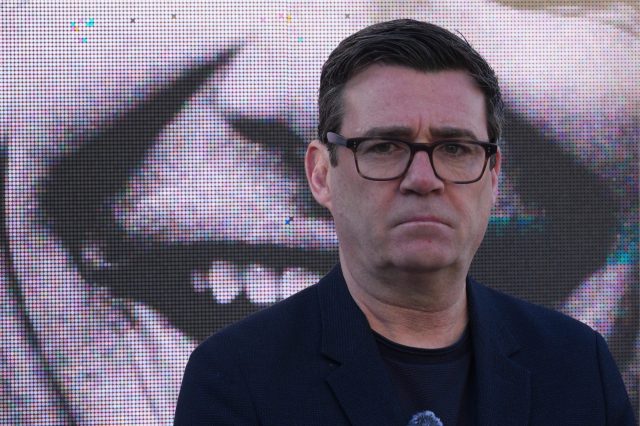
Farage's shadow looms over Labour. (Christopher Furlong/Getty Images)





Perhaps it was the hand of God that plopped Andy Burnham down in Makerfield. Had he got his first choice of constituency, Gorton and Denton, his now-inevitable ascent would have carried different implications. He might have won a mandate, as Hannah Spencer did, for an attack on the government from the Left. Makerfield, however, kept him tethered to the center.
That was apparent in Burnham’s shifting pronouncements on the European Union. Burnham never made a secret of his Remainerism when he was Mayor of Greater Manchester. Just last year he was trying to open up a conversation about rejoining. “I believe in unions of all kinds,” he bafflingly proclaimed: “the union of the UK. The EU benefited this country. Trade unions. People prosper more when they’re part of unions.” But the Makerfield constituency had voted Leave by two to one. Memories of the Remainer Burnham had therefore to be put out of Makerfield minds. Early in the by-election, he made the wise decision not to “re-run” the old arguments. That was enough to win the day; and now he is on track to be Prime Minister.
Plenty of Burnham’s old comrades-in-arms are, however, itching to re-run those arguments. Two days after the Makerfield by-election, on Saturday 20 June, the “March for Rejoin” descended on Westminster; 10 years of hurt never stopped them dreaming. The website advertising the march boasted a rather low-powered line-up. The only plausible A-lister was Neil Kinnock. He was joined by Layla Moran, a German MEP by the name of Terry Reintke, the anti-racism activist Shola Mos-Shogbamimu, and Madeleina Kay, author of Theresa Maybe in Brexitland (2018). Richard Morley, whose Rejoin EU Party got 35 votes in Makerfield, was there. Andy Burnham, who got 24,927, was not.
Burnham’s victory in Makerfield still should have put a spring in their step. The mere fact that a Remainer could win an old Leave seat, even if he had to hold his tongue, might be a sign that the Brexit divisions are a thing of the past, even that “Bregret” has taken hold and “Rejoin” is the future. Such a conclusion would be borne out by the polls. A stable majority of the British public, around 55%, supports the marchers’ mission. In the late 2010s it was common to hear the morbid claim that “cohort replacement” — the dying out of older Leave voters — made the eventual triumph of Remain a mathematical certainty. Generational patterns tell one half of the story; “Bregret” tells the other.
Burnham’s victory in Makerfield is not the only positive sign for Rejoin. One of the reasons it has been kept out of serious discourse is that nobody knows what rejoining looks like. Would we resume the status quo ante? Or would Britain, in punishment for its impertinence, have to swallow the Euro and Schengen Zone? Michel Barnier has recently said that the former ought to be on the table. For Rejoiners, that is an encouraging thing to hear.
The wind should have been in their sails. And yet they have the sad air of holdouts, of old men shouting at clouds. Despite the good conditions for Rejoin, they have not been able to sustain a mass movement. The “March for Rejoin” could not compete, in terms of numbers or élan, with Palestine marches, let alone the heights of the “People’s Vote”. They couldn’t get any celebrities; they couldn’t even bag Ed Davey. All they had to offer was a Who’s Who of Bluesky.
Burnham was right not to re-run the old arguments. Clearly that made sense in Leave-voting Makerfield; but he would be correct to apply the same instinct at the national level. I was too young to vote in the referendum in 2016, but I would have voted Remain, and nothing has happened in the 10 years since to shake my feeling that Brexit was, on balance, a mistake. Brexit has materially made my life worse in mundane, obnoxious ways. Living in Frankfurt last year, I had to wrestle with the German bureaucracy for months for a residence permit (eventually I gave up). And yet, I would sooner go through my German ordeal one thousand times over than join the “March for Rejoin”. I would stand in the queue at passport control for hundreds of hours if it meant I never had to hear the terms “Meaningful Vote”, “Malthouse”, or “Miller I and II”.
The march’s line-up was weak because the Rejoiners have been abandoned. Sir Keir Starmer was prince of Remain in the run-up to the 2019 general election; it was he who prevailed upon Jeremy Corbyn to gamble it all on a second referendum. He was the person responsible, second only to Corbyn himself, for Labour’s catastrophic defeat. He thus had every reason to forget about Brexit once he became party leader, and to hope that everybody else would forget about it too. When Sir Robert Peel was called to form a government in 1834, he, as an old anti-Reformer, had to address whether the Great Reform Act of 1832 was game for repeal. In the Tamworth Manifesto, the foundational document of the Conservative Party, Peel declared: “I consider the Reform Bill a final and irrevocable settlement of a great constitutional question, a settlement which no friend to the peace and welfare of this country would attempt to disturb, either by direct or insidious means.” Sir Keir, as he became Leader of the Opposition, had to perform the same trick. The “great constitutional question” had been resolved. Boris Johnson had won the general election; he “got Brexit done”. The second referendum gambit proved a miserable failure. It was now time, Starmer said, to move on, to “focus on the future”, to “look ahead”. These were clichés — evasive, self-exculpating clichés — but they were necessary. Without them, Starmer would have had no chance of becoming Prime Minister.
“Bregret”, though a real phenomenon, is simply no match for Brexit fatigue. It is telling that even the Liberal Democrats don’t want to open the can of worms. Their last manifesto promised to “fix the UK’s broken relationship with Europe”. This involved a “four-stage roadmap”, the fourth stage meekly “aiming” towards “seeking to rejoin the single market”. Aiming towards seeking, and not even EU membership — that was kicked into the long grass, as a vague “longer-term objective”. Jo Swinson learned the hard way the pitfalls of being a single-issue Remainer party; and Sir Ed was eager to drop that image. When the Lib Dems now urge Labour to drop their “torpor and timidity” on the EU, by which they merely mean that Labour should move to rejoin the single market, they are being timid themselves. Lord, make us an EU member — but not yet!
The most serious effort to put Rejoin on the agenda is Wes Streeting’s. This is probably a good strategy for internal party maneuvering. He lobbed it into the Makerfield by-election like a grenade; Burnham deflected it skillfully. Streeting, the shining hope of the Blairites, still found himself chided by the Master himself. “No one,” wrote Tony Blair in his essay, “was more passionately opposed to Brexit than I was.” But the negotiations, he continued, would be as backbreaking as the ones Monsieur Barnier put us through last time. Rejoin is no panacea. We should come to the negotiating table “from strength and not weakness”.
Absent any Prime Ministers past, present, or future, the case for Rejoin being made at the march in London has been left to an amateurish cadre of Remainer ultras. Their paladin — of course he is in the march’s line-up — is Steve Bray. The onetime Lib Dem candidate is infamous for his anti-Brexit campaigning stunts around Westminster; his magnum opus was when he interrupted Rishi Sunak’s announcement of a general election with “Things Can Only Get Better”. Thanks to 10 solid years of shouting “Stop Brexit!”, the poor man has become the face of the fevered mood of the late 2010s. Anthony Seldon’s new edited volume, The Brexit Effect, portrays him on the front cover, with his EU-flag cape and “Stop Brexit” top hat.
The British media has tended to cover Steve Bray as what he is: a sad, unhealthy obsessive. But he has been egged on in his pursuits, especially from abroad. In international coverage, Britain is still analyzed as “post-Brexit”; there is a general assumption that all its ills can be traced back to 2016. The idea of “Bregret” — and of a devoted, organized constituency for Rejoin — appears more often in the French and German broadsheets than it does in even The Guardian. Even in Denmark — not a country known for its sentimental Europhilia — Steve Bray is thus treated less as an odd curiosity than a serious public figure. “Steve Bray has been roaring about Brexit since the very beginning,” proclaims the Danish state broadcaster, “even when no one else could bear to hear about it.” The article goes on to suggest that this vox clamantis in deserto is being heard at last, and that when he shouts, he shouts for millions. The international Britain-watchers would be surprised, I think, by how little the Brexit debates reverberate today. Even Bray, this monomaniacal Remainer, has wider horizons. In April, as the Mandelson scandal was entering its third or fourth phase, Bray was blasting out Barry Manilow’s “Mandy”. What’s he got against the erstwhile European Commissioner for Trade? What does any of this have to do with Brexit?
The most interesting thing about Bray is that he was not political before 2016. Nothing could better encapsulate the problem with the Europhile, Remainer ideology. It has no deep roots in British culture. It was a synthetic product of the moment that followed the referendum. Practically nobody in Britain was waving around EU flags before 2016; you would have been looked at funny if you solemnly sang “Ode to Joy”. Nobody in Britain attached any romantic warmth to Brussels. But in the early hours of 24 June 2016, a kind of ethnogenesis occurred: at long last, the “British European” stepped forth. People who had never previously given much thought or care to the EU all of a sudden decided that it ought to be at the heart of their identity. It was, in a sense, a familiar, primitive impulse: initiates to the tribe marked themselves with the acronym “FBPE”, defining themselves against a Faragist outgroup. It became a powerful means of signifying what sort of person you were — softly Left, but in a “moderate”, “sensible” way; attentive to the “experts” and wary of “Russian disinformation”. Once the Remainers were routed, once Johnson had won, that Europhile ideology disappeared as quickly as it had arrived. If we do ever rejoin the EU, it will be for the hard-headed reasons we voted to remain in the EEC in 1975, the reasons most of the 48% in 2016 voted the way they did. It will have to be for banal reasons of economic security and strategic self-interest. It will be the vindication of George Osborne’s “Project Fear”, not of Steve Bray.
That is one big problem for the Rejoiners, one reason their grand vision isn’t taking off in quite the way the polls say it should. Another is that they are ideologically incapable of exploiting the situation at hand. There is obvious, tangible evidence that Brexit failed on its own terms — the Boriswave. But that is unwieldy material for Steve Bray and company. Among the Rejoiners it is an article of faith that Brexit cut Britain off from the world, reflecting and spawning an inward-looking rainy fascist island. This is hard to square with the simple fact that the government which enacted Brexit also oversaw the sharpest increase in immigration in British history. If neither side got what it wanted out of Brexit, in fact, it is natural to begin wondering whether Brexit mattered in the first place.
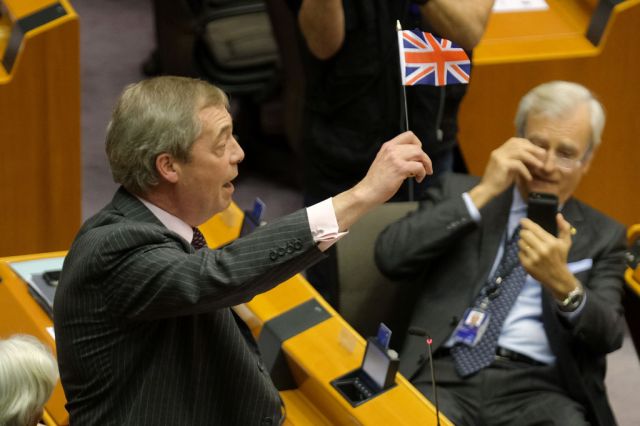
What a horrifying thought, perhaps the most horrifying of all, to the small group of protestors lining the streets of London 10 years after the referendum. Of course Brexit mattered: it was the point of no return in Britain’s decline, except only for the salvation offered now by Rejoin. There’s a sunk-cost fallacy: Brexit must really have mattered, or else why would these people have invested so much time and energy into fighting it? But the facts tell a different story.
Brexit was not what most of its supporters probably wanted it to be — a formal repudiation of decades of immigration policy. Nor was it what most of its opponents, in a spirit of Schadenfreude, wanted it to be — an economic catastrophe, the moment everything turned for the worse. On most economic graphs the financial crisis of 2008 appears as the real turning point. Brexit was, at most, a catalyst in Britain’s decline. Whatever economic consequences Brexit had were, in any case, swallowed up early on by the pandemic. We left the EU on 31 January 2020; 52 days later, Boris Johnson announced the lockdown. It will fall to the economic historians to disentangle the consequences of one from the other. But suffice to say, the present state of the EU hardly lends support to the notion that Britain would be doing much better if the referendum had gone the other way. Nor was Brexit especially significant constitutionally. It was not even the most constitutionally consequential referendum called by David Cameron: that accolade surely belongs to Scotland’s independence referendum two years earlier, which put a far more ancient and profound union on the line. In the years since Brexit we have discovered, much to our chagrin, that we are not as sovereign as the Leavers would have had us believe. We may be free from Brussels, but we are still shackled to Strasbourg. Theresa May was wrong about many things; but she might have been on to something when she laid down the bargain in 2016 of Britain remaining in the EU and leaving the ECHR. Remove all the passions of 2016–9, enter the cold light of day, and Brexit doesn’t seem to matter as much as everyone thought it did.
This, I think, is the conclusion that most people in Britain, Remainers and Leavers, have surreptitiously come to. Perhaps 55% of the British public really would rejoin the EU, if they could flick a switch and make it so. But how many would rank it in their top five or 10 priorities? How many really think, the way most people on the continent seem to, that Brexit was the defining moment in Britain’s recent history, that 2016 offers the master-key for understanding all that has happened since? Probably not many. What people wanted in 2019 — even many Remainers — was to “get Brexit done”; they were bored of it all, and there is no sign whatsoever that that boredom has abated. There is no clamoring, except from this small band of Rejoiners, for returning Brexit to the center of the national drama. It is bizarre, in retrospect, how much symbolic significance was attached to Brexit while these debates were occurring. It is quaint to recall how these arcane questions were indulged in, and with such gusto, all on the precipice of what proved to be a far greater crisis — the pandemic and lockdown. Hence the instinct, when beholding Steve Bray and his ilk, to feel a mixture of bemusement and pity. They are the only ones still fighting those old battles. The country, including Andy Burnham, has moved on. We are left to wonder not only why these people still care so much, but why the rest of us ever did.
