




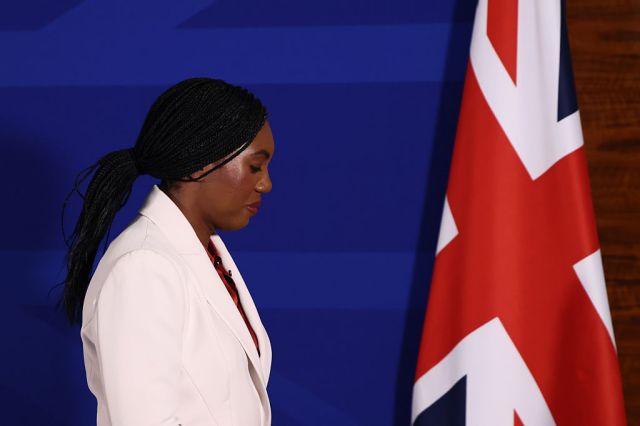
The party's polling remains dire. (Photo: Jack Taylor/Getty Images)





Today’s ballot will be a defining moment in British politics. Should Andy Burnham triumph in Makerfield, he’ll likely be our next prime minister. If Reform upset the odds, then Nigel Farage might as well start browsing his nearest John Lewis for Downing Street curtains. Victory in the Northwest, against Labour’s most popular national figure, would represent a new high water mark for the turquoise tide.
But if the nation’s eyes are fixed on Labour versus Reform, there is another story unfolding in this corner of Greater Manchester. It is ignored, because its roots stretch back much further, and its progress is more gradual. Yet it is no less significant. For amid the voters and canvassers and garden stakes I saw in Makerfield — cheering for Reform, Labour, Restore and the Greens — one name remained strikingly absent: the Conservatives. It’s not that voters in Makerfield despise the party. It’s just they don’t seem to care.
That might sound like a hackneyed observation, a contrarian effort to distract you from the main event. But it’s hard to emphasize just how non-existent the Tories feel in this patch of Lancashire. Especially so when you consider that, as recently as 2019, they came second in the seat, winning more than 14,000 votes. Pollsters now have them within the margin of error of zero.
And things are getting worse. In the Gorton and Denton by-election, at the end of February, the Conservatives garnered less than 2%. In Makerfield, they are set for a similar fate, only this time slipping behind Restore Britain, whose candidate — Rebecca Shepherd — is a rare example of a populist candidate who doesn’t have much to say. For the first time in British politics, the most successful electoral vehicle in modern history, the party of Wellington, Churchill and Thatcher will finish third among parties of the Right.
That has no precedent. In 1922, the Liberals fragmented into two rival factions. It was a similar story with Labour after the emergence of the SDP in 1981. More recently, of course, there’s been the Tories facing off against UKIP, then the Brexit Party and now Reform. But Makerfield is new terrain. It’s akin to the Greens and Your Party outperforming Labour in what was, until as recently as seven years ago, a target seat. Under first-past-the-post, success often rests on persuading voters that going elsewhere is a wasted ballot, however alluring that might be. It’s a hard trick to pull when your most loyal voters have two credible alternatives.
Yet despite this looming watershed, you’re as likely to find that analysis in the media as you are to encounter a Tory voter on the high street in Ashton. In Daily Telegraph editorials, and BBC broadcasts, we are daily reminded what a formidable politician Kemi Badenoch is, and how impressively she’s performed given the circumstances. But each time I hear or read that assessment, I have to remind myself: her party is about to lose its deposit in two consecutive by-elections.
As I’m neither a national newspaper columnist, nor a panelist on Newsnight, I have the luxury of being honest. Whatever elements of the media might tell you, we are witnessing the slow, dull destruction of the Conservative and Unionist Party. While many regarded the last general election, when the Tories won just 24% of the popular vote, as a nadir — I suspect future historians will look on it with admiration.
Why could things get worse? Because, until 2024, there were no parties on the Right seeking to expose the gap between Conservative rhetoric and reality. Now, like billionaires starting commercial space companies, two have come at once. For all the critics of Keir Starmer — hardly an endangered species — I can count on one hand those I’ve met who claimed the solution was the Conservatives. Serious activists who remain in the party simply talk about survival.
The great Tory failure, and thus their most substantial vulnerability, is with immigration. In 2010, David Cameron promised to reduce numbers to the “tens of thousands”. Instead, immigration constantly increased over the subsequent decade. Then, in the aftermath of Covid, Britain experienced the “Boriswave”, with almost a million net arrivals in a single year. In years gone by, before Lowe and Farage grabbed the national megaphone, the Tories would have responded with cynical hand-wringing. They might have admitted that “mistakes were made” — but that things would have been even worse under Labour.
If nothing else, that highlights the modus operandi of the Westminster system, where your vote is about stopping what you don’t want rather than endorsing what you do. Such a politics of negation was the principal means by which the Tories disciplined and corralled their voters. The arrival of Reform, and Restore, has destroyed all that. The Greens have done something similar with Labour: which is why the party’s NEC allowed Burnham to run after the debacle of Gorton and Denton. Triumph for Hannah Spencer raised the stakes to an existential plane.
That FPTP allowed the major parties to mobilize large coalitions through negativity, rather than shared beliefs and policy objectives, also meant both Labour and the Conservatives were inherently unstable coalitions, especially in our post-ideological age. The media speaks about this positively, emphasizing the need to build a “broad tent” to win Westminster elections. But, in reality, this meant effective collective action always depended on people with wildly different views.
Understand that and you grasp why we have witnessed decades of dysfunction — and the inability of our political class to solve the most basic of problems. While Labour are generally regarded as the more erratic of the two parties, attempting to unite unabashed Marxists and senior partners at Magic Circle law firms, this criticism more readily applies to the Conservatives. They have long tried to be the party of free markets, and of the petit bourgeoisie; of a globally integrated economy, and of Brexit and reduced immigration; of low tax, and the generous triple lock on the state pension.
Indeed, this monstrous blend of interests, worldviews and priorities relied on some economic growth, as well as the country’s electoral system and the political habits it engendered. It also meant that, as soon as an alternative emerged, the party was essentially doomed. But what really did for the Tories wasn’t just the demise of a meaningful growth model — which one could argue evaporated before they returned to power in 2010 — but the end of cheap money. It’s no coincidence that the Bank of England started to raise interest rates at the end of 2021, around the same time that Labour surged in the polls. For all the supposed impact on the Tories of Partygate, or Keir Starmer’s sober style, neither came close to the end of cheap mortgages.
Most fundamental of all, though, is the fact that Britain’s economic model can no longer reproduce a sizable middle class. As a result, the Conservatives, supposedly a pro-market party on the center-right, are unable to reproduce themselves as an electoral constituency. This can be inferred from a litany of data points — from the rising cost of private schools; to declining rates of home ownership among young adults; to the proportion of 25-to-34-year-olds living with their parents. Where qualifications in law or engineering were once a route to success, today they’re anything but. Machine learning will do something similar for professions like accountancy and consulting, while journalism has long been a pursuit for children of the elite, or those willing to embrace decades of precarity. Doctors and headmasters, those venerable burgher professions of yesteryear, now take industrial action over pay and conditions. It is often said that the rise of Reform and Restore is the function of an aging population, but they are also what happens when fertile conditions for a politics of the center-right collapses.
After 14 years of Conservative government, indeed, the situation is worse than ever. There’s the £100,000 tax trap, for one thing, which means you pay an effective tax rate of 60% over that threshold. Elsewhere, student loans have become a de-facto tax on the middle class, for everyone from millennials down. Loan repayments, combined with income tax and National Insurance contributions, now mean a young professional on a middling income can face a marginal tax rate of over 50%. This has obvious implications for those saving to buy a home, or who wish to start a family or launch a business — in other words basically anyone who might formerly have thought about voting Tory.
If these shaky economic foundations go a long way to explaining the Tory nadir, dramatic changes in the media matter too. This is most obvious with the emergence of GB News and X under Elon Musk. As with our often-asphyxiating electoral system, the big two parties relied on journalistic gatekeepers to retain authority and manufacture consent. While print, progressively so after Rupert Murdoch entered Britain’s news market, reflected a conservative worldview, broadcast media — particularly the BBC — offered a liberal counter-balance.
As I note above, you can still hear echoes of this in the traditional media today. But GB News scrambled journalism’s uneasy truce by taking the politics of the tabloid paper and sticking it onto our televisions. Looking back, it is clear that breaking the Westminster duopoly was always downstream of disturbing the ideologically cosy world of TV journalism. Suddenly, the talking heads of the Conservative and Labour parties, spouting their arguments as glibly as press officers, seem even more incurious and boring than before.
Restore’s media operation, for its part, is overwhelmingly online. To that extent, it is closer to the Greens than Reform. Rupert Lowe has a highly active Facebook page with twice as many followers as the prime minister. Then there are the young men circling around him, a group whose digital footprint is matched by their ideological stridency. This cohort includes the Lotus Eaters channel on YouTube, as well as Charlie Downes and “Young Bob” (who recently provided reams of evidence to Hampshire police while livestreaming dozens of individuals engaging in violent disorder).
Impressive as that growing cluster is, however, it’s no match to having one of the country’s leading news channels (GB News features two Reform MPs, Farage and Lee Anderson, as well as former parliamentary candidate Matt Goodwin). That helps explain the difference between the two parties in terms of exposure, and why Reform are contenders in Makerfield while Restore are not. Traditional stalwarts aside, the Tories are utterly lost in this new media world, and seem set to keep struggling as broadsheet circulations plummet.
Just as Jose Mourinho, twice a European champion, once mused that his greatest footballing achievement was to finish second with a Manchester United side replete with has-beens, Rishi Sunak might one day muse that winning 121 seats, despite the headwinds of history, was his political zenith. For Kemi the bar is lower still. If she slumps to 50 or 60 seats, even Times columnists will struggle to assert that lead is actually gold.
Aaron Bastani is the co-founder of Novara Media, and the author of Fully Automated Luxury Communism.
 AaronBastani