




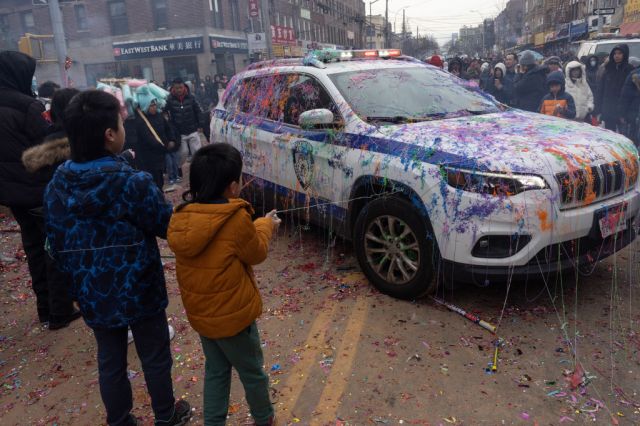
At a Lunar New Year celebration in Brooklyn's Sunset Park neighborhood, Chinese residents expressed discontent with American immigration policy. Credit: Getty





On a crisp morning last December, I took the 6 train from near my apartment in East Midtown toward UnHerd’s new US headquarters in Lower Manhattan. If the 6 isn’t delayed — which it often is — the trip is a miracle of transit efficiency, perhaps 15 minutes door to door. On this occasion, it was on time. The train stopped, and the doors happened to open right where I was standing. They revealed a curiously empty subway car (for peak rush hour).
It wasn’t, in fact, empty. Most of the straphangers had crowded to the ends of the car, leaving a gap of empty seats in the middle. It took me only a second to discern why. Sitting there was a man with a heavy shawl around his head and a stick in one hand. He rocked back and forth, absorbed in self-talk: now muttering softly, now breaking into shrill shouts. The language was maybe Tamazight, but I couldn’t be sure (I’m usually really good at clocking foreign tongues).
The doors closed behind me — too late to switch cars. According to an unwritten rule of subway safety, I should have joined the others at one of the two ends of the car. But I didn’t adhere to the crazy-guy-blast-radius norm, partly because I wanted to read my papers in peace, and partly because I figured the chances of an unpleasant incident were low.
I figured wrong. As the train rattled through the underground, I’d glance up from my copy of the New York Post and catch the man glowering at me. He kept up his self-talk. His periodic outbursts, formerly directed at the cosmos or God or the gods, now seemed aimed at a specific target: me. First stop, Grand Central — no incident. Second stop, 33rd Street — still nothing, though the growling had intensified. Final stop, 28th Street — home free.
Or not. The man sprang up from his seat in tandem with my motion. Before I could reach the door, he removed the heavy shawl from around his neck and began whacking the backs of my legs. His shouting crescendoed to a mad sputtering rage. The shawl-whacking produced only mild discomfort, and maybe for that reason, my first thought wasn’t escape, but indignation mingled with amusement. For a split second, I just stood there in the door, looking into his deranged, unblinking eyes while the other passengers stepped around me and out.
Then he raised his stick. OK, now get out.
Amusement and confusion — not really anger — were my initial emotions as I took the short walk from the station to our office. “Crazy old fuck,” I remember saying to myself with something like a smirk on my lips. Next came a set of questions. Why was this foreign person, who couldn’t speak English and was clearly out of his mind, menacing people on the transit system? Which precise path had brought him from his country to the Big Apple? Had he arrived as part of the Biden wave that had flooded the US homeland with an estimated 8 million newcomers, many of them unvetted? Or did he come earlier? And what was to become of him — raging stranger in a strange land — today, tomorrow, a month from now?
Soon the questions gave way to a conviction, which my mind repeated like a mantra: We shouldn’t have to live like this. We shouldn’t have to live like this. We shouldn’t. . . . I wasn’t unaware that my mantra is popular among the very-online Right on both sides of the Atlantic. This was discomfiting: the line had popped into my head in the same way that an advertising jingle might. It discomfited me still more that the mantra summed up precisely what I felt at that moment, and that it harbored a hard kernel of truth.
I’d just then experienced an acute case of what I’ve come to call diversity stress or migration fatigue: the pervasive anxiety that attends life in societies buffeted by too much migration and too much diversity. Too much defined as the point at which assimilation falters and majority-minority distinctions evaporate.
Diversity stress arises from having to constantly negotiate housing-, services-, and street-level incohesion: as we navigate linguistic barriers, normative differences, sheer unfamiliarity, and the potential for misunderstanding, the position is stressful, even if the outcome is relatively “harmless” (as in the case of my subway accoster). As the French geographer and urban theorist Christophe Guilluy has noted, people in such societies “need to manage, day in, day out, a thousand and one ethno-cultural questions while trying not to get caught up in hatred.”
It’s important to talk about diversity stress because it’s much less visible than spectacular cases of violence like the attempted beheading of Stephen Ogilvie by a Sudanese migrant in Belfast this week. Those sorts of cases are relatively — mind you, relatively — rare. They thus allow policymakers who’ve presided over uncontrolled migration to isolate the crisis in a dishonest manner: to speak of a few bad actors who must be left to the justice system to deal with.
What this framing misses is the systemic, low-grade diversity stress that afflicts much of the population as a result of mass migration, and which goes a long way toward explaining why seemingly “isolated” cases can trigger such ferocious eruptions of intercommunal violence. Put another way, if diversity stress weren’t constantly pressing down on society, then it would be reasonable to expect native populations to shrug off the “isolated” cases of ultra-violence.
In reality, diversity stress isn’t isolated — it’s omnipresent. Its effects, once confined mostly to the working and lower-middle classes, now increasingly ensnare even the upper-middle sectors, those who enjoy the authentic-ethnic-cuisine pop-up restaurants and benefit from the cheap nannies, dry cleaners, gardeners, and the like.
I fit into the latter category, though if anyone shouldn’t feel diversity stress, it’s me. As my byline hints, I’m foreign-born — an Iranian-American — and speak Persian fluently. My wife is likewise an immigrant, born and raised in China before coming to America as a teenager, lending our lives a nice sort of symmetry.
Moreover, various mishaps caused my life to take a particularly circuitous path through the class structure: I was born to middle-class Iranian bohemians in the capital, Tehran, but lived in a rural trailer park upon first arriving in the United States. Then, within a decade, the American meritocracy catapulted me to Rupert Murdoch’s newspapers. As a reporter, I’ve broken bread with Romani people in the Hungarian countryside, and with presidents and prime ministers. I can instantly tell whether someone is from Iraq, Egypt, or Lebanon based on how they speak Arabic. I can tell Eritreans apart from Ethiopians just by examining their faces. In short, I embody neoliberal fluidity.
And yet — as my response to the interaction in the subway shows, I am feeling it. It’s the little things, easy to caricature and dismiss by pro-immigration advocates. But they add up.
At some point in the past few years, for example, seemingly Gotham’s entire taxi corps — once made up of African Americans and white-ethnics — was taken over by South Asians, who only made up about 40% of drivers in the late 1990s. Nowadays, when I land at LaGuardia or JFK airports, there’s a nine out of 10 chance that my driver will be South Asian: Indians, Pakistanis, Bangladeshis. And they’re much more likely to have no idea what I’m talking about if I say, “Midtown East, take the Triborough.” Some will simply hand me their smartphones so I can input my destination, which is both alienating and requires me to actively monitor navigation; an exit might be closed for construction, and the driver has no capacity to improvise. Is that the end of the world? No. Nor is it stressful on a conscious level, but as an underlying irritant, it’s there.
Or take pedestrian transit in the city, an increasingly perilous enterprise as electric bikes and scooters have proliferated, and city authorities refuse to regulate these vehicles with even half as much vigor as they apply to cars. On a near-daily basis, at least one of these will zoom past me at a bewildering speed, the rider ignoring the pedestrian walk signal and forcing me to stop at the last minute lest my kids and I get struck. And almost always, the rider appears to be a diminutive Central American migrant racing to deliver a salad bowl to someone working from home like myself. Again, is that an indictment of Central Americans or an event to ruin my day? No, but still my fight-or-flight instinct has kicked in, and there’s a non-zero chance of my loved-ones and I ending up in the hospital. Even if we avoid physical harm, the experience creates diversity stress.
Finally, there’s the presence of burkas and niqabs among Muslim women on the streets and the underground, as well as their Asian medical equivalent, the protective face mask. Such face coverings are normative in parts of the Muslim world and East Asia, respectively, but they aren’t normative in the West. And while Western negative liberty guarantees a right to wear them, their very non-normativeness can be profoundly unsettling. To me, it suggests that I can’t be trusted not to leer at a woman’s face — or that I’m a mere vector for disease, rather than a fellow citizen and party to the social contract. And while I can’t speak for others, I must insist that I continue living in the West in order to live according to Western norms and standards.
This is just a snapshot. There are many other daily experiences of this kind. Any one of them, taken on its own, would be negligible. But taken cumulatively, they add up to a constant sense that everything is in flux, that I have no right to the familiar, or to any sense of stability in whom I’m obliged to accept as a neighbor. I’m also, as a member of the professional class, largely insulated from the worst of the diversity stress. I own a car in the city. I live in a co-op with a doorman, in the serene confidence that the two-bedroom unit above mine won’t suddenly come to be occupied by nine Turkish construction workers, who blast Turkish TV loudly into the night, chain-smoke inside, and don’t take too kindly to complaints.
Native-born working classes bear much more of the stress burden, giving rise to what Guilluy has described as the quintessential experience of mass-migration societies: the tense encounter in the stairway between a member of the old white proletariat and his Tunisian and Algerian neighbors in the suburbs that ring France’s 16 major cities. An American analog might be the experience of heritage African Americans in neighborhoods like Brooklyn’s Navy Yards or Roxbury in Boston, which became home to massive migrant-processing centers under the Biden administration. (All things considered, it’s a miracle that the anger stoked by such measures simmered but didn’t boil over.)
The working classes also disproportionately suffer from the economic stresses associated with unskilled mass migration, the way it undercuts the wages and bargaining power of those on the lower rungs of the labor market. The old labor Left didn’t fail to recognize the problem. As Paul Krugman, that arch-reactionary, observed in a 2006 New York Times column, “Many of the worst-off native-born Americans are hurt by immigration.” Because such newcomers “have much less education than the average US worker, they increase the supply of less-skilled labor, driving down the wages of the worst-paid Americans.” Moreover, “low-skill immigrants threaten to unravel [our] safety net.” All this led the likes of United Farm Workers founder Cesar Chavez and civil-rights pioneers Barbara Jordan and A. Philip Randolph to carve out restrictionist positions that scandalize their latter-day heirs.
But the economic stress, I suspect, is creeping up the class ladder. Take America’s competitive housing market. Ever since the 19th century, when the yeomanry tried — and failed — to keep their children living and toiling under the same roof, the American pattern has been for children to strike out independently after a certain age. Intergenerational solidarity, in other words, is thin.
By contrast, many migrant families maintain thick networks of mutual support. Part of that involves within-lifetime transfers — i.e., the parents downscale their homes, gifting the price differential and other assets to their children while they’re still alive. Thus, between two lawyers starting at the same salary at the same mid-sized law firm (say), the one from a Korean or Chinese or Iranian migrant family will have a much easier time ascending to first-time homeownership (even if this means putting up the parents or in-laws, who then also double as babysitters, making it still easier for the adult kids to grind out billable hours).
But perhaps the deepest source of diversity stress — afflicting the native-born and migrant alike — is the growing illegibility of majority and minority as categories. From a simplistic moral perspective, this is to be celebrated: almost by definition, majorities tend to lord it over minorities; a society composed only of minorities, a highly diverse society, will prevent such oppression. But not so fast. In mass-migration societies, as Guilluy observed, “ ‘the other’ doesn’t become ‘somebody like yourself.’ And when ‘the other’ doesn’t become ‘somebody like yourself,’ you constantly need to ask yourself how many of the other there are — whether in your neighborhood or your apartment building.” No one, he added, “wants to be a minority,” yet that is exactly what uncontrolled mass migration does — to everyone — generating stress.
Societies in which minorities encounter a clear majority are ones that make possible a certain social bargain or exchange: We are this, and you are that, but you can become part of our thing by sharing our burdens, adopting our ways, and, yes, losing part of your old self.
Without a clear majority — without a kind of social regency, which needn’t be racial — we end up with what one California historian called the “Blade Runner scenario,” after the Ridley Scott dystopian film based on Philip K. Dick’s novel: “the fusion of individual cultures into a demotic polyglotism ominous with unresolved hostilities” characterized by regular outbreaks of violence followed by “negotiated truce.” In the Blade Runner scenario, straining under diversity stress, I neither have a clear sense of what sets me apart as a minority, nor of my duties and prerogatives as a member of a majority.
But what about assimilation? Aren’t we ignoring the great American engine of assimilation, which can expand the majority, rather than living in fear of minorities overwhelming it? It’s true. America is better at assimilating newcomers than perhaps any other nation on Earth. But assimilation takes time, as Barbara Jordan, a Lyndon B. Johnson protégé who went on to chair President Clinton’s commission on immigration reform, noted. Like any engine, the assimilation engine breaks down when the volume of inputs becomes overwhelming.
There are signs that’s happening today. English-language acquisition among migrants, a key index of successful assimilation, is declining. “English proficiency is more common among immigrants who arrived in the US before 2000 than among those who entered the country later,” a Pew study found last year. “Some 57% of immigrants who came to the US before 2000 are proficient English speakers, compared with 47% who arrived in 2010 or later.”
Things are in even more dismal shape when it comes to ideological Americanization. Already a decade ago, a Hudson Institute study found that immigrants are 20 percentage points less likely than the native-born to consider America a “better” country than others; 30 points more likely to consider themselves “citizens of the world”; 30 points more likely to believe that education should focus on “ethnic pride,” rather than American values; 15 points less likely to support teaching students about America’s founding documents; and so on.
Part of this has to do with decades of multicultural education. As the heterodox Leftist thinker Christopher Lasch noted, schools in the 19th and early 20th centuries emphasized “ ‘Americanism’ and … [the] promotion of universal norms.” This “had a liberating effect, helping individuals to make a fruitful break with parochial ethnic traditions.” Lasch cited as an example the late Norman Podhoretz. The neoconservative godfather was born to Jewish working-class immigrants. His educators saw it as their mission to pull boys (and, increasingly, girls) like him out of their respective parochialisms — into a higher sphere of cultivated judgment, engaged citizenship, and American norms. But by the time Lasch was writing, in the 1970s, multiculturalist education was already winning the day. Such education, Lasch warned, “deplores the disintegration of folk culture and pays no attention to the degree to which disintegration was often the price paid for intellectual emancipation.”
Fast forward half a century, and there is another challenge to assimilation: technology. For the generation of migrants to which Podhoretz’s parents belonged, coming to America meant casting away the Old World and its ways. This was easier to do than it is today, when migrants carry the Old World with them all day long — on their smartphones. Casting away the old is rather difficult for the migrant cabbie or truck driver who spends all day speaking to his relatives back home or watching soap operas in his native language. Or for the Chinese student who finishes her education almost entirely in the company of other Chinese, whether in person or on her WeChat app. Is there a policy fix to that? None that I can think of — other than what voters, especially downscale voters, across the developed world have been demanding for years now: reductions in overall numbers and much greater selectiveness on who’s admitted.
Diversity stress may be difficult to quantify. But it can be rigorously conceptualized as a form of negative externality or transaction cost that must be reckoned in any cost-benefit analysis about mass migration. For too long, policymakers across most of the developed world have ignored this hidden, pervasive cost. It is long past due that they balance the freedom of movement and the growth imperative against the right to the familiar. We shouldn’t have to live this way.
Sohrab Ahmari is the US editor of UnHerd and the author, most recently, of Tyranny, Inc: How Private Power Crushed American Liberty — and What To Do About It
 SohrabAhmari