




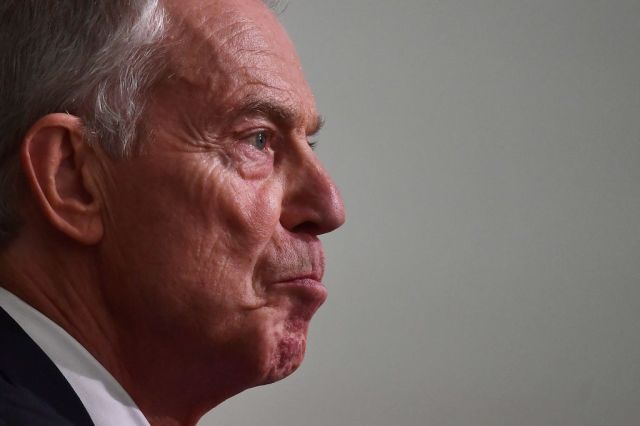
Blair 'bequeathed a legacy of economic decline'. (Charles McQuillan / POOL / AFP)





Once political ideas fail, they don’t get second chances. Communism has been tried. It won’t come back. Nor will Tony Blair’s idea of a “radical center”. It was the great political and economic philosophy of the age of globalization. As that era comes to an end, so too is the centrism that guided it.
It was none other than Karl Marx himself who made the sharpest observation of how history repeats itself. In his Eighteenth Brumaire of Louis Napoleon, he writes: “Hegel remarks somewhere that all great world-historic facts and personages appear, so to speak, twice. He forgot to add: the first time as tragedy, the second time as farce”. Marx was comparing the French emperor who had been dethroned after his defeat at Waterloo with his nephew, Napoleon III, a calamitous figure, who was King of France from 1852 until 1870.
Blair’s attempt at a comeback has a Napoleonic quality. Most commentary on his long essay focused on the man — his record in office and, especially, Iraq — and not on the arguments of the essay. A lot of people, especially on the Left, really hate him. But I think there is a bigger story here that is not about Blair himself, but about radical centrism itself.
He is right to say that “there are two epochal changes happening in the world today — one geopolitical, the other technological — and Britain is not prepared for either.” But he does not reflect on why this happened, and on his own role in that story.
Blair was the most successful Labour prime minister in history, if you measure success in terms of the number of times he managed to get elected. But his big idea failed. He bequeathed a legacy of economic decline that his successors were not able to address with the classic tools of radical centrist policies — inward investment, trade agreements, privatization, deregulation and financialization.
The election of Emmanuel Macron in 2017 should serve as a more recent cautionary tale of what happens when countries naively try to revive radical centrism. In 2016, Macron suddenly appeared on the French political scene with his own version of radical centrism. He was elected president in 2017, and his new party gained a majority in the French parliament shortly afterwards. His government passed big reforms — the liberalization of labor markets; cuts in capital gains and corporation taxes; reforms in social security contribution systems; apprenticeship and vocational-training reform; railway reform, and so many others. It was one of the busiest legislative agendas that Europe’s ever seen, similar to what happened in the UK during Margaret Thatcher’s first term.
But then it stopped. Macron was re-elected in 2022, yet his party failed to win a majority in the following parliamentary elections. In 2024, he made a bad call to dissolve the parliament, as a result of which his party was almost eliminated.
There is a pattern here. In both France and the UK, radical centrism initially seemed to work and then at some point turned into a car crash. Radical centrism fails not because it’s wrong in theory, but because it’s wrong in practice. It simply cannot be delivered in a small European country, because it requires a diversified economy. That’s why the US could deliver it better than others. Radical centrism means that, if you live in an industrial town and your employer goes out of business, you can move to another part of the country and find another job. Or, if you train as an electrician, you may end up running an electricity company. Or, if Elon Musk fires you from your cosy government job, you can get yourself a food truck and retrain as a chef. Social and regional mobility plays a big part in this. This stuff does not happen in the UK or elsewhere in Europe, at least not on the scale that would be needed for radical centrism to work.
What killed radical centrism in the UK was financial globalization. The UK never recovered from the global financial crisis, because its economy remained dependent on the City of London. Because radical centrism requires a diversified economy, it is not a feasible political ideology for a mid-sized European country.
One could have imagined the EU developing in such a way to make radical centrism feasible. There was a time, in the early Nineties, when people thought of the EU and its single market as the future. I was among them. But reality intruded. My family and I moved around four European countries. So did many families — but most of them stayed where they were.
The barriers were not cultural, as euroskeptics lazily claim, but legal and institutional. Europeans have a long history of migration. The very rich and the very poor have always moved around. But what stopped middle-class employees moving around the EU were practical issues like incompatible pension systems. If you took up a new job abroad, you could lose insurance claims that you’d built up over many years. Another problem, one that affected families with children, was that of incompatible school curriculums. Europe’s private schools are ultra-compatible; if you are rich, Europe is a dream. But if you’re middle-class ,and you try to put your 10-year-old through a French or Belgian state school, you will have second thoughts. Language will be the least of your child’s problems.
The idea of the EU as a framework of radical centrism failed because it would have required a degree of political integration that EU leaders were simply not ready for. One of them was Blair himself. Blair is pro-European in terms of his stated preferences. He was anti-Brexit, even in favor of a second referendum. But his revealed preferences tell a different story. Memories are still fresh in the EU of how Blair divided the bloc over Iraq. He nurtured a narrative about a clash between the old Europe and the new Europe, of which he was the natural leader.
But for me, the decisive moment came much earlier. The most consequential stated preference by Blair was his decision during his premiership not to enter the euro. Initially, he had wanted to join it. I remember the moment when Blair briefly toyed with it but decided to fall into line with the position of Gordon Brown and Ed Balls, who strongly opposed euro membership on macroeconomic grounds. The macroeconomic arguments were indeed weighty. But to reduce the question to macroeconomics alone was to confuse the short-term and the long-term. This was a strategic mistake for Blair. Had he joined the Eurozone, then he might have been able to deliver radical centrism back in the UK.
The reason the euro decision was so important is that it killed the idea of an integrated European capital market. The EU still does not have one today. The lack of a big capital market is the reason why Europe does not have a large tech industry, whereas the US and China do. European banks are not big enough to fund companies the size of Google, Apple, Meta or Nvidia.
Back in the late Nineties, the UK was in a unique position to change that. It had the know-how. It had the financial center. It could have driven the financialization of the EU. But to build a capital market of the scale and importance of the US would have required a single currency and a single government bond market.
History took a different turn — and it won’t turn back. Today the EU has eight currencies, one of which is the euro. On top of this, we have the British pound, the Swiss Franc, and the Norwegian krone. Every country has its own sovereign bond markets, its own banks, and its own capital markets.
All the big European countries today suffer from similar problems to the UK — a fall in productivity growth from which they never recovered. All of them failed to connect with 21st-century technologies. They have bloated welfare states. They have not spent enough money on their security. Their most talented people emigrate. As Marx correctly predicted in his Eighteenth Brumaire, the political leaders in Europe are squarely in the category of what he called “grotesque mediocrity”.
Blair himself is of a different caliber. What I found refreshing about his essay is that at least somebody in the UK is talking about political ideas. The debate inside the Labour Party is reduced to personalities and popularity. Neither Keir Starmer, nor his presumptive challengers, have the slightest idea of what they want. At least Blair has a plan.
Sadly, it is just not a good plan. I concluded a long time ago that Britain’s problems are not solvable at a national level. I clung on to the hope — the delusion, you might call it — that the EU could develop into a political union capable of addressing this problem. That did not happen and now it will never happen. There are no obvious solutions to the problem.
It is difficult to imagine whether Marx, had he lived today, would still be a Marxist. It is not nearly so hard to imagine what he would have made of Blair and the radical centrists of our generation — tragic figures who turned into farcical ones in their own lifetimes.
