




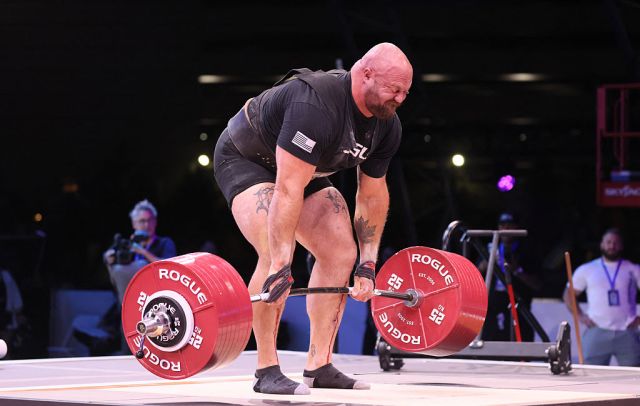
Canadian strongman Mitchell Hooper competes during the deadlift event. (Etienne Laurent/AFP/ Getty)





Blood is rolling down the shins of Mitchell Hooper. The two-time World’s Strongest Man has just deadlifted 475 kilograms — equivalent to a young hippo — and now he has a shot at the world record. As he steps up to the wooden stage, the crowd roars in anticipation. This could be it: the moment the 510-kilogram record is smashed. Bending down, Hooper clutches the bar. The glare of the spotlight glistens off his polished scalp, his shoulders swallowing his neck. He lets out a final wheeze and pulls. His whole body seems to swell under the strain. History is in the making.
The bar never leaves the ground. After three seconds of agonizing effort, Hooper releases it in defeat. He stands back, meekly waves to the crowd, and slinks out stage left. Even after a three-month regimen of heavy steroid and testosterone use, the synthetic support did not prove enough to get him over the line.
For this was not an ordinary strongman competition. This was the inaugural Enhanced Games in Las Vegas — an Olympics-style spectacle with a distinctly un-Olympian twist: drugs, and lots of them.
Testosterone, anabolic steroids, stimulants, metabolic modulators, and a pick ’n’ mix bag of peptides were just some elements of the “stacks” that these athletes had been taking ahead of the Games. In any other sporting context, it would have resulted in an automatic disqualification and a lengthy (if not lifetime) ban. But at the Enhanced Games, it was almost a prerequisite for qualification.
These competitors were, after all, sporting outcasts. They were rejects, drug cheats, and also-rans. Few had a pathway back into the disciplines they had spent their whole lives devoted to. Now, they had effectively sealed their fate by competing in a tournament that was widely dismissed as a “clown show” by the US Anti-Doping Agency and “dangerous and irresponsible” by WADA.
With so many drugs involved, I made my first trip to Vegas expecting an event as riveting as it was uncomfortable: a Hunter S. Thompson sort of scene, but with steroids instead of psychedelics. I didn’t plan on barrelling down the Strip with a fistful of mescaline and a quart of ether, but I had already been offered to go to a gun range by another attendee before the event had even begun. It was a promising start.
Instead, the Games proved to be a more sterile affair. Like the athletes competing, the crowd appeared to be on their own strict protocol, with tech bros and YouTube influencers flexing their enhanced muscles on camera. Veins bulged out of muscles I did not know existed, and skin stretched across foreheads so tightly that eyebrows were rendered immobile. As I wandered around the makeshift arena, many were happy to share with me the details of their regimens, no doubt taking inspiration from anti-aging guru Bryan Johnson, who was commentating on the Games. One even offered to put me in touch with his “peptide guy”, which I politely declined. As for Johnson, he delivered analysis while sheltering under a black parasol — all the better to prevent his skin from aging.
Ironically, many in the stands looked more enhanced than the athletes themselves. Since his dramatic weight gain last year, the swimmer James Magnussen, a former 100-meter freestyle world champion, had shed the 20 kilograms he once carried. Perhaps to the disappointment of thrill-seeking spectators, he was one of many athletes to have retained the lean, familiar physiques of their former Olympic selves. The contestants were competing across three categories: swimming, sprinting, and weightlifting, with 42 competitors vying for a total prize pot of up to $25 million. $250,000 would be awarded to first-place finishers and bonuses of up to $1 million for “breaking” world records.
By the end of the evening, only one $1 million prize was handed out. The Greek swimmer Kristian Gkolomeev swam 20.81 seconds in the men’s 50-meter freestyle, 0.07 quicker than the world record — and 0.05 seconds faster than his previous record at an Enhanced Games-sponsored event in February 2025. It hardly represented the dawn of a new sporting era, but it was nevertheless heralded by Max Martin, the Enhanced Games CEO, as the moment “we changed the world”. Martin knelt at Gkolomeev’s feet in gratitude; the prize money, evidently, was well-spent.

The millions of dollars in cash was certainly a powerful incentive for these athletes, but the event lacked the intensity of a conventional sporting competition. EDM music blared during races; sprinters were allowed to restart after false starts; and a weightlifter was granted an additional attempt in the snatch. Records or no records, athletes were applauded as if they were returning war heroes. By the end, I half-expected participation trophies to be handed out.
At times, the Games felt more like an episode of Severance: a sealed-off system observed from the outside, its participants acting according to rules that seemed both hidden and self-evident to them. At the end of each race, athletes were routinely asked how enhancement had changed their lives. The responses were uniformly effusive — gratitude directed at the organizers; praise for a newfound lease on life; and carefully rehearsed reflections on the transformative effects of the substances they had taken.
This was, of course, the point. The Enhanced Games is a publicity stunt. The athletes are running, swimming, and lifting advertisements for the long list of the supplements, longevity treatments and specialized regimens promoted on the event’s newly revamped website. But if they were meant to be an advert for a better, faster, stronger tomorrow, tonight’s performances suggest there is some way to go.
Critics have already dismissed the Games as a sideshow, but they are wrong to do so. If last night’s competition revealed anything, it was the glimpse it provided into a future in which “enhancement” is no longer the exception, but the norm. With the use of performance-enhancing drugs on the rise, even as “looksmaxxing” becomes normalized, events like these are helping redraw assumptions about what constitutes a desirable or even normal body. As those boundaries shift, so too may the pressure for people to interfere with their bodies — chemically, medically and permanently — without fully reckoning with the risks.
Enhanced had billed the competition as the beginning of a new era for elite sport — one in which pharmaceutical optimization would render old records obsolete, and bring human potential to new frontiers. Not only was a single world record broken, but three unenhanced athletes ended up winning their respective events. Ben Proud, the Olympic silver medalist and poster child for the Games, improved on his previous personal best, but missed out on the world record by just 0.05 seconds. His dejected look at the finish line made clear his disappointment.
If these results were meant to serve as a rebuke to the old sporting system, the event was a failure. But they also pointed towards a deeper tension that lies at the heart of the organization. On the one hand, its founders present the Enhanced Games as a “new Apollo mission”, testing the limits of human performance and pushing the boundaries of human potential. On the other hand, they argued that there was nothing altogether that different from what today’s enhanced athletes are doing compared to previous generations. Promotional videos invoked the Ancient Greeks, who supposedly used figs, mushrooms and plant seeds to sharpen performance, or the runners of the early-20th century who turned to stimulants and tonics in pursuit of an edge.
It does not take a scientist, however, to understand that there is a difference between eating a fig and injecting EPO (erythropoietin), a hormone which is designed to increase red-blood-cell count, but can also raise the risk of stroke, heart attack, pulmonary embolism, blood clots and sudden cardiac death. While Enhanced athletes underwent medical supervision in the months leading up to competition, the long-term consequences of sustained pharmacological enhancement remain poorly understood. That uncertainty raises a broader question: what happens when these protocols — or simplified, mass-market versions of them — move beyond tightly controlled experimental settings into a wider, commercially accessible market?
The rise of the “looksmaxxing” community offers some clues. Though Enhanced’s founders reject any direct comparison with influencers such as Clavicular, there are notable overlaps: in both cases, the body is subjected to pharmaceutical intervention in pursuit of an aesthetic goal. The language may differ — performance versus appearance, sport versus self-image — but the underlying logic is not. Besides, most of Enhanced’s customers will be less fussed about beating world records than looking good in the mirror, which they can do with testosterone injections for $169 a month, low-dose tadalafil for $80 a month, or semaglutide for $179 a month.
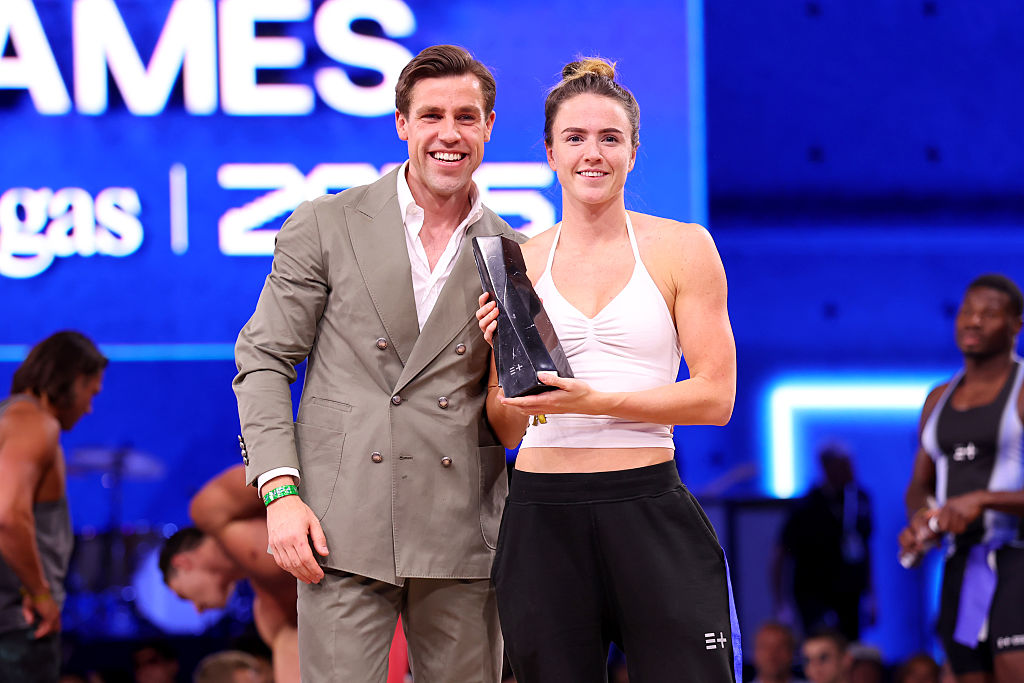
Enhanced’s co-founder Christian Angermayer has himself acknowledged that vanity is no bad thing. He argues that the pursuit of enhancement does need not be morally distinguished by its motivation: whether driven by vanity, ambition or competitiveness, it forms part of a single continuum of biomedical self-optimization. Notably, he sees these Games as a node in a broader cultural campaign to make pharmacological enhancement socially acceptable, arguing that medicine is too narrowly focused on treating illness rather than improving healthy people.
Yet what is most revealing is where he draws his inspiration from: the trans movement. Writing in 2024, he argued that the broader freedoms won through struggles over gender identity would eventually extend to the right to “shape and enhance one’s own body and mind according to individual desires and aspirations”. In his telling, enhancement is not simply a sporting or medical question but a libertarian one — part of a wider rejection of fixed ideas about what constitutes a “normal” body.
It is a revealing analogy. The debate around transgender athletes exposed how fraught questions around hormones, bodily autonomy and fairness in sport can be. In 2022, the 6’1” trans swimmer Lia Thomas won a National Collegiate Athletic Association women’s freestyle title in 2022; the sight of her on the podium alongside smaller female competitors became a lightning rod for public unease about where inclusion ends and competitive advantage begins. James Magnussen’s own transformation — after putting on 20 kilos through pharmaceutical enhancement — provoked a different but related reaction. His enlarged physique, with lats spilling out of his swimsuit, looked disturbingly unnatural, looking more like that of a WWE wrestler than an Olympic athlete.
Perhaps this is part of the appeal. People came to the inaugural Games expecting to see mutants; this time around, mutants were not forthcoming. But as more and more people develop their own regimen at home, that boundary may begin to blur. As for the Games itself, the format will almost certainly return, iterate, expand. And once athletes have crossed the line into enhancement, there is no obvious way back to the old rules without cost — physiological, competitive, or reputational. In that sense, what happens in Vegas rarely stays in Vegas.
