




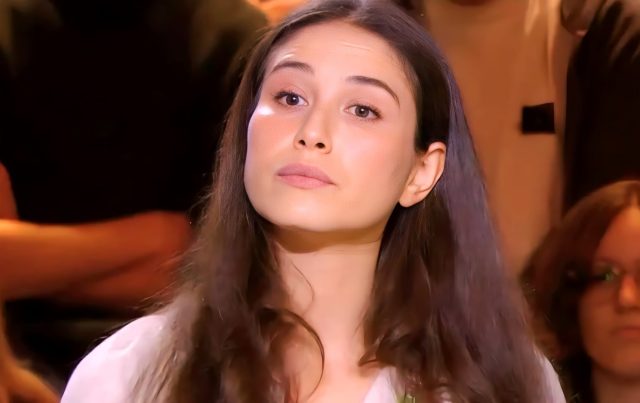





On 20 May 2026, I learned that I had been condemned by the French justice system for a sentence I had uttered during a television debate three years before. What I said was this: “As women, we are obliged to be wary of people with penises” or, in the original French: “On est obligées de se méfier des personnes à pénis en tant que femmes”.
As far as I was concerned when I spoke those words, I was offering my own perspective as a woman — but also saying something that every woman on this planet has always known, and that feminists have repeated for decades. We really must be wary of men because the problem of sexual violence is overwhelmingly a male problem. In France, 99% of rapes are committed by men. Women know.
According to the three LGBTQ+ organizations who brought criminal proceedings against me — Mousse, SOS Homophobie and ADHEOS, all of which receive funding by French taxpayers, by the way — my words amounted to incitement to transphobic hatred. On Wednesday, the judge delivered his verdict that, yes, I was guilty of committing a “public injury towards a person or a group because of their sex, their sexual orientation or their gender identity”. On top of paying €1,000 to the French state, I’m also liable for various other costs. All told, I’m obliged to pay €4,754.
Of course, what matters here is not money but principle. Apparently it is now against the law for women to tell other women to be wary of the opposite sex. Naturally, my lawyers and I intend to appeal this Orwellian verdict, all the way to the highest court in France if necessary, since it marks a worrying shift in French freedom of expression — quite beyond the specifics of my own rather absurd trial. It seems to me basically unacceptable that a woman should be condemned for having expressed her misgivings about the safety of women and the reality of biological sex. This represents narrowing of permissible speech in France, the judicialization of ideological disagreement — and the growing influence of gender politics on a country that once prided itself on intellectual honesty.
I uttered the fateful phrase in October 2023. In my work as a feminist writer and activist, I have long argued that allowing men to change their legal sex and be recognized as women has real implications in various areas, from medicine to law to parenting to sport — and that these merit discussion. I co-founded the feminist NGO Femelliste, and later co-authored a book investigating the excesses and consequences of modern gender ideology.
When I was invited onto the France 2 show Quelle époque, hosted by the prominent TV journalist Léa Salamé, I hoped it would be a chance to have an open, honest and respectful discussion. I would be appearing alongside France’s first-ever transgender mayor, Marie Cau, then-head of the small northern village of Tilloy-Les-Marchiennes.
In the event, the debate felt more like an ambush. I was accused of being part of the “far-Right sphere”, which could not be further from the truth. Then the contentious moment arrived when Salamé asked me what I, as a feminist, thought transgender demands might take away from women. I answered that these issues should not simply be opposed — “we must find common ground”. I then raised specific areas where conflicts arise, notably around sport and prison policy.
In relation to prisons, I referred to documented cases in the United States and the United Kingdom, where male prisoners convicted of violence against women had self-identified as female and been transferred to women’s prisons — where they subsequently sexually assaulted female inmates. It was in this specific context that I said: “I am not saying that all trans people do this, far from it, but as women, we are obliged to be wary of people with penises.”
Two months later, I received a complaint from Mousse, SOS Homophobie and ADHEOS. The associations cited several of my statements in the program, including one in which I said that, in my view, Marie Cau was a “transfeminine man”. This was framed as a “transphobic insult”. More broadly, the document portrayed me as someone who contributed to a climate of hostility, even suggesting that my words could be linked to the suffering or suicide of trans-identifying individuals.
So the initial complaint was not narrowly constructed. It was an attempt, rather, to build a case around a series of statements that, taken together, characterized me not just as someone who had said something controversial: but as someone engaged in a broader pattern of harmful speech. This strategy did not survive legal scrutiny. Before the trial began, my lawyers Richard Malka and Marine Viegas challenged the admissibility and legal qualification of several statements. A significant portion of the complaint was dismissed on procedural and technical grounds; what remained was not the full set of accusations, but that single sentence — “As women, we are obliged to be wary of people with penises”.
Note that the sentence had become curiously detached from its preceding qualification: “I am not saying that all trans people do this, far from it, but…” Indeed, I was speaking about a concrete category of risk — in other words, doing the opposite of generalizing. This did not prevent the complaint from accusing me of “abusive generalization”. This was the first lesson of the case: once a statement has been ideologically re-coded, context ceases to matter.
At the hearing, the court returned obsessively to two things: the phrase “people with penises”, and the verb se mefier de — which might be rendered as “to be cautious of”, “to be wary of” or “to watch out for”. The prosecutor argued that my words were doubly discriminatory: first, because they implied that all men are dangerous; and second, because they targeted trans women, recast as “women with penises”, as objects of suspicion. The prosecutor even requested that I be sentenced not only to a fine, but to a so-called “citizenship training course” — a faintly comic euphemism for ideological re-education.
The court’s questioning suggested that my phrase “to be wary of” had to be understood as a hostile generalization. It was treated not as the language of female self-protection, but as a form of exhortation. The word “obliged” made it worse, the prosecutor argued. It transformed caution into an injunction.
Then there was the phrase “people with penises”. The judge suggested that it sounded like a punchline, a provocation. I explained that I was in fact using a term that is deemed by many progressives to be more inclusive than merely “men” (since as we now know, not all men have penises). Indeed, “people with penises” comes from the same discursive universe as “people with uteruses”, “people who menstruate”, “sex assigned at birth”, and so on. However, it seems that when linguistic logic is applied in the wrong direction, it suddenly becomes indecent.
The judge then pressed me, several times, on whether I believed all men were dangerous — attempting to force me into either caricature or capitulation. Did I think literally all men were rapists? Really? Every single one? At one point, I was momentarily thrown off balance by this insistence. My lawyer Richard Malka intervened and reframed the point. Not all men are violent, obviously, but the overwhelming majority of rapists are men. That is the social fact women live with, and it is what underlies female caution. It was a necessary intervention as the hearing repeatedly tried to re-code rational female behaviors as forms of ideological extremism.
But as I learned, this new moral grammar has rendered lived experience all but illegible. Like all women, I have learned from childhood to assess risk. Do not walk alone too late. Watch your drink. Be careful with men you don’t know. Trust your instincts. These are all things we learn as we navigate a social world structured by asymmetrical risk. In court, though, the female habit of caution was recast as criminal suspicion. For this, ordinary reality had to be denied.
I chose Richard Malka to represent me for a particular reason. His name is not just associated with technical legal expertise — but with some of the most consequential free speech cases of the past two decades. He was the lawyer for newspaper Charlie Hebdo, before and after the terrorist attack on its offices. Malka defended the newspaper’s right to publish caricatures of religion even though they were offensive. That case was about whether a society accepts that certain expressions must remain lawful even when they provoke outrage or worse. Freedom of expression, Malka argued, does not exist only for consensual speech, nor for ideas that flatter prevailing moral sentiments. It exists precisely for what shocks, disturbs, contradicts.
Malka later represented Mila, a 16-year-old girl subjected to an extraordinary wave of threats and harassment after she criticized Islam in a social media post. The girl had committed no crime, Malka argued, and yet she had effectively been purged from civil society. “I can’t get over the fact that she lives as a recluse,” he told the court. “Imagine her life, she can no longer walk peacefully, she can no longer do internships, all doors are closed to her.” In this instance, it was those issuing the death threats who were on trial, but the case raised the same underlying question: does the right to free speech remain protected irrespective of the sensitivities of whoever may be offended by it? Or does the concept of harm expand if the identity group is sufficiently sensitive to offense?
In both cases, Malka defended a strict, almost classical understanding of free speech: the law does not exist to protect people from being offended, but to protect the conditions of open debate. It is increasingly rare to find people who defend this position, even in France, which is why I had contacted Malka years before my trial — when I had already begun to face professional consequences for stating that, in my view, being a woman refers to biological reality. For years I had been targeted by activists openly calling for violence against me, even for my death, all while promising legal defense funds for those willing to attack me. When the complaint was eventually filed, I knew who to call.
In principle, French law still distinguishes between opinion and incitement. The offense at issue — provocation to discrimination, hatred or violence — traditionally requires something more than a harsh statement. It requires an actual call to hostility or exclusion. Marka’s colleague, Marine Viegas, made precisely this point: “I will not fall into the trap set by the civil parties,” she told the court. “For or against trans people? For or against gender identity? That is not what this case is about. The only question is whether, today, in a democratic society — ours — it is still permissible to debate this subject, the ideology it has produced, its excesses, and its taboos.”
Viegas argued that my words did not target trans people as such, but a category of individuals defined by specific acts and circumstances — in other words men who exploit loose self-identification rules to enter women’s spaces and harm women. In French law, that distinction matters. It is not an offense to criticize people for their conduct. Viegas also pointed out what should have been obvious: there was no call to hatred in my words, no exhortation to attack, expel, discriminate against. At most, she said, it was “a measured recommendation”, rooted in documented facts and limited circumstances. As she concluded: “Forgive us for having dared to say that women should be cautious of rapists.”
Viegas also made the peculiar inversion of victim and accusers central to the defense. She reminded the court that the associations prosecuting me claimed to act in the name of tolerance and protection, while aligning themselves, explicitly or implicitly, with people who had subjected me to sustained intimidation. She cited messages calling for me to be “burned alive”, “crushed”, or “destroyed”. Those same actors, she argued, had now come before a criminal court to demand the policing of a single phrase. When you “attack everything and everyone”, as she put it, you lose the ability to distinguish between hatred and disagreement.
That, indeed, is exactly what I believe this bizarre case illustrates. Asymmetry is now structural. Explicit threats can be minimized, contextualized, or ignored, provided they come from the “right” side of any given moral divide. But a statement grounded in observable reality becomes suspect, actionable, even prosecutable if it disrupts the dominant narrative. The legitimacy of the act becomes secondary to the identity of the speaker. Once that shift is complete, the law ceases to regulate behavior. Instead, it regulates who is allowed to speak and who must be silenced.
Perhaps the most revealing move by the prosecution was the implication that I had dredged up some bizarre, malicious fantasy — that my worries about male offenders exploiting self-identification rules to enter women’s prisons was the lurid invention of a woman obsessed with discrediting trans people. But as my defense made absolutely clear, the prison issue was real and documented — and these people were not being criticized for being trans but for being violent criminals.
That was my point, and it remains my point now. Not all trans-identified prisoners are dangerous. Perhaps the vast majority aren’t. But some are, and women should be able to discuss the consequences without being accused of hatred.
What is particularly dismaying about all this is that France has long imagined itself as intellectually distinct from the Anglosphere — where these debates have been raging for a long time. The Republican tradition is, at least in theory, universalist. French citizens are treated as individuals, not as members of identity groups, and public debate can be abrasive, even confrontational, without automatically becoming a legal matter. This is now beginning to shift. What is being imported is not so much Anglo-American law, but Anglo-American ways of interpreting speech, in which disagreement is reframed as endangerment and criticism as a form of violence.
In court, I was told that statements like mine could contribute to suicides among trans-identifying individuals. Such reasoning does not belong to traditional French legal culture. It belongs to a broader cultural shift, visible across parts of the Anglosphere, where the boundary between speech and harm has been progressively blurred in public discourse.
This was also a central point in the defense. Marine Viegas insisted that my case was not a marginal provocation emerging from the “far Right”, but part of a wide and ongoing debate with implications for many sectors of French society. And yet the language used to police it is distinctly un-French. We have imported a distinctly alien cultural reflex. In her closing statement, Marine Viegas asked the question the court should have asked from the beginning: by what right should the French public be deprived of this debate? I believe it is the right question.
In the end, my case is not about whether my sentence was elegant, diplomatic, or gentle. It is about whether women are still permitted to speak plainly about sex, risk, and bodily reality: when those realities conflict with the demands of gender ideology. If a woman can be prosecuted for saying something that basically all women know to be true, then free speech in France does not exist. It is being conditionally tolerated, and only so long as it does not disturb the reigning moral consensus. For that reason, if nothing else, we will appeal — for I cannot accept that women have no right to speak our truths.
Dora Moutot is the author of ‘Mâle Baisées’ and co-founder of feminist website, Femelliste (femelliste.com)
 doramoutot