




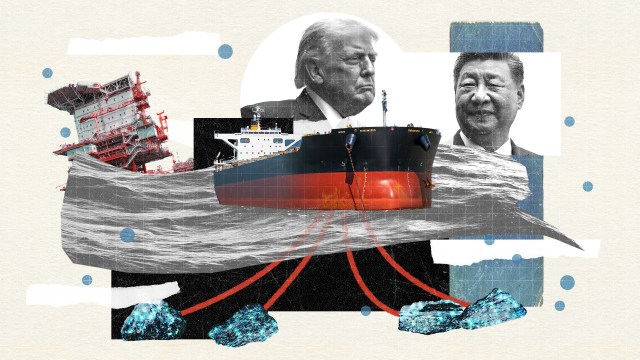
The US and China are competing for mineral resources. (JG Fox/Getty)





Like the howling ice shelves of Antarctica, or the searing depths of the Earth’s crust, the deep-sea floor is both of our world and alien. The abyssal plain is a Lovecraftian land in which strange creatures, some of them eerily aglow, live and die beneath the pitch-black weight of several miles of ocean. It is no place for our fragile species. If a human body had, through some black magic, appeared in the darkness tens of millions of years ago, it would, in a split-second, have been turned to pulp.
After that, things would slow down. The corpse’s tissues would be painstakingly scavenged; its gases, puff by puff, disgorged. Yet its teeth, if spared by scavengers, could outlast most species. A tooth in the abyssal plain attracts charged particles. Over millions of years, that ion-gathering tooth becomes a rock — and such rocks, today, are grenades beneath the palace of international law.
For a war is now underway: a war for the rocky riches of the deep. Those rocks are teeming with the kind of minerals whose unique physical properties make them essential to modern manufacturing. So far, they have been mined on land, with China coming to dominate their supply. But at the bottom of the world’s oceans lie the forbidden fruit of the mining sector: an estimated $20 trillion of deep-sea minerals. Since the Sixties, diplomats have fought over that unplucked fruit. Soon, the conflict will enter public view, bringing to a head many decades of diplomatic skirmishing.
The first fortifications were laid by a Maltese diplomat. With Uncle Sam soon to imprint the virgin lunar regolith with its first bootprint, Arvid Pardo urged the UN to declare another vast, unclaimed realm — the ocean floor — off-limits to colonists.
“The dark oceans,” Pardo told the General Assembly, “were the womb of life: from the protecting oceans life emerged.” It was to the depths of the seas, Pardo explained, that man was returning: laying cables, drilling for oil, dispatching submersibles, prospecting for minerals. “His penetration of the deep could mark the beginning of the end for man, and indeed for life as we know it on this earth: it could also be a unique opportunity to lay solid foundations for a peaceful and increasingly prosperous future for all peoples.”
Pardo’s principal worry was that the ocean floor, shrouded by the opacity of the sea, would become the natural home of missile silos. Such installations could be laid dangerously close to enemy shores. But he also feared that the ocean floor would be exploited, that richer, more rapacious countries would appropriate its buried treasure: not only the spoils of ancient shipwrecks, but the natural bounties of gold, silver, and the materials that we now know as critical minerals. Those valuable rocks, Pardo feared, those slowly-growing bundles of metals, would be plundered.
The high seas, Pardo concluded, referring to the parts of the oceans beyond the reach of the coast, were “the common heritage of all mankind”. This is a demarcation that stirs the blood of both Third World diplomats, to whom it signals that their countries might be handed a generous slice of profit, and their US counterparts, to whom it signals that the slice will be cut from an American cake.
Eventually, in 1982, the UN came up with a treaty to govern deep-sea mining. It was an extraordinary document, outlining a proposal that the UN itself, via an entity called “the Enterprise”, be permitted to mine; that signatories’ mining operations, should they outcompete conventional mines in developing countries, could be compelled by UN judges to pause their work; that profits be taxed by the UN and redistributed among member states; and that if a signatory were to develop particularly effective mining technology, such as equipment that could mine a seabed five kilometers below the surface, it would have to share that technology with the rest of the world — even if the innovator were the US and a beneficiary were the USSR. Perhaps predictably, the proposals were greeted with obloquy from Ronald Reagan. The US did not sign the treaty, nor did it sign the watered-down version that followed.
Even without the Americans involved, the would-be regulators have found it impossible to reach an agreement. The International Seabed Authority (ISA), which was set up by the UN in 1994, continues to deliberate. Of particular difficulty is the unresolved question of precisely how much harm undersea mining will cause to marine life. Europe lobbies for caution; the Third World for a cut of the profits; but those who are best-placed to profit are becoming impatient. The Pacific island state Nauru is leading the charge, but Japan, Russia and India, too, are tired of waiting.
Over the years, the ISA has issued a limited number of licenses for commercial operations, sponsored by individual governments, to explore the ocean floor, if not yet to mine it. To the relief of environmentalists, the deadlock has lasted decades; on rumbles maritime law’s equivalent of Jarndyce v Jarndyce.
Given that the international attempts at regulation have been going on since the Moon landings, it’s remarkable that the US, for better or worse, has only very recently decided to defy a moratorium to which it was not a signatory. China’s dominance of the critical minerals market has been decades in the making and was never a secret. It was as early as 1992, when the ISA was but a twinkle in the UN’s eye, that Deng Xiaoping said that “the Middle East has oil, China has rare earths”.
Consider almost any critical mineral and the story is the same: China either mines it or has an ally mine it. Take lithium, a metal whose lightness of weight and generosity with electrons makes it a critical ingredient for batteries. Or tungsten, whose high melting point and diamond-surpassing hardness make it a potent ingredient to rocketry, aviation, munitions manufacturing and mining. The same is true of neodymium, which makes for the most powerful permanent magnets on the market; and dozens more. Be it an electric vehicle, a fighter jet or data center, if it’s 21st-century Western hardware, Xi Jinping has it in a headlock.
Add the headlock, administered by China, to the deadlock, perpetuated by the ISA, and the result is a truculent America. Already, the US has set up a club of Western-aligned countries that, together, are attempting to lessen their dependence on China. So serious is America’s shortfall of critical minerals, in other words, that Donald Trump’s White House has had to make a rare foray into multilateralism — even as it shakes down Greenland and Ukraine for their own mineral resources.
But these various efforts do not touch the seabed and its $20 trillion booty. It has not escaped Washington’s attention that the ISA’s long delays suit China, which happens to be the body’s biggest funder.
Last April, the White House lost patience. President Trump signed an executive order via which the US has given itself the power to award deep-sea mining permits, bypassing the ISA. America’s favored mining companies will target the Clarion-Clipperton Zone, a vast stretch of the Pacific seabed where the local polymetallic nodules harbor metals — nickel, manganese, copper, cobalt — that are crucial for batteries.
Drums are now sounding in the deep. The US could issue its first mining permit this year or next, though large-scale activity will take several years more. The likely beneficiary is the Metals Company, whose two exploration licenses cover an area larger than Great Britain. These licenses, having been sponsored in part by Nauru and Tonga, are recognized by the ISA. Yet trouble looms. America is on the unilateral warpath, and already the old regime has suffered a defection. Japan, putatively a member of the ISA, has agreed to collaborate with the US, and in February, Tokyo announced that it had successfully extracted mineral-rich mud from elsewhere in the Pacific. Thought to be among the minerals in that mud is neodymium.
The CCP, still aiming to oversee regulation that suits Chinese interests, remains committed to the ISA, which is attempting to hurry things up. In July, the body will meet in Kingston, Jamaica, but whether Part II of its 31st International Session will be the one that does the trick, turning those exploration licenses into full-fledged mining permits, is unlikely. Those countries that desire a share of the subsea spoils must now decide whether to stick with the ISA, join the American breakaway — or start a piratical operation of their own.
Where does that leave Britain? Last November, the Government published a new critical minerals strategy. It classifies 34 minerals as critical, noting that the vast majority of them are 100% imported. We should meet at least 10% of our needs domestically, the report said; to that end, the Government is keen that we get better at recycling those minerals we have already used. It is less keen to use natural gas to make our industrial energy, which is the most expensive in Europe, any cheaper. Instead, the Government will give metal refiners, who turn mined ores into high-purity product, relief on their high energy bills. Taxing Peter, in other words, to give a tax break to Paul.
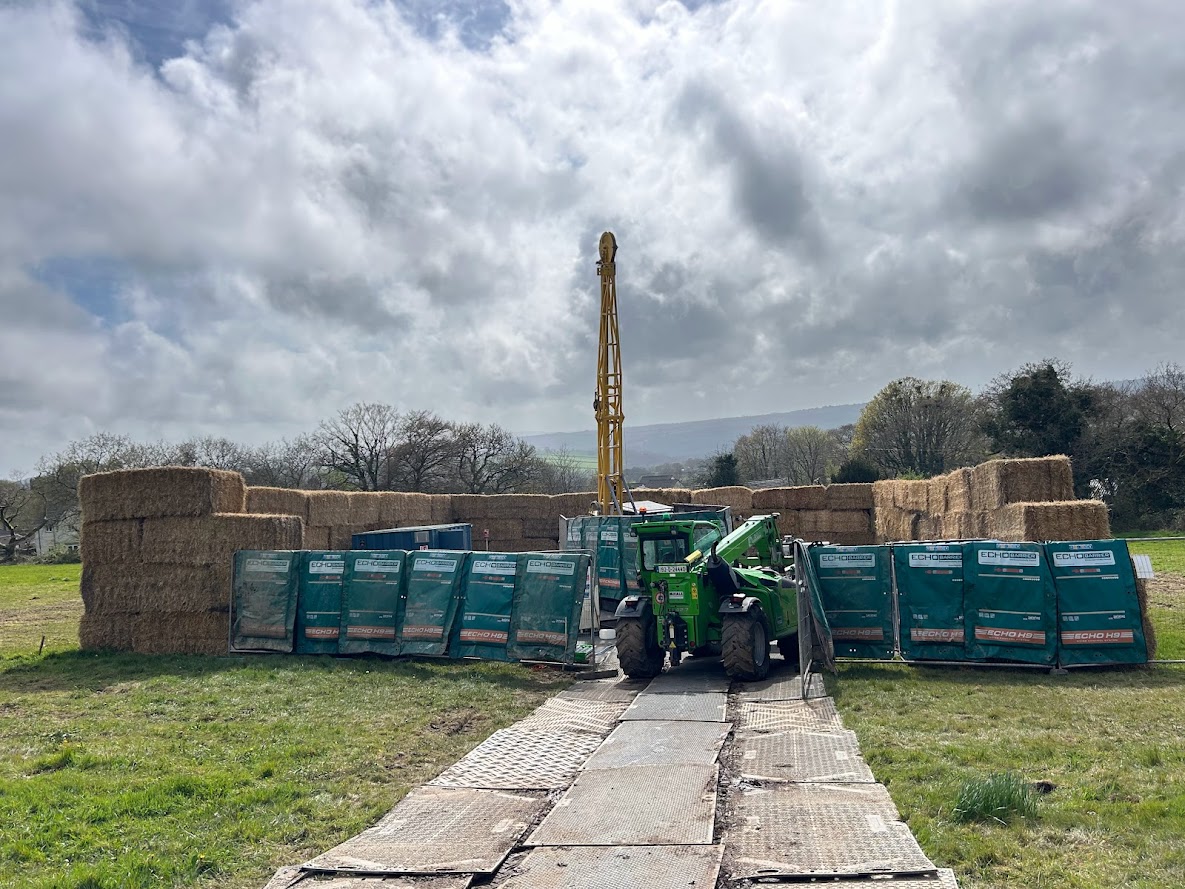
Other parts of the strategy dig a little closer to the root of the problem. Through various financial vehicles, the Government is seeking to spur new mining endeavors, for Britain’s geology, already so many times our benefactor, has more to yield. This spring, I visited a new tungsten mine in Cornwall, one that has been the beneficiary of Government support. Walled off by bales of straw, the drill rig sits unobtrusively in a field of grass. Beneath that field is Europe’s highest-grade undeveloped tungsten resource. As Dennis Rowland, the project’s managing director, told me, Cornwall might seem over-mined, speckled as it is with the ruins of 19th-century tin mines. But by the standards of modern mining, it is under-explored, and the country’s needs have changed. “Our project, historically, wouldn’t have been mined,” he said, “because tungsten wasn’t exactly what they were looking for.” But it is tungsten we need today, as well as lithium — another specialty of the Cornish bedrock.
For all the governmental talk of Britain and the West moving to “warfighting readiness”, then, Britain’s critical minerals strategy still leaves many sacrifices unmade. We won’t rip up the countryside for the sake of mining: in Omagh, Northern Ireland, a mining company has been waiting for eight years for permission to begin a gold-mining operation worth tens of billions of pounds. Nor will we rip up our commitments, legislated and otherwise, to reduce our emissions and to protect places like the Clarion-Clipperton Zone.
Yet a more deeply imperiled Britain would inevitably become more creative in its sourcing of critical minerals. Antarctica, another of those unearthly realms, offers a continent’s-worth of forbidden resources, of which an exposed slice of north-reaching peninsula is claimed by Britain. “Should Antarctica,” a New York Times report asked in February, “be added to the treasure hunters’ list?”
The overseas territories, then, might one day help address Britain’s shortfall of critical minerals. We are unlikely to achieve critical-mineral autarky, but we can at least build some leverage. The same is true for what we might call the underseas territories; and in this case, the deposits often need simply to be scooped from the seafloor rather than blasted out of bedrock.
Through Trump’s caprice, Britain retains the Chagos Islands. The importance of the US-UK base on Diego Garcia is by now well-known; a more underrated providential gift of the archipelago, however, is its proximity to the mineral riches of the Indian Ocean. There are polymetallic nodules in this ocean, too, and polymetallic sulfides: hydrothermal vents that look like spires from the Sagrada Familia and are rich in copper, zinc, gold and silver. On this particular battlefield in the war for critical minerals, it is India, now in possession of three regional exploration licenses from the ISA, that has been the most muscular.
Britain, committed to a moratorium on deep-sea mining, and perhaps unwilling to irritate India and China, did not compete for those licenses. Discreetly, though, and despite itself, the country has a claim on two slices of the Clarion-Clipperton Zone. These claims descend from the Seventies, when the American defense and aerospace manufacturer Lockheed Martin had an interest in deep-sea mining. Because the US was not part of the ISA, Lockheed turned to the British government instead. With London’s help, Lockheed acquired two exploration licenses, which together cover an area the size of England. When Lockheed pulled out of the region, it passed the licenses, with Britain’s approval, to a second company; when that company folded, the licenses were transferred to a startup, Glomar Minerals. It is as if Britain owns a magic ring that keeps finding its way back into our pocket.
In April I spoke to Walter Sognnes, who leads Glomar. “The UK is in a better position than, for example, Germany,” he told me, “because you are an offshore nation. But you are missing the window, I think, because everything is stepping up, and you are not taking the lead. You are moving too slowly.”
Glomar, naturally, is held in deep suspicion by Greenpeace. But Sognnes argues it is better for the West to mine the ocean floor, with governments maintaining scrutiny of the companies concerned, than to pay for those same metals to be extracted near-lawlessly from third-world rainforests.
In time, the world might not need either, for the vast majority of the universe’s resources exist either above the deposits we know about or below them. Buoyed by Nasa’s retrieval of regolith from an asteroid, an American aerospace company, AstroForge, aims to mine richly-endowed asteroids, and has already put two experimental craft into space. Hades Mining, a German startup, hopes to one day use lasers to penetrate many miles into the Earth’s crust, multiplying the amount of deposits we are able to extract. Both ventures must contend with exceptionally hostile frontiers: the abyss of space, with its vast distances and lethal radiation, and the molten hell that is miles-deep bedrock.
But neither frontier will be conquered imminently. And Britain, like the liberal-order firmament as a whole, does not have time to wait for difficult tradeoffs to evaporate. To forgo our primary form of energy, in our case oil and gas, is a luxury that would hardly have been conceivable before the modern era. To outsource to adversaries our supply of critical minerals, the resources that make an energy transition possible, is complacency. The US will mine the Clarion-Clipperton Zone; American and Chinese astronauts will seek to use the natural resources of the Moon, too, just as their countries industrialize and militarize lower-Earth orbit. Where such endeavors differ from traditional colonialism, crucially, is that these new realms have no indigenous populations. But their purpose, one that is common to any colonial expedition, is to turn the resources of a frontier into wealth for a homeland; and if there is collateral damage, then so be it.
The world’s civically-minded middleweights will not relish this dynamic, but they cannot ignore it. Britain, one of those middleweights, must return to the frontier.