









May 2 2026 - 8:00am
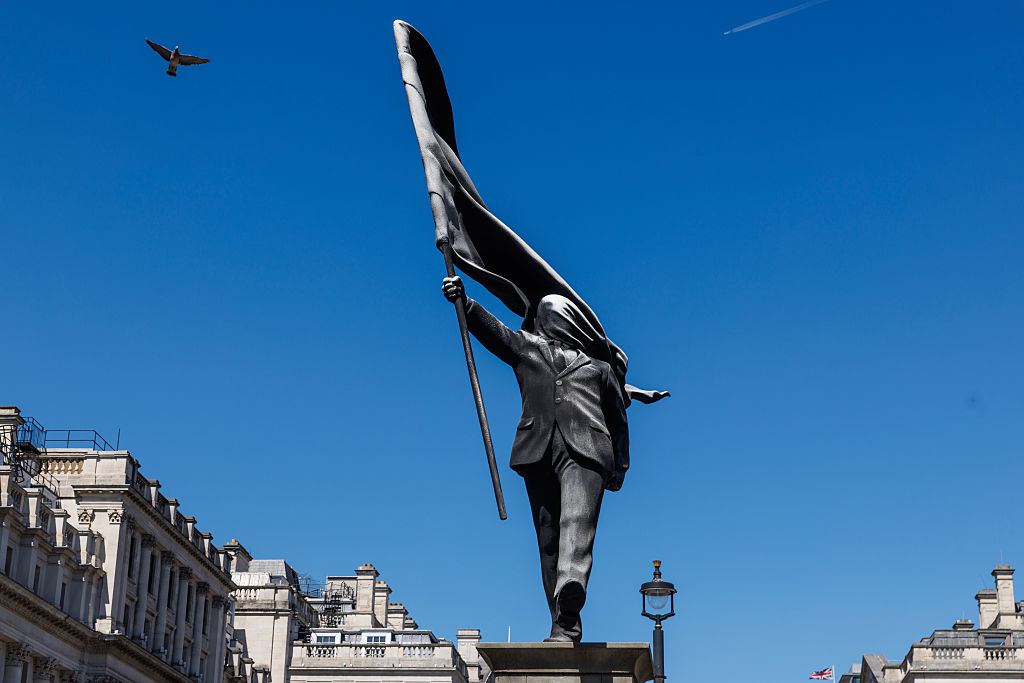
Britain’s most boring street-art propagandist has struck again. Banksy’s latest installment statement — a besuited man with a flag obscuring his face, mounted on a 12-foot plinth in the heart of Westminster — appeared in the early hours of Wednesday morning. It arrived, as these things often do, under cover of darkness — at a time when, one has to assume, the Metropolitan Police and Westminster Council’s night teams were elsewhere, or asleep.
The council has declared that, rather than immediately bulldozing this bit of illegal fly-tipping and sending it directly to landfill, the artist’s latest midwitted incursion on the national conversation will be left up “for the public to enjoy” while the authorities consider options.
What, though, is there to enjoy? We have come a long way from the once-playful, mischievous humor of Banksy’s early-2000s graffiti — stenciled images depicting little girls with balloons and rats with bazookas — which conveyed a clear moral disgust at consumerism and militarism. In recent years, that playfulness has been replaced by a more didactic, hectoring tone, increasingly resembling propaganda rather than provocation.
The flag-waving figure can be read as a somewhat clumsy projection of what one might assume to be the artist’s enduring source of anxiety: the populist revolt that has marked the past decade, and its perceived clash with the green, Left-liberal, progressive orthodoxy for which Banksy has often served as an unofficial mouthpiece.
This self-styled avatar of street-level rebellion — once aligned with anti-establishment sentiment — has repeatedly framed that political shift as a source of alarm. In 2014, for example, Banksy traveled to Ukip-supporting Clacton-on-Sea with a stencil depicting grey pigeons holding “migrants not welcome” placards, contrasted against a more vibrant, “foreign” bird. And in the aftermath of the Brexit referendum, he produced a mural in Dover showing EU stars being chipped away by a white, overalled laborer.
Since then, the Bristol-born artist has increasingly aligned himself with a familiar set of progressive causes, from funding migrant rescue efforts in the Mediterranean to sustained criticism of Israel. The politics of national sovereignty, it’s safe to say, is probably not to Banksy’s tastes. That helps explain the symbolism of the flag-waving figure, especially in the context of a year in which English suburban discontent has taken on a visible, street-art form through the “Raise the Colors” phenomenon.
The fact that Banksy’s statue turned up a week before Britons go to the polls in the local elections is no accident. Nor is it especially surprising that Labour-run Westminster Council has been slow to get rid of it. If anything screams “regime artist”, it’s having your artworks fawned over officialdom rather than swiftly removed.
Whether the council will seek any meaningful consultation with residents is another question. And when it comes to public art and statues more broadly, decisions often appear to be made with limited regard for local sentiment, particularly when they align with prevailing “progressive” preferences about what should be commemorated, removed, or replaced.
Banksy’s position by now seems fairly clear: the public should be nagged toward the “correct” view, and something of that contempt slips out again in the Instagram clip promoting the statue’s installation. After a montage of Union Jacks and statues of figures including Churchill, Clive of India, and Edward VII set to Elgar’s “Pomp and Circumstance”, the video ends with an elderly white Londoner in municipal high-vis. “No, I don’t like it,” he says of the statue. “I prefer that statue up there,” he adds, pointing to the gilded figure of Pallas Athena above the Athenaeum Club.
The implication is fairly clear: this is a “philistine” opinion and, in the Banksy framing, not one that particularly matters.