




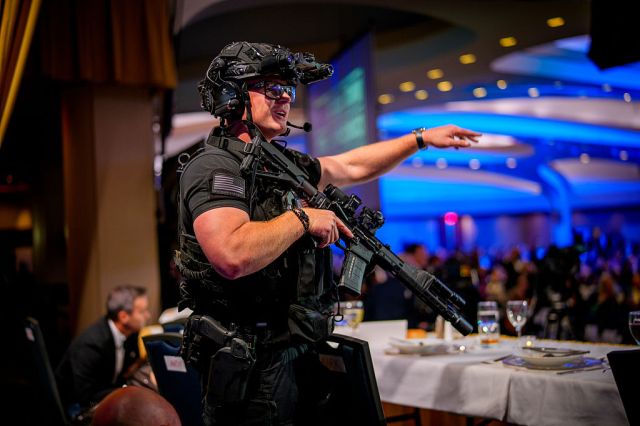
A Secret Service agent at the Washington Hilton. (Andrew Harnik/Getty Images)





The gunshots at the White House Correspondents’ Dinner had barely stopped echoing through the DC hotel before the internet had solved the case several times over. The leading theories: it was all staged, or all the Left’s fault.
It’s another reminder that we’re in the era of the post-event event: something happens, and then the event is subsumed by its own interpretation.
The facts, such as they are: a man armed with a shotgun, a handgun and multiple knives charged through a security checkpoint outside the ballroom of the Washington Hilton on Saturday night. The suspect has been identified as Cole Tomas Allen, 31, from Torrance, California, and he allegedly told authorities he was targeting officials in the Trump administration. A Secret Service agent was shot in the bullet-resistant vest and is expected to recover. Trump and other top officials were evacuated as hundreds of journalists dove under tables. The dinner — the first Trump had attended as a sitting president, at an event he had boycotted for years — was postponed.
We still don’t know the shooter’s motive, but that hasn’t prevented the two great machines of American political interpretation from giving him one. Within minutes of the attack, everyone seemingly had their own answer. On the Right, the shooting became evidence of Left-wing violence, and of Democratic rhetoric run amok. Perhaps it was the fault of the Left-wing streamer Hasan Piker. “What happened tonight is a stark reminder. The Bolsheviks want to kill us all,” posted conservative pundit Jack Posobiec. “They want to kill us and our families and they will laugh about it. The evil is real.”
In the conspiratorial fever swamps that now constitute a meaningful portion of the anti-Trump coalition, the attack was a false flag, a psyop, a plot to justify Donald Trump’s long-desired White House ballroom. Or a wag-the-dog distraction from the unpopular war in Iran. Maybe it was a rescue operation to save sagging poll numbers — or all of the above.
One post, which has circulated widely, quoted Karoline Leavitt, Trump’s press secretary, from earlier in the evening. Leavitt promised viewers that her boss would bring the heat and that there would be “shots fired in the room” — meaning, of course, sharp rhetorical attacks. Social media seized on the clip — some joking that Leavitt was part of the plot, some not, but these days, it’s hard to tell the difference. Others claimed the fact that the suspect was allegedly wearing an IDF sweatshirt in an old social media post was proof of ties to Mossad. The intense speculation didn’t just come from online pundits or partisans; instead, they were joined by normie Democrats and independents in comment sections and Facebook posts. During the phone-in portion of C-Span’s broadcast of the correspondent’s dinner, one caller insisted she believed it was staged before the host cut her off.
In our topsy-turvy world, it’s the man who built a career on wild-eyed conspiracies, Alex Jones, who is now playing the role of the sober-minded critic downplaying the internet theories and accusing people of “misinformation”. (“You don’t have a lot of black cops in on a staged shooting!” he said in a video uploaded to X.)
It begs the question: are we all conspiracy theorists now? Nearly a decade ago, the writer Lauren Duca published a viral essay arguing that Trump was “gaslighting America”. The phrase captured something real about his political style: the insistence that everything the mainstream media was producing was fake, while he invented facts on the fly. But the Correspondents’ Dinner incident suggests we have moved into a stranger phase. Now America gaslights America. The manipulation no longer has to come from the top; instead, the crowd supplies the manipulation itself. An assassination attempt can no longer simply be what it appears to be. It must become proof of something else: corruption, staging, media complicity, divine favor, or an ancient evil.
The problem with these theses: Trump doesn’t need to stage anything. He already operates in a universe where nearly every event bends toward his will. “When you’re impactful, they go after you,” he said at a White House press conference in a reference to presidents on the receiving end of assassination attempts. “When you’re not impactful, they leave you alone.” This is not a lie. For better or worse, he has become one of the most important — and divisive — figures in modern American history and has, in some sense, remade the world in his own image.
What’s clear is that he will continue to play that same role as the world’s greatest protagonist and antagonist. It’s true that for one night, Trump and the press were not simply opponents in a long-running national psychodrama, but people in the same room during an attempted shooting. That may work to soften the atmosphere for a few days. There will be sober reflections, statements of gratitude towards law enforcement, and, as Saturday’s press conference hinted, perhaps even some temporary warmth between a president who has spent years demonizing the media and a press corps that has spent years treating him as both a threat to democracy and a ratings engine.
It probably will not last. Butler, Pennsylvania, produced a similar fantasy after the 2024 assassination attempt: perhaps a near-death experience would temper Trump, perhaps blood would do what impeachment, defeat, prosecution and age had not done. But Trump needs the media as antagonist and foil; the media needs Trump as spectacle and a ratings grab. By next week, they will likely be back in their old roles.
Americans, meanwhile, will keep believing one party or the other or — as is increasingly the case — no one.
