









April 25 2026 - 8:00am
The European Union this week pushed its €90 billion loan to Ukraine over the line, after Hungary dropped its opposition. With this settled, an even more fraught diplomatic issue is rearing its head: Kyiv’s EU membership.
It is clear now that Ukraine will not become a full EU member next year. The €90 billion loan will not be repaid by Russia, a story that German Chancellor Friedrich Merz keeps telling to cover his own incompetent diplomacy leading up to the EU summit last December. It was at that meeting that Belgium blocked the Russian sequestration scheme, and it would have even less reason to agree to such a deal now that the loan is guaranteed by the EU itself. When Belgian Prime Minister Bart De Wever arrived for the informal EU summit in Cyprus this Thursday, he warned that while Viktor Orbán was not always easy to deal with, “there are other countries and leaders in Europe who do not always agree with the consensus.”
That sums up the current state of diplomacy between Brussels and Kyiv. There is a fractious consensus in favor of maintaining support for Ukraine for as long as it takes to reach a war outcome that EU leaders have never defined.
Back in December, Belgium was not ready to incur legal risks for Ukraine. France and Italy were not ready to provide robust guarantees for Belgium. Hungary, the Czech Republic and Slovakia did not take part in the loan. These are the revealed preferences of European politicians, as opposed to their stated preferences in which they pledge unending solidarity with Ukraine. The hypocrisy is most egregious on the topic of Ukraine’s EU membership. The European Commission has discussed a membership-lite version, which is a nice way of saying no. Ukraine would have neither access to the most important EU policies nor voting rights. Volodymyr Zelensky is smart enough not to fall for any symbolic promises.
After all, would Germany and France agree to increase their contributions to the Brussels budget considering the dire state of their public finances? Integrating Ukraine into the EU would also require financial sacrifices by existing recipients including Poland and Hungary, while the addition of another large country would dilute voting rights in the Council. The German position is that a reform of voting rights in the Foreign Affairs Council would be a requirement for Germany’s approval of further EU enlargement, but that would require treaty change.
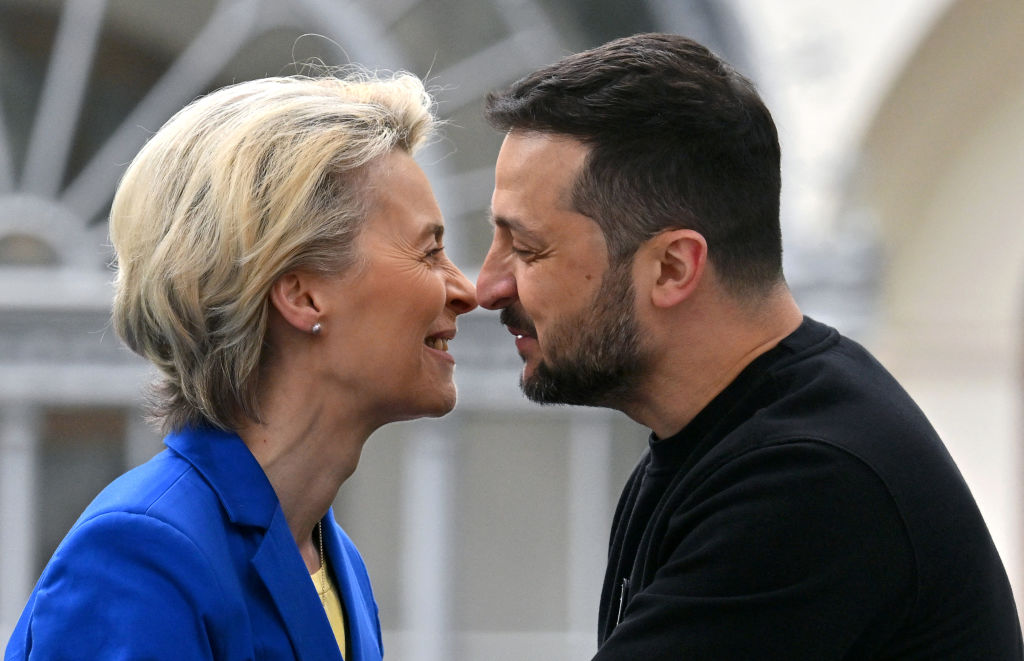
Outwardly, the EU presents an image of cohesion. Yet, behind the staged pictures of embraces with the Ukrainian President when he visits the European Council, tensions are starting to build in the background. Lithuanian Prime Minister Inga Ruginienė this week accused Zelensky of intimidation for his reference to an imminent Russian attack on the Baltic states. The Estonians made the same criticism. Zelensky had previously been successful in getting Europeans to believe that Ukraine was fighting the war on Europe’s behalf, and that the continent’s own security was at stake. Now, that narrative is becoming harder to sustain.
The war itself is settling into a mutually destructive stalemate. Western reports about the Russian economy often fall into the category of propaganda, as do the hypothesized casualty numbers. The Russian economy was in a recession during the first quarter of this year, but the latest forecast by the Vienna Institute for International Economic Studies, the most authoritative Western source of information about the Russian economy, has the 2026 growth rate at 1.2% this year — a figure reached before the rise in oil prices. It’s strange to read German newspapers predicting a collapse in the Russian economy, when Russian growth regularly exceeds Germany’s own.
Right now, Ukraine faces critical shortages of air-defense systems, while political tensions are rising between Zelensky and his parliamentary majority. The €90 billion loan was necessary to prevent Kyiv from falling into immediate bankruptcy, but Russia will continue to outspend Ukraine by a wide margin.
This is an edited version of an article that first appeared in the Eurointelligence newsletter.
