




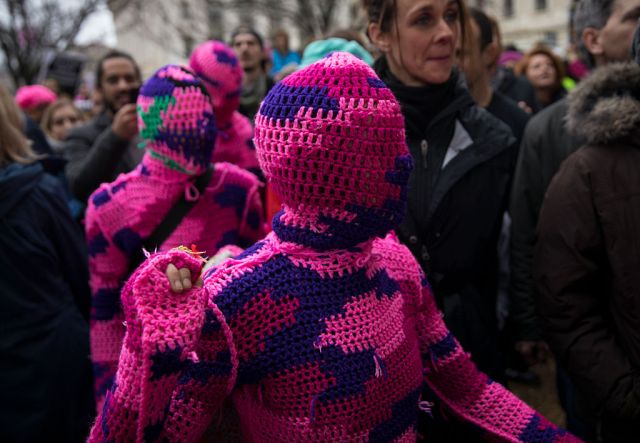
The Angry Young Women are on the march. (Robert Nickelsberg/Getty Images)





Some weeks ago, at the bitter end of a midweek drink, a friend and I found ourselves trying to talk a 24-year-old down from the edge. What seemed at first to be common-or-garden romantic gloom became, over half an hour on that dive-bar banquette, despondent fury: the problem was, she told us, that she just hated men. All of them without exception were inherently bad; anyone with a boyfriend was setting herself up for the moment his true, rotten form was revealed — maybe in a week, maybe in 40 years; either way, he would find a means to destroy her. Happy heterosexuality was a myth to trick us out of sex and time, and we were suckers for believing it.
The diatribe dragged wearily on: she’d never want a son — what the hell would she do with it? — and she couldn’t wait to be a “chic divorcée”, quite an ambition for a woman with only a single long-term boyfriend under her belt. Every man she met promised harm, risk and psychic poison; every guy in a bar or on Hinge was bound to ghost her, or cheat on her, or tell his friends she had fat thighs. Men only wanted big-titted bimbos; those women in turn were shallow patsies who lacked the rich inner lives of, say, herself. I reeled off our male mutual friends: “Is he evil?” I asked of the softly spoken journalist devoted to his fiancée whose worst known habit was being too generous with trays of shots. Her reply: “Not yet.”
This was not my first such evening, nor were this woman’s views especially radical in my milieus in New York or London. I was not surprised, then, by the depressing revelations in the New Statesman’s gripping cover story on “Angry Young Women” last week. The article drew on polling of 2,000 Britons between 18 and 30, finding that three times more women than men held a negative view of the opposite sex (21% versus 7%). They were more pessimistic about their futures, more likely to feel that the odds were stacked against them. Soi-disant feminists interviewed at university clubs would gloat that they “don’t care for” men, nor would they date, or be friends with, one they disagreed with politically.
To older or less online readers, all this must seem shocking. The suspicion, the detachment, the hopelessness; it’s not how most men or women recall the ups and downs of dating. Yet the landscape has changed: these women were teens when the first volleys of #MeToo were sounding across social media; their early romantic experiences were mediated by dating apps; their partners’ sexual appetites were honed by the ubiquity of hardcore porn. To cope, the feminine cyberspace has warped into something dark and cynical. In incel culture, total romantic resignation is known as “the blackpill”: while the so-called manosphere preaches the inevitability of rejection based on looks or status, its incipient female version — the femosphere — slaps acolytes around the chops and warns them of the abject humiliation they’ll face should they be so weak as to fraternize with a sex both destined and determined to hurt them. This certainty unites the femosphere’s twin poles: the dejected women like my friend who’ve “given up”, and the “dark feminine” influencers who tell them instead to use male decrepitude to their advantage. For both camps, the bestiary of modern men is 1,000 synonyms for “dick” — fuckboi, softboi, finance bro, DJ, pervert, weirdo, fascist, too nice: the man mavens of TikTok tell us that if we must interact with one, we should do it only for personal gain.
On TikTok — the crucible of Gen Z female culture — “dating experts” such as SheraSeven coach their followers first to accept the Badness of Men and then to profit from it. Seduction is not about romance but leverage; women must rinse men for all they’ve got; “if he’s not paying, he’s playing”. Women should never reveal their true feelings, only select “targets” who offer to buy them something within the first 15 minutes of interacting and, most importantly, remember that we are “single until we’re married”. All men cheat, Shera tells us; she dares deniers to “bet your life on it and see if you stay alive”. Dating is a race to the bottom and men languish on the ocean floor: gaming the system gives the canny among us a snorkel. If that’s how young women are being told to view prospective partners, is it any surprise that many want to withdraw from dating entirely?
Those who do are comforted by spreading their dejection to other women. The femosphere is foreclosing on the life-giving possibilities of love (300,000 BC – 2026 AD) so as to reinforce itself; dig beneath the headstone and you’ll find that villainous worm, female intrasexual competition, which gluts on universal despair. Misery loves company, and the quietly cutthroat dynamics familiar to anyone who went to an all-girls school are extrapolated into adulthood through gossip, mockery and eye-rolling when a member of the coven shows signs of hope. She’ll learn, the grumbling goes. At the end of the day, he’s still a man.
There is something fundamentally wrong with the philosophies of both “dark feminine” influencers and the despairing celibates who obsess over a vicious caricature of the opposite sex. In her radical cynicism (though not in her sexual aggression), Shera is the mirror image of Andrew Tate, another profiteer of gutter sex discourse. Both philosophies desecrate one of the finest human faculties — the romantic imagination. They limit boys and girls to callous, incurious, self-defeating futures devoid of hope or affection, sighing armies of Houellebecqinos.
But the biggest problem with the female blackpill is that it’s intellectually dishonest. The bitterness of incel ideology relies on gormless simplicity: feminism bad, women selfish, men wronged. Its logic dissolves on contact with real women. Satisfaction, beauty, romantic success — such blessings streak through populations like raspberry ripple, even among those men fated to have weak jaws. Life is not so unfair. Nor is it for young women, who are no more destined for loneliness or disconnection than incels are: the new cohort of blackpilled Zoomettes are only doomed by their delusion, by too much time spent rehearsing their own misery. For a generation so fixated on the sacred and unique nature of personhood, it should not be so easy to write off an entire sex; women were once denied key rights on that very basis, and so we should know better. As a category, men were once permitted or encouraged to be promiscuous, aggressive and extractive with women. Sometimes, in some countries and on some corners of the internet, they still are. This does not doom them all, and especially not today.
The false logic of Angry Young Women is fragile; the only way to sustain such perverse fantasies about the inherent Badness of Men is never to interact with one. Unfortunately just that is happening all over the world, as the sexes splinter into a perpetual school disco, sniggering and shuffling their feet as a way of avoiding romantic risk. Women who deign to go to the dark side — i.e. go on dates — venture there only with pegs on their noses. Here in New York they defensively uncouple sex and love; they boot boys out at 2am; they hold the lowest of expectations and their finger over the “block” button like the sword of Damocles. Hope invites snipes from friends, and breakups jubilant schadenfreude. Feminism is brazenly misinterpreted as hatred of and opposition to men, and wielded as a club to beat them with.
The intoxicating appeal of the female blackpill is its vain simplicity: it’s not that I’m flawed, or insecure, or even less desirable than another — it is that the world was not built for me. It is incel cope in a bow, blackpill in pink varnish, and it is bullshit. Get some fresh air and you’ll see the world is not an unfriendly place — yes, even its men. By their nature, sex and love come with terrifying risk; many men are physically dangerous, or at the very least might hurt your feelings. But there is a vast difference between vigilance and resignation — and in that gap might be the best moments of your life.
