




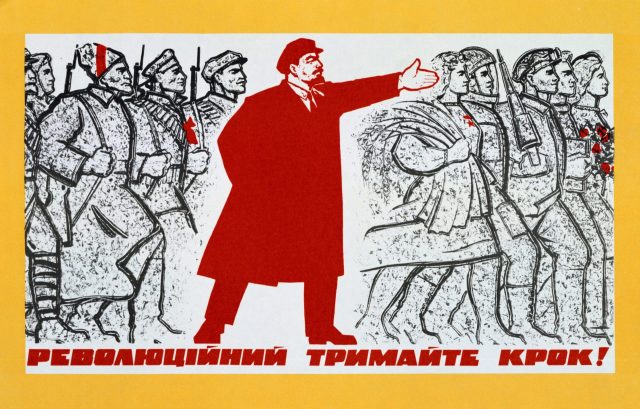
Poster depicting Vladimir Lenin from October 1917. (Universal History Archive/Getty Images)





Please meet the newlyweds, whom the introduction of Anatoly Marienhof’s Cynics sums up as “the idiotically romantic Vladimir and his attractively dangerous love Olga”. Dear Olga can be a trifle promiscuous. To one acquaintance she remarks: “I believe I’d give myself to you, Ilya Petrovich, for, say, fifteen thousand dollars” — as indeed she does, meanwhile inviting her husband to taste his plump and rubicund housemaid Marfusha. To each according to his needs, dear comrade. The $15,000 our wedded pair will donate to the Famine Relief Fund. Talk about diddling while Rome burns. For Olga, I fear, is a member of what Lenin called “the former possessing classes”, so her destiny might be unpleasant. Before wisely deserting the Revolution, her father counseled her “to ‘guard the apartment.’ To do this he recommends my marrying a Bolshevik.” But, well, the authorities intend to turn off her heat, and here’s Vladimir to keep her warm at night. “Devotedly in love?” she inquires. “Exaltedly in love? In that case… fetch the enema bulb. Are you listening to me?”
Sure, she’s “attractively dangerous,” not least to herself. Shouldn’t she have married a Bolshevik after all, or at least reserved her whore-earnings against future cold spells? (“Czechs take Kazan; Archangel shelled by British; cholera in Petersburg”, runs a scene-setting montage.) “Say, Vladimir…” she frets, “you don’t suppose they’ll stop selling French lipstick in Moscow, do you?” With her gold Guerlain pencil now off the vanity table and in her hand, she continues to educate her spouse. “How should I ever get by without it?” Fortunately, she won’t have to. Marienhof being anything but subtle, the reason why she won’t gets foreshadowed on their first post-wedding morning, when the “coverlet severs her head at the shoulders” and “her hair flows like blood” down the pillow, reminding hubby of John the Baptist: “I am as proud and as happy as King Herod.”
Over 130 matrimonial pages later, she rings him up: in five minutes she will shoot herself. Her adorer rushes home, and there she is, awaiting him in bed, jolly and bloody, ha-ha! (For Cynics, you must admit, is a real laugh.) “‘I imagine I shall be dead by this evening,’ she says… The operation is carried out without chloroform… She struggles to open her eyes and says: ‘Don’t be a cretin… I just can’t stand lying here without any lipstick on… I must be a frightful sight.’” Then down to death she goes, obedient to the hordes of Red prophets. “Our terror shall not be individual,” says one, “but it shall be a mass terror, a class terror.’” So they divide the bourgeoisie into three categories: liquidate the first, lock up the second and set the third to “menial labor”.
Olga, in her own way, picks the first. As for the enema-bringer, he may not be as “idiotically romantic’ as we suppose. “I hate my love,” he says, “I would tie a stone weight to its neck and drown it.” Never mind how spoiled she is; both spouses are self-destructive ditherers leeching off capital to which the Revolution is entitled. Sometimes I find them pitiable, but never admirable. Nor is any other character, not even Vladimir’s Bolshevik brother Sergei. So now you know why The Cynics remained unpublished in its native Russian until 1988, when Sovietism was senile and dying.
As for Marienhof himself, though he had fought on the frontline in the First World War, involuntary service for the Tsar hardly impressed the Bolsheviks. About that slaughter Solzhenitsyn remarked: “It isn’t the advancing armies, the fires, and the bombing that make war terrible, it’s terrible mainly because it gives stupidity legitimate power over intelligence.” Cynics takes a comparable view of the Revolution itself: “My brother,” says Vladimir, “had been given as tutors three commanding officers, each one decorated, like most Russian generals, with senility and defeat.” Olga wants to work for the Soviet government, and Sergei wants Olga. Now what exactly can she do for the Revolution? Since she “of course” does not know much of anything, Sergei decides that “in that case, you’ll have to be given a position of responsibility.” The Party was not amused. Cynics first appeared in Berlin in 1928; after 1930, its author would be unpublishable for life.
Worse yet for Marienhof, he was co-founder and core member of the Imaginists, a literary group who instead of accepting that art must follow ideology dared propound that art’s mission is simply to make images. These, in turn, can address each other through literary tropes, as in the best sentences in Cynics:
The stars look as though they have been washed with good-quality perfumed soap and dried with a Turkish towel… The brazen moon sheds streams of cold copper. They have soaked me through… But what does the moon have to do with it?… It’s love that’s to blame…! I spit in its eyes and talk to it like a drunken pimp demanding his nightly receipts from some little trollop.
Doesn’t that make you reach for your enema hose?
Marienhof’s Imaginist colleague and possible lover Sergei Yesenin dedicated works to him. In due course, those dedications necessarily got deleted. For this was, you see, a happy, happy time. Yesenin just happened to be under his own dark cloud. Arrested and rearrested, he kept getting out of trouble, but hanged himself in 1925, with or without the “help” of the OGPU secret police. Doubtless that event failed to brighten Marienhof’s already sunny disposition. But why shouldn’t he give us a chuckle? After giving herself to Sergei, Olga comes home, finds Vladimir sampling Marfusha and says: “Pray don’t go to sleep… once you’ve finished ‘draining the cup of pleasure.’ I’ve brought… new Imaginist poems. We can laugh at them together.”
The communist and fascist movements of the Twenties provoked artistic engagement with mass consciousness. In 1927, following a stimulating but unfulfilling visit to Moscow — his Latvian beloved not being in the mood — Walter Benjamin wrote that the city “reveals a full range of possibilities in schematic form: above all, the possibility that the Revolution will fail or succeed. In either case, something unforeseeable will result… The outlines of this are brutally and distinctly visible among the people and their environment.” In other words, here was a theater for Bolshevism to perform itself in; likewise a laboratory mixing-vessel, school, dungeon and inspiration. The operation will be carried out without chloroform.
In Dziga Vertov’s astounding 1929 film-about-itself Man with a Movie Camera, the masses constitute one animated Leviathan. We follow their frenetic detachments, from dawn to dusk, of a single composite day. Cynics’s very distant cousin, James Joyce’s Ulysses, was a stream-of-consciousness recounting of another single day, in Dublin, in 1904. Comparing that 1922 work to Cynics would be a tedious, slippery endeavor. Let me simply say that this city likewise “reveals a full range of possibilities in schematic form”. Dublin’s parts are concrete, identifiable, while like the characters they stand in for semi-unconscious mythic things.
Andrei Bely’s Petersburg — also 1922 — was set a year later than Ulysses, in allusion to the bloody confrontation between the masses and Tsar Nicholas II. Its doom-ridden, symbol-overgrown weirdness places it in the same genus as Cynics, to which it is much superior. The translators of the edition I own note that Bely is “constantly invoking the gray faceless masses of the metropolis… Ultimately there are no private thoughts or private actions; all are reflexes of larger realities.” Whether Marienhof’s Olga and Vladimir actually generate private thoughts or are merely parodic “reflexes of large realities” is for the reader to decide. (I see them as somewhere between brain surgeons and enema hoses.) In both novels, reality’s playthings sense with dread that “something unforeseeable”, whose onset if not yet its character is “brutally and distinctly visible”, and which will soon overturn the known. “The coffins lined the paths…” writes Bely. “Time sharpens its teeth for everything — it devours body and soul and stone.”
I should also mention Alfred Döblin’s Berlin Alexanderplatz (1929), which employed montage in the fashion of Cynics, causing Walter Benjamin to enthuse that this might show literature a new way forward. Like Petersburg, it is a work of a genius, whereas Cynics is a work of mordant promise. That promise might have been fulfilled had Marienhof been better treated. As it is, the book remains worth reading for its patches of Imaginist lyricism.
Now here’s another montage for you, courtesy of Cynics: the district morgue, capacity 12 corpses, now houses 300. Another: in comes official news on “the results of experiments in baking bread from rotten potatoes.” That bread might go divinely with potage à la paysanne, peasant-style soup made from “liquid Smolensky clay and rich black Penza soil.” A horse dies, probably from hunger; Olga consoles the coachman with a bourgeois diamond. Meanwhile the authorities advise the hungry to seek food elsewhere at the expense of class enemies: “Worker! Peasant! To the kulaks’ granaries for bread!” The kulaks were rich peasants. If they were well off, then they must be criminals; war communism was brilliant at quick, cruel solutions.
When that gave way to the New Economic Policy (NEP), which temporarily reenabled small-scale capitalist enterprises, cruelty grew more capricious, not to mention speckled with corruption. Benjamin observed “members of the opposition removed from important posts… countless Jews removed from middle-level posts… The leftist movements which had proved useful during… war communism are now being completely discarded.” As Olga put it: “That most beautiful of mothers is giving birth to a monster.” After her $15,000 NEP-man lover recounts his triumphant speculation in paraffin, Vladimir ingenuously tattles to his brother, who gets the fellow arrested. Olga smilingly feeds her husband one of the NEP-man’s chocolates. And history goes on making progress, like a scalpel in flesh. Another jaunty montage sums up Marienhof’s theme: “There are reports of cannibalism on a mass scale.”