




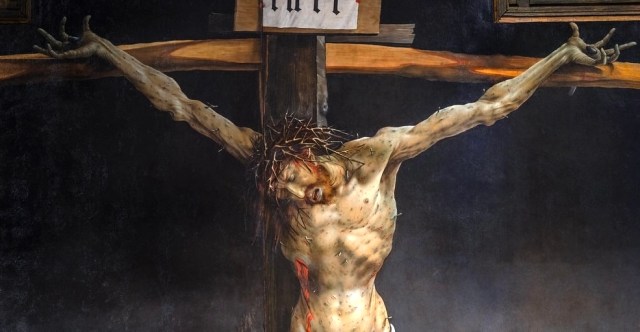
The Isenheim Altarpiece, by Nikolaus Hagenauer and Matthias Grünewald (1516)





As a storyteller I know that more than one type of time exists. There’s Kronos time, which is all about school runs, news reports and political debating. All necessary. But Kairos time is when we break out of all that accounting into something a little more glorious. Kairos time is that once-upon-a-time, once-beneath-a-time, once-before-time-was-stretched-on-the-rack-of-infinite-progress kind of time.
With even more turmoil and war than usual, even more stress radiating from our screens, could this be a moment to curate our imagination a little more carefully? What could that look like?
Too much Kronos and we have all the facts and none of the story. But Easter could be a circuit-breaker from endless doomscrolling. A time to settle into the nourishing strangeness of a story describing something impossible from a Kronos point of view. The death and resurrection of a God. It’s quite possible to get through Easter and completely avoid this gnarly old story. Just munch another chocolate egg and settle down for the afternoon movie. Maybe a day off work.
But we dig in and we find the tale: of a dusty healer from Nazareth tipping over the tables of polite society. He outrages and blesses in seemingly equal measure. His story is profoundly odd: he is born into this world as a fugitive, is butchered as an outlaw and has the audacity to return. His parables seem designed to melt our heads. Whatever game his contemporaries are playing, he’s doing something inflammatory and different. Even the Gospels can’t quite agree on the exact manner of his resurrection, only that it happened. A rock got rolled away.
Of course, Christ isn’t the first mystical character to return from the dead. The Sumerian goddess Inanna had ventured to the Underworld, been killed by her sister Ereshkigal and been resurrected by the god Enki. The Egyptian god Osiris was murdered by his brother Set and reconstructed by his wife Isis. There are tales of Dionysus being ripped to shreds and put back together. It happens. In fact it’s something of a gold standard for myths all over the world. Their capacity to reassemble in such a way is what would qualify them as a god. As a mythologist I’ve spent thirty years exploring these stories at universities all over America and the UK. The sheer variety of stories with this theme is why we are encouraged to see the Jesus story as not at all remarkable. We’ll come back to that.
Here’s a couple of resurrection stories from outside the canon. For many years I’ve told a Siberian folktale called “The Red Bead Woman”. It involves a woman of the margins who agrees to marry the chief of the village. On the way to her wedding she’s murdered by a sorceress who gathers up her victim’s dress and pretends to be her, even succeeds in duping the girl’s husband-to-be. For a long time the body remains in the forest until a little dog turns up at the awful scene. By now it’s bones. Being a tiny little fellow, the hound finds something most wouldn’t. A little bit of her heart under her chest bone. Through snow and rain the dog carries the morsel to the very place she was born and buries it in the soil. As spring comes she is reborn and, after much to-ing and fro-ing, gets to the wedding that was always meant for her. Here we have the great Easter theme: life, death and renewal.
In a Russian story I tell called “The Firebird”, a young hunter jumps into a cauldron of boiling water and for twenty minutes is not seen. The surface bubbles and, in some sense, the hunter has clearly died. But keep looking at the water. Finally a man emerges from the waters, not a boy, and he is so beautiful they say it was as if he was burnished in gold. He has been resurrected from an ordeal so awful his former life is long gone. This and Red Bead Woman cheer us in the inevitable scuffs and betrayals of our own life. For in our lives we know something of the Easter cycle. Nobody is quite the same character they were 20 years ago. Things pass away, others are born. These are what I would call Kairos stories. They abide in the myth-time. But something different happens at Easter. Something even more mysterious.
Easter is where Kairos crashes into Kronos, causing the shockwaves of what we call the Christian experience. The timeless and the timebound actually meet in this strangest of stories.
Jesus arrives on a donkey to Jerusalem for the great harrowing we call the Passion. Not on a mighty stallion or cloaked in rubies and pearls. This odd, underestimated figure takes himself to the temple and steams into the money lenders. This begins the process that will ensure his terrible butchering. Jesus is the dog that God has in the race, and that race is now reaching its terrible and extraordinary accomplishment.
C.S. Lewis was once known to have said that anyone who calls the Gospels a myth clearly hasn’t read many myths. I think he’s referring to this extraordinary collision of time signatures. This most essential theme of myth lands in the dust and pain and wonder of the life of Jesus. Suddenly myth has a postcode. No fairytale reads like the Gospel of Mark. It’s rough, startling and feels an awful lot like reportage. It’s no longer happening “long ago, or in some other time” but right here in Kronos time. We even started counting modern time — A.D. — from this moment.
I think the story of Easter is not a tired retread of the older myth cycles but the formidable accomplishment of everything they hinted at. The martyrdom of the early Christians is not something accomplished by simply “a really entertaining story” but by an event so utterly life-changing that people were prepared to die for its reality. Fables are a beautiful education in the most profound of truths, and, for Christians, Easter is when this most profound of mythic truths reveals its hand in a lived reality. As C.S. Lewis claims, this is the arrival of the “myth made fact”.
Whether we are religious or otherwise, Easter is a moment to ask real questions about our own lives. What in us is ready to die, what’s looking to emerge? It may seem trite, but there are few more important questions. What do I wish to serve? In the mania of individuation it’s an oddly radical step to make decisions of moral strength, to have a lintel overhead that is not dependent on our own fluctuating emotional state.
Easter. We only have to look out the window to see how the pattern of life, death and renewal chimes with the movement of the seasons. As I write to you, here in the wilds of Dartmoor I glimpse the confirming sight of daffodils jutting defiantly out of cold dark soil. The innate poetry of this rhythm is inescapable. There’s a point in mid-January when we’d be forgiven for thinking such a redemptive sight most unlikely. But there it is, the daffodil, year after year. After a long winter it’s a sight we never get sick of. So what can we, as modern people, do with Easter?
I’ll start with Lent. Traditionally, Lent is a time to give something up. In a society addicted to feasting we attempt to become a culture conversant with fasting. It can be surprisingly difficult. For some friends, their Lenten sacrifice is not turning their phones on for an hour after waking, or only checking the news once a day. For others I know, it’s a return to writing longhand for forty days, strengthening their much neglected penmanship. Less keyboard tapping. Preparing for Easter is a time to become keener in spirit, more vigilant to habitual indulgence, and more open to renewal.
Even amongst the grit of Easter, in the end there is much to celebrate. The story is heading somewhere extraordinary. Somewhere wonderful. Easter is a dimension of what the mythologist Mircea Eliade called The Myth of the Eternal Return. Through ritual, music, story, prayer we step out of what he called profane time into the sacred. We all have our version of that.
But I’d like to finish by giving attention to the moments that are rather less glorious. Christianity is a religion that certainly understands, and gives enormous room to, the experience of suffering. Easter shows us that in the most terrible moments the door to mercy can still be open.
In our combustible climate there’s much nationalistic bluster about apocalypse, holy wars and the imminent return of Jesus amongst the missiles, but we seem to neglect the sorrowed places he says he’ll always be. Wandering the bomb shelters, refugee camps, tending the wounded, sitting with the dying and the desperately lonely. We should stop gazing zealously to the skies for redemption and bring our Kairos attention into the Kronos.
That is the Easter reality. That is Jesus’ legacy. To make the mud and smoke of our own lives luminous for a moment.
Maybe every time we do Jesus has, in fact, returned.
Happy Easter.