




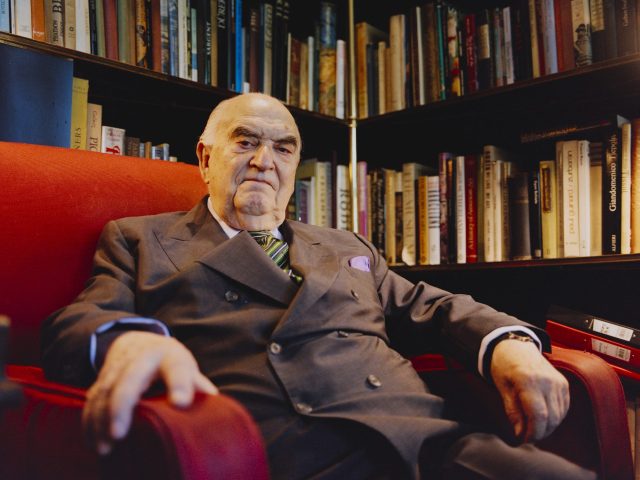
“George was not a groper”, but rather that “his way was vocal”. (Credit: Richard Baker / In Pictures via Getty Images)





Always partial to a slick antithesis, the British pundit class quickly decided that Axel Springer’s proposed purchase of Telegraph Media Group for £575 million cash would put a “very German” media company in control of a “very English” entity. Up to a point, Lord Copper (or should that be Lord Rothermere?). If it goes ahead — and every signal points to rapid regulatory approval — then the Springer surprise attack, which torpedoed the Daily Mail’s own offer for the paper, would certainly place the firmly pro-EU Berlin conglomerate in charge of one of this country’s Euroskeptic temples. Appearances, however, may deceive.
Look further into the motives behind the Springer grab, and a much more nuanced Anglo-German — or rather, Anglo-German-Austrian — story begins to take shape. Far from representing the triumph of “digital-first”, AI-obsessed Prussian technocrats over a citadel of insular exceptionalism, the acquisition could be seen as the final, posthumous, coup by a legendary deal-maker who brought the manners, and outlook, of pre-war Mitteleuropa into the heart of the British establishment. Somewhere, Baron Weidenfeld of Chelsea is chuckling over his apple juice or Earl Grey tea (never, in his 96 years, anything stronger).
Mathias Döpfner, the 6’ 7” colossus who heads the Axel Springer empire (and, with the founder’s widow Friede Springer, commands 95% of its shares), first met George Weidenfeld at the Frankfurt Book Fair in the mid-Nineties. There, the supremely well-connected publisher was launching his name-dropping memoirs, Remembering My Good Friends. Despite a 43-year age difference, the pair forged an “emotional connection” after Döpfner invited Weidenfeld to write for the Hamburger Morgenpost. He declined, but accepted Döpfner’s later offer, once he had moved to be editor-in-chief of the Springer “quality” flagship, Die Welt. Weidenfeld, ingeniously charming as ever, had written that the young German “saved his life” by buttonholing him in Frankfurt in front of a full-blast hotel AC unit. A bout of pneumonia followed, which led Weidenfeld to give up the cigars he enjoyed and so (he winningly claimed) extend his lifespan.
In time, Döpfner became not just Weidenfeld’s good friend, but perhaps his best. “A more intense” bond developed. Weidenfeld told the younger man: “You are the son for me that I never had.” In the sophisticated, worldly but idealistic Jewish survivor of the worst of German-dictated history (Weidenfeld’s two grandmothers perished in Nazi camps), the fledgling media entrepreneur found far more than a mentor with a gold-plated contacts book.
The Vienna-born publisher, who fled Austria for Britain in 1938, embodied a once-menaced but still resilient European culture that Döpfner sought to edify and champion. As Weidenfeld lay dying in 2016, the friends talked on the phone. At Weidenfeld’s memorial service, Döpfner gave one of the eulogies, along with Antonia Fraser — perhaps the publisher’s favorite among his legion of bestsellers — and Isaac Herzog, now the President of Israel. In a slightly queasy moment during his research, Weidenfeld’s biographer Thomas Harding asked Döpfner if the soulmates “expressed their affection physically”. Yes, they hugged, Döpfner replied, but, more importantly, they held hands: “I remember that sometimes we sat for half an hour holding hands.” Weidenfeld, who for decades worked for British reconciliation with the cherished German-speaking culture of his youth that fascism wrecked, had achieved it in the most personal of terms.
Meanwhile, his friend re-injected Weidenfeld’s core values — from European solidarity and the Atlantic alliance to fervent Zionism — into the Springer DNA. Famously, journalists at Bild and Die Welt must sign up the company “Essentials” that enshrine these principles (though, reportedly, the Telegraph crew will not share that obligation). The five company “Essentials” mandate support for freedom and democracy; for the right of Israel to exist; for the US-European alliance; for the free-market economy, and rejection of extremism and discrimination in all their forms. Weidenfeld himself lived and worked by these lights. So Döpfner’s raid means not an alien seizure but the return of his mentor’s genial spirit to the London media and cultural scene.
Some former colleagues or rivals will relish the prospect of Weidenfeld’s ghost pulling strings in the mind of his most devoted, now most influential, follower. Others, not so much. In one camp, Henry Kissinger, whose career Weidenfeld arguably made by publishing the uncommercial thesis of an obscure young émigré scholar, lauded “a kind of conscience for our world — ubiquitous, committed, civilized and, underneath the accommodating exterior, made of steel”. In the other, Max Hastings — who fell out with Weidenfeld after being arm-twisted into self-censoring a book about Bibi Netanyahu’s brother, the Entebbe raider Yoni — thought him “in every way a loathsome human being”. In my experience, many writers and publishers — enchanted by his initial warmth and zeal, then chilled by some fine-print twist that dashed their hopes — could hold both positions at exactly the same time. But no one ever forgot his impact.
The various women that this great seducer — by repute and, to a lesser degree, in reality — encountered varied just as sharply in their verdicts. Harding (whose book The Maverick was, admirably, published censorship-free by Weidenfeld & Nicolson) interviewed some who found his attentions “creepy”: “He was just someone you wanted to run a mile from.” Other conquests, actual or intended, affirmed that “he treated women with respect”, and that “his personality and his intellect and his charm were brilliant”. All agree that, in an age that often licensed handsy men in bespoke suits, “George was not a groper”, but rather that “his way was vocal”. In business, and pleasure, the tongue worked its magic.
Anyone who knew the London publishing world during the decades of his tenure may have difficulty separating the Weidenfeld they actually met from the penumbra of stories and rumors that always surrounded him. As an occasional attender at the launch parties he threw in his Chelsea Embankment river-view apartment, I have no private cache of scuttlebutt. I do recall that what George did, and said, or was supposed to have said, exerted an outsized influence not just on the book business but on the wider networks in culture, politics and business that he spun, curated and, sometimes, chose to break.
After all, in the balance-sheet perspective, the firm of Weidenfeld & Nicolson never counted as a big player in itself. It emerged from a failed magazine, Contact, in 1947, after Weidenfeld — a 27-year-old refugee journalist for the BBC — went into partnership with Nigel, the blue-blooded son of Vita Sackville-West and Harold Nicolson. The imprint’s peerless roster of star authors — from Kissinger to Malala, Keith Richards to Pope John Paul II, Nabokov to Bellow, Albert Speer to Harold Wilson, Edna O’Brien to Angela Merkel — grew and shone thanks to the force of its publisher’s irresistible charm offensives, not because some corporate bulldozer made these diverse luminaries offers they couldn’t refuse. That said, Weidenfeld often paid over the odds for celebrity or top-table recruits (such as Wilson on his resignation as prime minister) who would never earn their keep. What he offered a disciple such as Döpfner was not a business-school lesson in publishing efficiency — far from it — but a masterclass in the high-level integration of commerce, politics and culture.
There was, all the same, method in his apparent madness. From a launch list in 1949 that included both Mussolini’s memoirs and those of Hitler’s exonerated central banker, Hjalmar Schacht, this narrow escapee from the Holocaust revealed a curious enthusiasm — deeply perverse, to some critics — for giving a print outlet to servants of the ideologies that had murdered his relatives. Weidenfeld & Nicolson kept faith with its founder’s stalwart Zionism by publishing books by or about almost every Israeli leader. It also became the house of choice for grizzled ex-Nazis who had dodged the noose.
Schacht, Speer, Kurt Waldheim, Joachim von Ribbentrop, Admiral Dönitz: this victim of Nazism insisted on building platforms, even megaphones, for its supposedly repentant living pillars. You must talk to your enemy, he believed, although later research disclosed the degree of self-justifying evasion and deception in (for instance) Speer’s 1970 apologia, Inside the Third Reich. The whiff of power, present or past, certainly acted as an editorial aphrodisiac for Weidenfeld & Nicolson. If Arthur Weidenfeld, son of a Viennese insurance salesman (the “George” took over when he started broadcasting on BBC radio), sought to play his part in rebuilding a European culture of democracy and commerce, then the broadest stable of opinion-formers and change-makers would hasten the goal. From Kissinger to Merkel, his list opened doors down the corridors of power. For Döpfner, this amused interest in all the sinners and the saints of public life appealed deeply: “George”, he told Harding, “was the opposite of cancel culture”.
Several Weidenfeld tales feature imputations of sharp practice, sometimes shaded by the smoking-room antisemitism he faced when — along with other dynamic refugees from Hitler’s Europe — he started to refresh the fusty decor of London publishing. Notoriously, he edged Nigel Nicolson out of the firm he co-created, although Nicolson’s admiration and affection for his erstwhile partner’s “courage, hard work, intelligence and enterprise” never faltered. So it’s worth stressing that, by most normal measures, Weidenfeld often wasn’t that smart as a businessman. Yes, the firm regularly landed big bestsellers, from Nabokov’s Lolita — although that was a risky bet, given the strong chance of an obscenity charge — to his ex-employee Antonia Fraser’s Mary, Queen of Scots; from James Watson’s DNA-discovery memoir The Double Helix to Keith Richards’s jaw-dropping Life. (Mick Jagger’s aborted memoir, however, proved a dismal chapter of costly accidents.)
Yet Weidenfeld could regularly splash out on exorbitant advances to make friends and influence people. His company almost collapsed on occasions; in the Eighties, after a US spending spree, he grew dangerously dependent on subsidies from Ann Getty (wife of Gordon). In 1991, he sold up to the Orion group. The name endured, but as a smallish cog in a corporate machine. Weidenfeld continued on his path as a world-class, globe-spanning schmoozer, and book-generator, among the great and good almost until his death. A career that had begun with purely personal charisma ended that way too.
Beyond profit, beyond power, the virtuoso bridge-builder seemed to follow a singular vision of a restored freethinking and free-trading European home. The American alliance would tether one side of this dream; an unwavering commitment to Israel the other. Ruth Cheshin, former head of the Jerusalem Foundation that he philanthropically supported, thought that “Israel was the only woman he was loyal to all his life”. (Weidenfeld married four times, divorced three.) But if Mathias Döpfner shares, and inherits, those Weidenfeldian touchstones, he does so in a vastly different world. Europe, in its EU incarnation, struggles for coherence and momentum, while neither the erratic US nor the impervious Israel now functions as reliable bulwarks of the Euro-Atlanticist faith.
Weidenfeld was at heart an old-school bookman. For him, the world in any of its aspects finally made sense in the shape of a handsome printed volume. Döpfner, conversely, has aggressively frog-marched Springer into the vanguard of digital media, and now strenuously waves the banner of “AI or die”. In the political realm, meanwhile, the German — still an occasional partisan columnist — chooses a harder culture-war tone than the emollient and fence-mending clubland and grill-room publisher would ever have adopted. As opinion-monger, Döpfner has a stridency that feels an ocean (or maybe an epoch) away from his model’s diplomatic flexibility. In December, writing for the Springer-owned Politico, Döpfner scolded European hostility to Trump and claimed that Keir Starmer “is pursuing a similar course of cultural and economic submission” to France’s Emmanuel Macron, president of a nation allegedly “in the chokehold of Islamist and anti-Semitic networks”. Döpfner seeks a fundamental reversal of migration policies in Europe — the sort, presumably, promoted by figures such as Boris Johnson and Weidenfeld’s good friend Frau Merkel — that he views as “rooted in cultural self-hatred”.
As a fierce competitor in a harsher climate, Döpfner sometimes seems eager not to build bridges but burn them. In contrast, I can imagine Weidenfeld today scheming to get a tell-all book — if not now, then in a calmer future — out of Iran’s conflicted President Pezeshkian. The Springer chief embraces the Telegraph, which might once have looked like a custom-built vehicle for the Weidenfeld Weltansicht, at a moment when few of the ideals espoused by his beloved mentor feel as robust as they once did.
In 2009, Döpfner made an affectionate film portrait of his friend for the German channel ARD. The aspiring press baron trailed the veteran publisher around and interviewed his friends in the highest places. One shrewd critic ended a review by asking, “Wie viel Weidenfeld steckt noch in Döpfner?” How much Weidenfeld is there still in Döpfner? At the Telegraph, they may very soon find out.
Boyd Tonkin is a journalist, editor, and literary and music critic, and author recently of The 100 Best Novels in Translation.
 BoydTonkin