




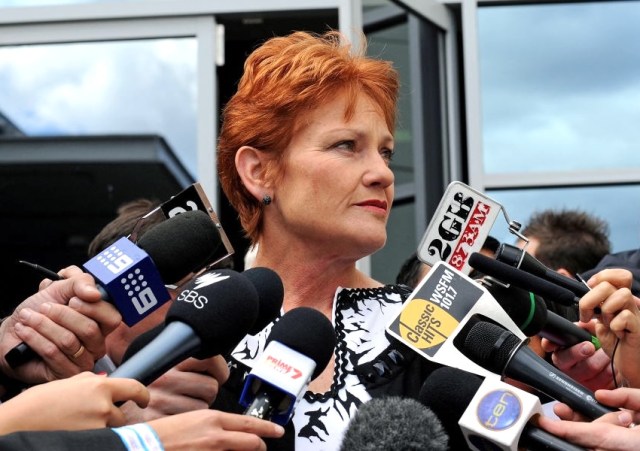
(Greg Wood/ Getty)





This weekend, voters in South Australia (SA) go to the polls in an election that has right-wing pundits in a knot of excitement — despite the winner being a foregone conclusion. Peter Malinauskas, the state’s wildly popular Labor premier, described as “a heat-seeking missile for the political center”, will prevail without a single bead of sweat on his handsome brow. Instead, it’s a heat-seeking missile for the populist Right who is drawing attention: Pauline Hanson, alumna of Dancing With the Stars, star of her own “anti-woke” film, A Super Progressive Movie — and founder of the insurgent One Nation party.
Hanson, a former fish-and-chip shop owner from Queensland, debuted on Australia’s political scene as a dis-endorsed Liberal candidate 30 years ago, around the same time Nigel Farage burst into public view in Britain. In her maiden speech, she warned that Australia was “in danger of being swamped by Asians”. Since then, she’s come and gone as an animating force on the far Right — and the bête noire of the cultural elite — switching targets over the years from Asians to Muslims. Indeed, just last month, she told Sky News that there are no “good” Muslims.
Such views have long kept Hanson on the fringe of Australian politics. At May’s federal election, One Nation won 6% support, concentrated in regional Australia. But within months, its status as a fringe party began to change. By September its standing in the polls hit double digits. In the aftermath of the Islamic State-inspired Bondi Beach Hanukkah massacre in December, which left 15 dead, including a 10-year-old girl, One Nation’s rise is so steep that even cautious pundits are breathless. “I am shocked [by] every poll I see — and I do this for a living,” Australian National University’s political scientist Jill Sheppard told the ABC. “This is not a blip,” added the Sydney Morning Herald’s James Massola, “One Nation’s rise is real.” “Drastic” is how pollster Kos Samaras puts it. One Nation’s surge, he suggests, is “a contagion.” The weekend’s election will be the first to test if the “contagion,” which is as high as 30% in some national polls, translates into actual votes.
The next, and perhaps more telling, litmus test is a federal by-election on 9 May in Farrer, a seat in regional New South Wales vacated by Sussan Ley, deposed last month as leader of the center-right Liberal Party and head of the conservative Liberal-National Coalition. (This fact alone tells you something about the disarray on Australia’s mainstream Right.) Further along, Victorians will go to the ballot box in November. Victoria is home to Australia’s most ardent progressives. Its state capital, Melbourne, is the only one in the country regularly cited by an indigenous name, Naarm; its five-year-olds are encouraged to express a “gender identity” in school. Even here, or maybe especially here, One Nation is going gangbusters.
As with Reform’s trajectory in the UK, One Nation’s surge was initially a response to the implosion of the center right, to which it now poses an existential threat. (Some polls have the Liberal-National Coalition as low as the teens.) But latterly, Hanson has started eating into Labor’s support too. The pollster Samaras, well-versed in the French economist Thomas Piketty’s theory of the “great realignment”, is not surprised. Labor, Samaras has warned, has shed its identity as a party of the working class in favor of the identity-obsessed “Brahmin Left”, with an electoral reckoning only a matter of time. Still, the most jaw-dropping measure of the national mood is the sheer number of Australians who admit to being, shall we say, One Nation-curious. According to a Guardian poll last month, nearly 60% of the country said they’d be open to voting for the party at the next federal election, including nearly half of current Labor voters.
Of course, many of these One Nation-curious voters probably won’t end up taking the plunge; and in any case, raw support for One Nation won’t necessarily deliver them a slew of seats. In South Australia, the minor party surge will likely erode the Liberals’ primary vote to Labor’s advantage. The already enfeebled opposition is confronting the prospect of holding fewer than five of the 47 lower house seats; electoral oblivion beckons.
Still, to concentrate on this risks missing the main point, which is that such things aren’t meant to happen here. Australia’s political sensibility has long been grounded in the center, largely because of structural factors such as preferential and compulsory voting. But national ethos, character — these are also real. We’re accustomed to seeing our distance from Europe and the US as philosophical as well as geographical: radicalism isn’t for us. We like to think we still believe in the “fair go”. We like taking the piss.
A recent Resolve poll offers glimpses of what’s fueling the anti-establishment mood. One person told pollsters, “the major parties are just arguing in parliament about ISIS brides while the world’s burning!” Another was “leaning towards One Nation because at least Pauline loves her country”. The public mood, then, is dark. People are angry at the political class for not focusing enough on a cost of living crisis that was already acute before the fuel shock from the Iran war. And they are angry at the taboo that surrounds immigration, in particular the importing of Islamic extremism.
So Australians are breaking their own taboo against flirting with the feral. Or, more accurately, the definition of feral has undergone a sharp revision since the late Nineties. Let’s return for a moment to Australians’ fondness for taking the piss. Aside from her poll numbers, we also could track the mainstreaming of Pauline Hanson to a seismic shift in the political economy of satire; as in, who takes the piss out of whom. Six weeks after her “swamped by Asians” speech, a TV journalist asked Hanson, “Are you xenophobic?” To which she responded: “Please explain.” The soundbite became late-Nineties shorthand for small-minded racism. “Pauline Pantsdown,” a drag queen, savagely parodied her. Outside the (redneck) Sunshine State of Queensland, people rejected Hanson’s nostalgia for the era of restrictive immigration known as the White Australia Policy, officially only scrapped in the Seventies but already sounding like an echo from ancient history.
Hanson’s first act flamed out by 1998, when she lost her seat. Scandal and infighting plagued her party. She spent 11 weeks in jail for electoral fraud before her conviction was overturned. Then, in 2016, she returned to the Australian Senate just in time for Donald Trump’s first term, now insisting Australia was “in danger of being swamped by Muslims”. While Islam is Australia’s second-largest religion and one of the fastest growing, thanks largely to a steady intake of refugees, the percentage of Muslims in Australia is roughly half that of Britain. All the same, as net migration peaked at 556,000 in 2023 and Australia’s much-vaunted prosperity came under increasing strain, the fragile consensus began to fracture.
The Coalition’s Peter Dutton, who had himself warned in 2018 that people in Melbourne were too scared to go out to restaurants because of “African gangs,” went to last year’s election vowing to boost housing affordability by cutting permanent migration and tightening caps on international students. The polls were hot for him until they weren’t. Like Canada’s failed populist conservative leader, Pierre Poilievre, he was viewed as Trump-adjacent and his rivals weren’t. Steady-as-she-goes is the Australian default. So, Anthony Albanese’s Labor wiped the floor with the Coalition, winning 94 of 150 constituencies. Dutton lost his seat. Still, Labor had secured only a third of the vote — preferences from the Greens, independents and minor parties did the rest. Sound familiar?
Reeling, the Coalition installed the moderate Sussan Ley as its doomed leader. She made ambiguous vanilla pronouncements on everything contentious, including immigration. Within two months of the election, One Nation started its rise.
The Liberals’ traditional base of affluent voters had already embraced the socially-conscious “Teal” independents. Now the Coalition was bleeding support from its Right flank. Defections ensued. Barnaby Joyce, the florid former leader of the National Party of Australia and deputy prime minister, jumped ship to join One Nation, citing disagreement with the party’s stance on renewable energy and immigration. In November, meanwhile, Hanson had turned up to the Senate dressed in a burqa (she did the same thing in 2017). Critics decried it as a divisive stunt. Then came the Bondi attack and suddenly her alarmism about Islamist terrorists didn’t seem all that foolish. Unlike Australia’s Prime Minister. In the days after the attack, Albanese only spoke about the failures in gun control and the extremist threat from neo-Nazis. As former Liberal treasurer Josh Frydenberg said in a lacerating speech from the massacre site, “if you’re unable to say those words — radical Islamist ideology,” then you can’t begin to address it. Albanese was forced into announcing a public inquiry into the Bondi massacre and antisemitism more broadly.
But while “Albo” often struggles to read the public mood, he’s gifted at what he calls “fighting Tories”. And certainly at “wedging” them. His legislative response to Bondi — gun control measures together with tougher hate speech penalties — rankled dissidents in the rural-based Nationals and spelled the beginning of the end for Ley. Last week, the Nationals’ leader David Littleproud humbly resigned. “I’m buggered,” he explained.
Amid all the drama, there came a point when our household started following One Nation’s animated satirical web series titled — you guessed it — Please Explain. It’s funny. It takes the piss out of everyone in Canberra. Somehow, Hanson had amassed enough cultural capital to become the one cracking the jokes at the elites’ expense. Her recently released A Super Progressive Movie, features “King Albo”, his transgender “daughter”, and the relentlessly persecuted hero, Pete, a “cisgender straight white male”. It had achieved its aims even before its release, when iTunes pulled Holly Valance’s theme song and a Melbourne cinema canceled its screening on staff “safety” grounds — before un-canceling it. As for its content, the movie is most interesting for its critique of the Left’s obsession with race. A running gag has the “Naarm” brigade trying to fit in with what they assume are the cultural norms of the redneck outback..
When a party knows how to make people laugh, it knows how to tap the zeitgeist. To downplay the relevance of this is to live in a fantasy universe, and a dangerous one at that. But Hanson’s rise is — forgive the cliché — no laughing matter. She is simultaneously a beneficiary and a driver of political fragmentation and polarization; a warning sign of the ailing health of Australian democracy.
During Hanson’s first act, the Coalition joined Labor to starve One Nation of preferences in an attempt to beat back the overt racialism she had introduced to the political discourse. We don’t know what they’ll do now. In any event, the Nationals’ new leader, Matt Canavan, seems more willing to take Hanson on. He has attacked her no “good” Muslim remark as divisive. Angus Taylor, the new Liberal leader, was more limp. Caught between a rock and a cliff face, he took power backing a reduction in “bad immigration”. “The starting point for me is values,” Taylor recently told a conservative think tank. “Are these people going to come to this country and bring the hatred and violence of another part of the world onto our shores?”
This is all very well — but it’s Albanese who really needs to adopt such a line. More than that, he needs to signal that he won’t be cowed by sections of Labor’s constituency and a broader Left inclined to go soft on political Islam. On this score, he might follow the lead of Labor premiers. Chris Minns from New South Wales, has warned the pro-Hamas brigade “Australia is just not the country for you”; South Australia’s Malinauskas has meanwhile expressed disgust at the platforming of an arguably pro-Hamas writer at the taxpayer-funded Adelaide Writers’ Week (she was later disinvited and the event was canceled).
It falls on Albanese — who else? — to restore trust in the institution of government at a volatile, combustible moment. Because as Hanson’s opponents scramble to calibrate their message, the One Party leader remains as abrasively authentic as ever. A management coach, writing in the Australian Financial Review, remarked on her faltering style of speech and why it works for her. “The tight throat, the shallow breathing, the quaver that appears under pressure,” suggested Louise Mahler, “is congruent with her message…She sounds exactly like someone defending territory.”
It’s time the leaders from Australia’s political center began defending theirs.
