




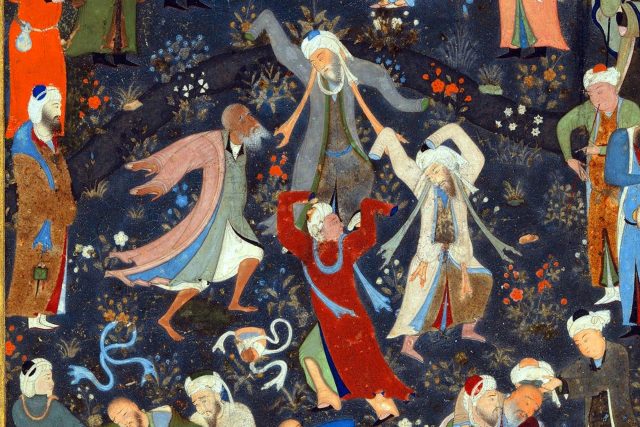
Dance of Sufi dervishes, by Kamal ud-Din Behzad. (Credit: Pictures From History / Universal Images Group via Getty Images)





Lately I’ve been promoting a novel, which means that interviewers sometimes ask me what I’ve been reading. I’m obliged to tell them that for the past year I’ve read virtually nothing outside of a single subject: Islamic philosophy. This has been doubly surprising in that, firstly, I’m not a Muslim, and secondly, only a year and a half ago, I’m not sure I even knew there was such a thing as Islamic philosophy.
My chief guide to the unsuspected riches of Islamic thought — particularly its mystical tradition, the subtle wisdom of the Sufis — is a French philosopher of the 20th century who, despite his formidable scholarly achievements, remains relatively little-known outside of academic circles. Henry Corbin (1903-1978) was, in the words of the literary critic Harold Bloom, a “scholar of genius” and “a wisdom writer of the highest eminence”. Other commentators have described Corbin’s special brilliance as “visionary scholarship” that combines “a refined spiritual sensibility with vast erudition and impeccable scientific honesty”. Having spent a year studying his work, I might add that, with his otherworldly concerns illumined by fierce intellectual acumen, there is nobody else like Corbin. His unique synthesis of Heidegger and Islam is as strange and startling as it sounds. Rarely since discovering the work of Friedrich Nietzsche in my early twenties have I been so entranced by an author and the cosmos he represents.
The country with which Henry Corbin is most closely associated is the one that screams from today’s headlines of war, massacres, oppression: Iran. But, enthralled by its civilizational splendors, Corbin shows us instead a land of the most exquisite spirituality and philosophical refinement. Moreover, the insights he discovered there, particularly those pertaining to what he called “the imaginal world”, suggest a missing, potentially regenerative link in Western thought.
The arc of his life indicates a mirroring of inner and outer worlds. Henry Corbin was born in Paris (let’s get it out of the way: he’s a Frenchman, so it’s pronounced Enree Corban), and his mother died six days later. A sickly child, he spent long periods in the enforced contemplation of convalescence. The young Henry had a keen aptitude for music, which would not be incidental to his later understanding of mystical ecstasy (he was to rhetorically ask, “But is it not frequent in the Bible for the Prophets to demand the assistance of a harp-player in order to open the eyes of their inner vision?”). He was raised as a Catholic, later moving to Protestantism because it allowed him greater freedom to engage with symbolism and sacred imagery. A brilliant student, he studied philosophy at the Sorbonne while also studying numerous languages. During a period of “notorious asceticism”, he taught himself Persian and Sanskrit simultaneously, having already mastered Arabic, Greek, Latin, and various European languages. After finishing his degree in philosophy, he worked as a researcher at the Bibliothèque National, where he was much inspired by the pioneering scholar of Islamic studies, Louis Massignon. It was Massignon who made the decisive introduction that would set the course of Corbin’s destiny, by gifting him a manuscript by the 12th-century, Persian mystical philosopher Suhrawardi.
Known in the Islamic world as the “Shaykh al-‘Ishraq” (the Master of Illumination), Suhrawardi died a martyr’s death in Aleppo in 1191 and addressed his writings “to those who aspire at once to both mystical experience and philosophical knowledge”. Taking inspiration from Plato, pre-Islamic Iranian spirituality, and his Sufi forebears, Suhrawardi’s mystical theology held that reality is made of light, its gradations conjuring up the world of multiplicity we see before us. To Corbin, Suhrawardi would henceforth be “mon Shaykh”. He later told an interviewer that “with my meeting with Suhrawardi my spiritual destiny for the crossing of the world was sealed”. Following his studies, Corbin became a professor at the Sorbonne, commencing a remarkable career as a scholar of religion, philosopher, and eventually “Iranologist” — a pioneer in the field of Iranian Studies which he redefined through his philosophical and spiritual focus, and whose parameters he explores in the essays collected in The Voyage and the Messenger: Iran and Philosophy.
In 1939 he traveled to Istanbul with the intention of staying for six months, during which he would gather for publication all of Suhrawardi’s extant writings. The outbreak of the Second World War kept him in the city for five years — a period of intensive immersion in Suhrawardi’s texts and the mysteries of Islamic gnosis. The work of this period strikes me as one of the great feats of sympathetic scholarship — a quiet heroism of the mind while the world raged and burned outside. Henry’s wife, Stella Corbin, remarked that her husband wanted to create a bridge between East and West such as existed, briefly, in the 12th century of Spain’s “Al-Andalus” and the Islamo-Hellenic thought which flourished contemporaneously in Persia. From Corbin’s immersion in arcane texts in Istanbul, three decades of extraordinary work would flow.
After the war, Corbin moved to Tehran, where he established a university department in Islamic philosophy. On arriving in Iran for the first time in 1945, he described it as “a country the color of heaven”. He was to live there for many years, spending only his summers in Paris. In 1949, he attended the Eranos Conference in the Swiss resort town of Ascona for the first time. He was to become a central fixture at this annual gathering of luminaries with an interest in metaphysical, psychological and spiritual matters. At Eranos he met the likes of Carl Jung, Gershom Scholem, Mircea Eliade, and the American depth psychologist James Hillman, who would write a short book inspired by him (Corbin’s concept of the mundus imaginalis would prove pivotal for Hillman’s rich work on dreams and the psyche).
Corbin’s mastery of Oriental and Islamic thought was matched by his deep erudition in Western philosophy. He described himself as a born Platonist (“just as one can be born an atheist, a materialist, etc. It is a question of the impenetrable mystery of pre-existential choices”), and he called the great Iranian sages he studied the “Platonists of Persia”. These Muslim philosophers had indeed absorbed classical Greek thought, and it’s well-known that they reintroduced Greek philosophy to Western Europe following the Dark Ages. Corbin was passionately engaged with the West’s visionaries and heretics such as William Blake, Emmanuel Swedenborg, the Gnostics and the Neoplatonists. Moreover, his intellectual outlook was decisively shaped by his engagement with the philosophical schools of phenomenology and hermeneutics. In fact, years before his journey to the East, Corbin was responsible for the first French translation of the work of the German philosopher Martin Heidegger, whom he traveled to Germany to meet. In archives in Paris there exist copies of books by Heidegger owned by Corbin — in which his marginal notes are written in Arabic and Persian! Towards the end of his life, when Corbin was interviewed on his philosophical itinerary, it was published under the title “From Heidegger to Suhrawardi”.
Henry Corbin died of lung cancer in Paris just as the Islamic Revolution was catching fire in Iran — a development he observed with great sorrow. Even still, there’s a street named after him in Tehran, and his intellectual influence in the country remains potent (before anyone cries “Orientalism!”, it’s worth noting that prior to Corbin’s arrival in the Shah’s Iran, university philosophy departments taught only Western philosophers). Corbin translated and edited many critical editions of works of Islamic philosophy previously unknown in the West, and wrote numerous extraordinary books (his magnum opus, the four-volume En Islam iranien, remains untranslated into English). His History of Islamic Philosophy is a valuable work of reference with which to familiarize oneself with the names, disputes and concepts that comprise a tradition little-appreciated in the West.
But all of that is mere context: it can give no more than a hint of the intoxicating strangeness of reading Henry Corbin. Admittedly, at the outset the prospect can appear daunting. So much in Corbin’s world will meet Western readers as radically other, unfamiliar, mysterious, even suspect. Some might be put off by the titles alone: Corbin’s major works include The Man of Light in Iranian Sufism; Alone With the Alone: Creative Imagination in the Sufism of Ibn ’Arabī; Avicenna and the Visionary Recital, and Spiritual Body and Celestial Earth: From Mazdean Iran to Shi’ite Iran. A typical list of chapters partly reads:
The Heavenly Twin (Mandeism and Manicheism)
Visions of the Pole in Rūzbehān of Shīrāz
The Senses of the Suprasensory World
The “Heavenly Witness”
Black Light in the “Rose Garden of Mystery”
But to read these books is to roam through marvelous landscapes of the imagination — visionary topographies described in a lexicon of dazzling metaphysical exoticism. A sample of Corbin’s vocabulary might include: hypercosmos; the eighth climate; the barzakh; metahistory; Parousia; the Cosmic North; Sophiology; Cherubic Intelligences; prophetology, the eternal syzygy; precosmic eternal entities; hierocosmology; hierognosis; Zoroastrian angelology; superconsciousness; the Night Ineffable; the mountain of Qāf; the resurrection body; the earth of Hurqalya; the interworld; disoccultation; theomorphism; the supreme pleroma; supracelestial Earth.
While such language might suggest the kind of florid effusions to be found inside dubious books shelved in the “Mind, Body and Spirit” section, Corbin’s works are written to the highest standards of French scholarship. It’s as if Roland Barthes or Jean-Paul Sartre were philosophizing from inside the universe of Frank Herbert’s Dune. More importantly, the Islamic mystical philosophers whom Corbin meditates on — “theosophers” is his preferred term, marking the fact that Islam has never undergone a process of secularization by which theology and philosophy split into separate disciplines — are as rich, subtle and nutritive as they are initially unfamiliar. The cast of characters across Corbin’s books is immense, but three central figures are: Ibn ’Arabī, the mystical sage of 13th century Andalusia whose influence on the Islamic world has been without parallel (he is known as the “Shaykh al-Akhbar”, the greatest master); Suhrawardi, the aforementioned Persian philosopher, who looked back to Iran’s pre-Islamic spirituality — Zoroastrianism and Manicheism — to develop his “Illuminationist School” of Islamic theology; and Mulla Sadra, a 17th century Persian philosopher whose influence has likewise been vast.
So this is niche stuff… but only on the surface. The truth is that, insofar as one is willing to take any of this material seriously (and an entire philosophical orthodoxy resists this, about which I’ll say more later), Corbin’s engagement with such figures allows him to write passionately into the profoundest and most universal of themes: the nature of reality; the origins, purpose, and ultimate destination of human life; the true nature of the self; and the mystery of what will follow “the supreme ecstasy of death”. You don’t need to be a Muslim to find intellectual wonderment and spiritual insight in his books, any more than he needed to be one to write them. (Contrary to what is often assumed, Corbin never converted to Islam.)
The first of Corbin’s books that I read, Alone With the Alone, not only introduced me to a figure, Ibn ’Arabī, who has come to captivate me; it gave me a strikingly novel vocabulary and framework — almost a new mind — with which to understand religious experience… which in turn has revitalized a long-dormant curiosity about the monotheistic tradition I was born into as a Catholic. (In a time of religious war, it’s worth recalling the obvious fact that the Christian, Muslim and Jewish nations all fight in the name of the same, Abrahamic God.) Corbin’s elucidation of Ibn ’Arabī’s metaphysics persuaded me that, while he was intensely rooted in the Islamic faith, this sublime Spanish mystic created the visionary-philosophical framework for something like a universal meta-religion, wherein the ineffable divine mystery reveals itself to diverse peoples in their own unique theophanic forms — the many dazzling faces of an inconceivable radiance. Though only some 140 pages, Corbin’s later book The Man of Light in Iranian Sufism took me an entire summer to read, such is its compression of frequently startling insight. While many have intuited the lineaments of an invisible architecture of being beyond the realm of the senses, Corbin, with his restless trawling through humankind’s gnostic legacies, goes further by mapping it out, charting a means of ascension by which those who are compelled to might embark on an inner, suprasensible journey. Taking Man of Light a few pages at a time, I could feel it realigning my perceptions, altering my experience of being alive.
As a writer, Corbin might be categorized alongside other giants of comparative religion such as Mircea Eliade and the scholar of Jewish mysticism Gershom Sholem. But Corbin stands apart for how, without losing the run of his superlative scholarly faculties, he writes consistently from inside the experience of gnosis — knowledge of spiritual mysteries. Although he is not given to autobiographical divulgence, his work exudes the sense of an urgent philosophical quest fueled by ineffable private experience. In other words, Henry Corbin was himself a mystic, a gnostic, a visionary, even if discretion kept him from discussing such matters publicly.
Stella Corbin emphasized that across her husband’s work, “the real goal is self-transformation”. That is, Corbin did not merely collect picturesque lore from arcane faith traditions in far-flung lands; he sounded out the hidden depths in such traditions for what he called “salvific knowledge” — the elixir of gnosis that he believed enables human beings to discover who they truly are, thereby fulfilling the profoundest purpose of earthly life. For Corbin as for the Sufis, the divine is not a matter of mere belief, but is to be encountered first-hand in transfigurative inner experience. He saw no need to limit his investigations to any one era or faith. Ontologically, his instincts are multiplicative rather than reductive. Occam’s Razor — the principle that every concept should be explained in its simplest form — doesn’t get a look in. Corbin is a great one for complications, comparisons, finding resonances across ages and spiritual lexicons. He seeks the truth not only behind but within multiplicity. Concerned as he is with “events in Heaven” — not history but “metahistory” — he gathers evidence from a plethora of sources to get to the heart of a given spiritual phenomenon. This sees him ceaselessly shuffling through what one critic irritably calls “religion after religion”: schools, doctrines, languages, concepts, prophets, ontologies, cosmologies and mythologies pullulate in a way that can leave the reader dumbstruck. Everything in Corbin’s thought shoots for the baroque. Worlds and dimensions branch off into a dizzying, ever-shifting ontological anti-structure that suggests a limitlessly complex and mysterious “beyond” — a vast angelological meta-universe which the human intellect can only ever hope to penetrate in fleeting transcendental moments.
Nowhere in his books does Corbin lay out any definitive philosophical “system”. Like Ibn ’Arabī, he saw himself as a wayfarer in thought and ideas, never resting in one place for very long nor being content with final classifications. However, certain elements lend his body of work its unity. In one of his many arresting phrases, Corbin writes of “the metaphor of the phenomena”. To him, as to his beloved theosophers, the visible world is replete with signs and symbols pertaining to an invisible world that is more real than the one simultaneously revealed and veiled by the senses, and this higher world is a level closer to the absolute inscrutability of what the Islamic sages call al-Haqq, “the Real”. In the words of one commentator, “to invoke the name of Henry Corbin is thus to invoke the primacy of the invisible.”
For those to whom all talk of mysticism (let alone angelology) induces automatic skepticism, one way to approach reading Henry Corbin might be to regard him as a sui generis literary figure who pioneered a singular form of avant-garde, scholarly-theological fiction. Jorge Luis Borges, who Corbin sometimes reminds me of, might have welcomed such a reading: the great Argentine claimed to appreciate metaphysics and theology as specialist branches of fantastical literature. It helps that, unlike many philosophers, Corbin writes beautifully. To enter his imaginal space is to be transported out of our habitual reality to an alien universe populated by hosts of numinous beings, enigmatic sages, ethereal prophets. Consider Khidr, the “immortal wanderer” of Sufi lore who visits solitary mystics in dreams and visions; or the “Hidden Imam” of Shi’ite apocalyptic theology who went into occultation many centuries ago and will reveal himself again at the end of time. I’ve found that reading Corbin’s work, which abounds with such Borgesian personages, can induce trances of amazed perplexity more akin to the effects of music than of fiction. In this sense, form mirrors content. Ibn ’Arabī has written: “True gnosis is bewilderment.”
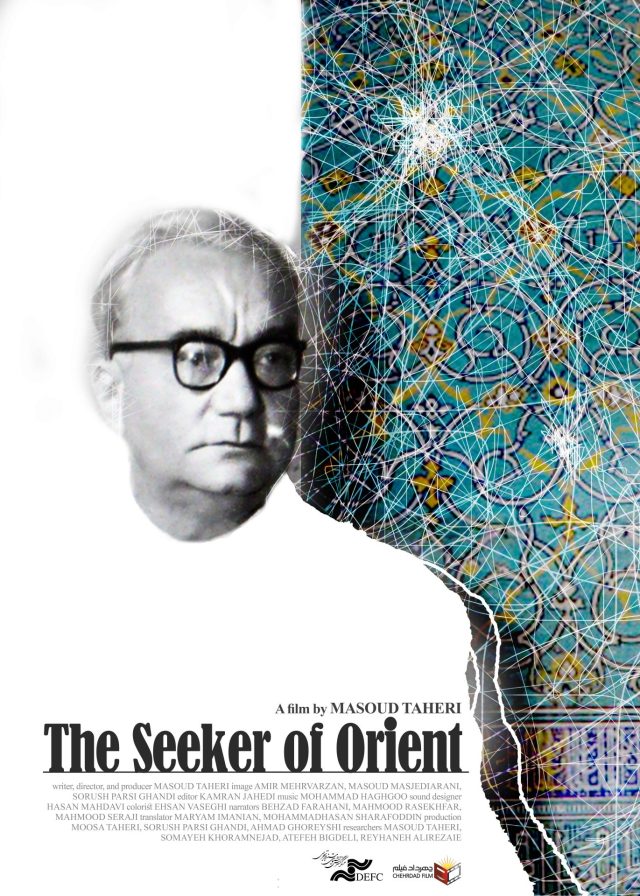
But ultimately, whether one truly connects with Corbin’s work will depend on one’s openness to the possible existence of dimensions beyond the immediate realm of the senses, classes of experience beyond rational comprehension. Corbin’s philosophy is incompatible with the dogmas of scientific materialism that have gripped the Western mind since the Enlightenment and still dominate the 21st century’s skylines even as their foundations have come to seem unstable, inadequate, not modern enough. In an Iranian documentary that examines Corbin’s intellectual legacy, dubiously translated as The Seeker of Orient, one commentator remarks that Corbin was too advanced to be properly appreciated in the 20th century. The implication is that our own century, in which the scientific imagination has begun to harmonize with the religious imagination it formerly displaced — panpsychism, Simulation theory, a renewed interest in mysticism and so on are all in the air — may provide a more receptive context for Corbin’s geographies of the invisible.
His critics have noted that Corbin has little to say about Islam as a religion of laws and beliefs as practiced by millions of Muslims around the world — the fiqh (jurisprudence) and sharia (divine law) of the clerics and mullahs. It’s true that Corbin’s thought is predominantly in service to what I might call his spiritual individualism. In this regard, while his heart is in the 12th century, Corbin’s mind has a modern cast. The inner event of spiritual birth “implies a break with the collective, a reunion with the transcendent ‘dimension’ which puts each individual person on guard against the attractions of the collective, that is to say against every impulse to make what is spiritual a social matter”. To Corbin — and perhaps this only affirms him as an honorary Sufi — the challenge of religion is profoundly personal, both in that he urges a private, immediate experience of the divine, and by way of the diverse ontological schemata he reconstructs for understanding the soul as individuated phenomenon, site of unique theophany. To Corbin, the Nietzschean injunction to become what one is necessitates casting off the mask of worldly persona to unveil “the essential individuality, the ‘celestial’ transcendent ‘I’”. Like Ibn ’Arabī, Corbin fathomed oceans of meaning in a celebrated hadith: “He who knows himself knows his lord.” That is, self-knowledge not only entails knowledge of God, it entails God’s own self-knowledge. In the formula of the German theologian, Meister Eckhart: “The seeing through which I know him is the same seeing through which he knows me.”
Rather than its outward practices, Corbin’s concerns lay chiefly with the esoteric side of religion. This word, like gnosis or mysticism, will make some readers wary. But Corbin reminds us that alarm around the term “esotericism” forgets that, “in accordance with its Greek etymology, it merely expresses a notion current in every traditional culture: inward things, hidden things, suprasensible occurrences”. Elsewhere he writes, “The terms ‘esotericism’ and ‘initiation’ do not imply any exclusive claim to teach by some self-instituted authority. They refer, respectively, to hidden, suprasensory things, to the discretion which the words themselves suggest in regard to those who, not understanding, scorn them, and to the spiritual birth that causes the perception of those hidden things to open.”
Corbin makes frequent appeal to the Arabic word ta’wil: the exegetical practice of following an idea, symbol or sacred text back to its source, penetrating its interior meaning. An adjacent lingual pairing is that of the zahir — the exoteric, outward, sensible, phenomenal — and the batin: the esoteric, inward, suprasensible, noumenal. Corbin’s concern with veiled, interior meanings owed much to his earlier engagement with Heidegger’s hermeneutics. His procedure was not that of an academic vivisectionist, analyzing dead materials into ever more rigid states of unlife, but rather one of intensive, living identification — a marriage of scholarly attentiveness and visionary absorption. He presents Shi’ite sages of bygone centuries as vital, undimmed presences. During his lifetime Corbin faced hostility from within the academy due to his rejection of the dominant academic mode, historicism, in favor of the phenomenological. That is, Corbin insisted on studying a given phenomenon as it is experienced. The ideas within a religion were to be understood as they are experienced by believers in that religion.
The beating heart of Corbin’s work is what he called the mundus imaginalis, or imaginal world. The former is Corbin’s direct translation of the Arabic term found recurrently across centuries of Sufi thought: the Alam al-Mithal (the world of images). So, Corbin did not invent this notion, but unearthed and reanimated it for a Western mind which had long lost sight of it. The mundus imaginalis is an ontologically real zone of “metaphysical images” that exists in between the senses and the intellect, between pure matter and pure spirit. The italicized words in the previous sentence are crucial: to Ibn ’Arabī, Suhrawardi and their successors, the imaginal realm is the barzakh, the interworld by which human consciousness can interface with the divine realm of absolute, inscrutable being.
To Islam’s theosophers, this barzakh of freestanding metaphysical images is objective and consequential, just as the quandaries of nihilism and agnosticism that prevail in the West because of our losing contact with it are alien. Corbin reminds us that in the West our “official philosophy” admits only two sources of knowledge, namely empirical sense data and rational, intellectual understanding. We have amputated the vital faculty of the “active imagination” which is the locus of intuitive knowing and the site of vision, prophecy, dreams, and symbolic understanding. Note that we’re talking here of the imaginal and not the imaginary: to Corbin, the imaginal faculty became degraded in status in the West till it was confused with the imaginary, which denotes mere fantasy and make-believe. Contemplatives and visionaries of all traditions have cultivated this faculty by which may be accessed ‘a suprasensible world which is neither the empirical world of the senses nor the abstract world of the intellect’. In the secular West, it is left to poets and artists to draw nectar from this officially excluded realm.
Corbin discovered the “key” to this imaginal interworld in “the two ages of the spiritual world in Iran”, namely the Islamic and the pre-Islamic, as they were synthesized by Suhrawardi. Building on Suhrawardi’s thought, the Iranian philosopher Mulla Sadra argued that the imaginal faculty, which allows us to perceive the mundus imaginalis, is an organ of perception that exists independently of the physical body — and hence survives biological death. By way of such concepts, the Islamic sages make an unnervingly credible case for the persistence of postmortem consciousness in a hellish or blissful afterlife, each soul realizing a personal eschaton. Frequenting their philosophy could make words resound ominously, words I initially thought were uttered by the Prophet Mohammad, but which I now suspect I heard in a dream: “Death will meet men like a mirror.” Or the stark words in the Qur’an: “On that day, no intimate has he.”
To Corbin, the consequences for the West that ensue from “the loss of the interworld” are tremendous. No longer recognizing an inner organ of perception by which we can access the symbols, images and figures of the invisible world, we fall prey to psychic and civilizational maladies against a horizon of ever more suffocating nihilism. In the “Prelude to the Second Edition” of Spiritual Body and Celestial Earth, Corbin writes:
Our western philosophy has been the theater of what we may call the “battle for the Soul of the World.” […] Is it a matter of a battle that has finally been lost, the world having lost its soul, a defeat whose consequences weigh upon our modern visions of the world without compensation? If there has been a defeat, a defeat is still not a refutation.
In the 2020s it’s hardly controversial to observe that in the West something has gone catastrophically wrong. Corbin insists that our malaise is not to be located in this or that symptom, be it societal, political or cultural, but must be traced into the philosophical foundations of secular modernity itself. An orientalist by vocation and Iranologist by profession, Corbin’s zeal for the thought of the East was driven by a sense of the self-impoverishment of Occidental vision, and the ache of “a nostalgia that nothing has ever succeeded in snuffing out of the human heart”. Although he spent much of his lifetime in the Middle East, Henry Corbin always maintained that the true Orient he sought was not to be found on any map. The orientation his books encourage is a matter of inner adventure, an ever-renewed voyage to realms unknown.
Rob Doyle is an Irish novelist, short-story writer and essayist. His most recent book is Cameo.
 RobDoyle1