




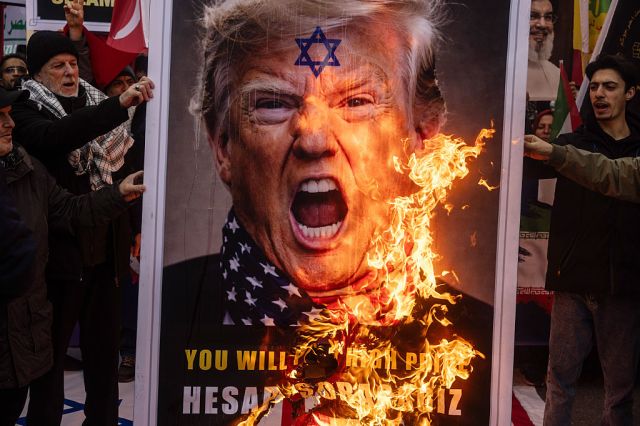
Iranian pro-government protestors burn a portrait of Donald Trump. Credit: Getty





The Left wants to blame President Trump and his supporters for the debacles of this day, or week, or decade — Iran foremost, but we can take our pick. And the Right, which is starting to wonder about its man, still wants to blame the Left for being such dimwits as to make Trump necessary. But instead, we should blame ourselves. Donald Trump is only in a limited sense an individual; in a wider one, he is an expression of the total-hatred politics that has been ascendant in America and across much of the world since the early aughts.
He is us, an equal creation of the Left and the Right, and our leaders will all be Trumps from now on — unless we do something. Gavin Newsom, the democratic frontrunner for 2028 has explicitly styled himself after Trump. And a new crop of politicians from Republican James Fishback in Florida to Democrat Kat Abughazaleh in Chicago have adopted his divisive, confrontation-all-the-time style.
I first noticed the total-hatred phenomenon while living in Moscow in 2004, in the months leading up to the Orange Revolution. At that time, a corrupt outgoing president of the Ukraine, Leonid Kuchma, widely seen as a Kremlin puppet, had anointed his corrupt, Russian-leaning prime minister, Viktor Yanukovych, a representative of the oligarchic crime syndicate from the Donbas, as a successor. Yanukovych was facing a stiff challenge from the Western-leaning Viktor Yushchenko, who was campaigning against corruption and who had been spectacularly disfigured by an attempted assassination with the poison dioxin.
To Americans in Moscow, already high on blue passports and cultural superiority, and to the Western-leaning Ukrainians among us, this was a clear battle of democracy against autocracy, and good against evil, with Yushchenko’s scarred face as a banner to elicit passionate feelings of outrage and righteousness. It was easy to dismiss the more pragmatic Russian opinion: that Yushchenko was merely the representative of a different crime syndicate; and that Russia and Ukraine were neighbors with mixed populations and deeply intertwined trade and military relationships, and they had to get along.
Prior to this point, at least in the United States, politics had been the business of politicians and a niche interest among wonks and lobbyists. To the extent that anyone got angry at their friends over dinner over the issues of the day, it was a foible. We lambasted our presidents — Reagan was an evil representative of wealth and greed, Clinton a liar with bad morals, George W. legendarily stupid. But personally, passionately, hating them, and delegitimizing them through the intensity of our hatred, that was still in its infancy.
Yanukovych — who appeared to deserve it — was the first politician I saw receive this kind of total character annihilation.
He was a criminal and a rapist, Ukrainian friends told me, a person so tarred by savagery that any means were necessary to prevent his ascendency. One young Ukrainian woman, married to an American banker, trembled with rage when she discussed him over drinks. Her anger seemed so justified that it was easy not to notice that it shut down consideration of the issues. Frankly, there didn’t seem to be any issues — always a warning sign.
According to the website of the now-shuttered, reformist English-language daily The Moscow Times, Yanukovych was convicted for robbery as a teenager, served time three years later for severely beating someone, and was accused of large-scale theft, tearing earrings from people’s ears, and an attempted rape, all prior to being appointed Kuchma’s prime minister as a representative of the Donetsk oligarchy. Records of these crimes were missing from the local police stations that handled the crimes.
In the event, Yanukovych won the election, which was swiftly condemned as rigged by then-US Secretary of State Colin Powell. My Ukrainian friends decamped Moscow for Maidan Square and, along with many others, overturned the election through sheer force of rage, and the rest was a beautiful Orange victory for democracy.
Except, from this early, larval form of total-virtue politics, sprung the hideous insect of total-hatred politics that afflicts us today.
Total hatred, on the Left, is the belief that our political opponents are not just people with reasonable disagreements about how to achieve the common good, or different beliefs about what the common good should be — but that they are, personally, bad people, who want something bad, and their leaders are really bad people. To demonstrate your hatred of these bad people, in the most explicit and grotesque terms possible, becomes the highest good. You #Resist, nevermind that you’re resisting the results of a free and fair election in your own country.
Trump Derangement Syndrome, of course, is the flower of total-hatred politics; as is cancel culture, and the split between Twitter and Bluesky, and all the broken families and broken friendships that have come in the wake of polarization. The arts have fallen victim, with satire and rage becoming the dominant mode of production. The Netanyahus, a satirical, fictionalized version of Bibi’s family’s visit to Harold Bloom at Cornell in 1960, by Joshua Cohen, won a Pulitzer Prize for Fiction in 2022. Satirist laureate George Saunders, once a good writer, has turned full-time to Trump-parody dreck. Since when has it been a virtue to make each other appear worse than we are? Performances demeaning the American president — he’s a giant inflatable toddler, wearing a crown! — have become so routine that even The New York Times is bored.
The hatred has never felt quite so personal coming from the Right, but it’s equally destructive, taking the form of pointless norm-breaking, aggression, and rebellion against perceived injustices from the Left. One of the most insightful comments I’ve seen about Trump was that he had a seven-letter platform that starts in F and ends in U. Decisive pluralities of Americans voted for this — and relished doing so. And now we’re seeing the fruits.
F-U to the Gulf of Mexico, to Europe, to Greenland, to Venezuela, to Iran. F-U to the illegal immigrants, and to the blue states that want to shield them, and to the many Americans who will be distressed by seeing long-standing neighbors ripped from their homes and deported.
Neither form of hatred has respect for American institutions or the rule of law. Democrats turned the mainstream media into organs of overt activism, discriminated based on race, passed off a vegetative president, and engaged in frivolous impeachments. Republicans are attacking free speech and academic freedom, and breaking norms on a massive scale.
The emotional manifestation of total hatred is an urge toward murder and death, as we can see on social media, where calls for people to die have become their own form of parody. Trump should die. Netanyahu should die. A departing editor at the Los Angeles Review of Books thinks that the upper management — of a nonprofit book review — should die (for failing to pay staff and contributors). And of course, people are actually killing each other or trying to: Donald Trump, Charlie Kirk, Renee Good, Alex Pretti, three people in an Austin bar on Sunday.
The political manifestation is what we have today: a politics that is increasingly incoherent, illiberal, and anti-democratic, and which makes no effort to fulfill its core function of negotiating a shared settlement. When the Democrats are in power, they illegally throw open the borders. When the Republicans take their place, they pursue the legitimate end of deporting people by cruel means. They kill people. “Fuck Trump” and “Fuck ICE” the other side responds, and surges onto the streets to carry out its agenda by force.
When we discuss this kind of dynamic, the usual culprit is social media. As the writer Freddie DeBoer once said, “the human mind was not meant to be constantly rubbing up against other human minds.”
And surely that’s been an accelerant, but I’d place the moment we gave up on each other many years earlier, during the transition that, paradoxically, occurred with the triumph of Western liberal democracy in the post-Cold War era.
Which brings us back to my first brush with Ukrainian hate politics. The fall of the Soviet Union was perceived as a victory for the West, chalked up to Ronald Reagan’s commitment to the arms race and his promotion of democracy and American values. Reagan’s foreign policy was a pivot for Republicans, who had previously stuck to a Kissinger doctrine of realpolitik — the idea that politicians should seek stability, rather than pursue a foreign policy that promoted ideology. Arguably, realpolitik worked — at least, it was inclusive, in the form of Nixon bringing both China and Russian into political relation — but it was easy to brand as both amoral and soft, and we’ve abandoned it. With Reagan, it became impermissible to demand anything less than Total Victory Over Evil in foreign policy.
The moral high produced by winning the Cold War has been long-lasting. Star Trek: The Next Generation, a deeply influential and treacly good television show about exporting liberal democracy to the entire galaxy aired from 1987 to 1994. The West Wing, a similar idealization of the liberal project, ran from 1999 to 2006. The Wire, from 2002 to 2008, a deeply influential show that formed the moral architecture of most of today’s educated Left, was a grittier version of the same good-versus-evil narrative. These shows ran through the presidencies of George H. W. Bush to Bill Clinton, George W. Bush to Obama, all offering different flavors of the same virtue. A virtue that criticizes America, to be sure, but in the deep grounding of each human soul, a prideful, crusading one, that tells us we’re the good guys.
This has rendered us unable to face reality and grapple with opposition. If Evil Russia has interests in Ukraine, we erase them. If Muslim theocrats wouldn’t actually be nice people to live with, and that contradicts our tolerant self-image, we deny it (Queers for Palestine, folks. Hands off Iran). If people in our own country aren’t totally with the program, we bully them into submission. And it’s that slippery spot where we can’t see our own pride that has shifted the political ground from reason to emotion, and from negotiation to sheer rage.
Democracy is better than autocracy; Viktor Yanukovych stole an election and was a bad guy; Ukraine should be allowed to govern itself — none of these things is wrong. But promoting these goals in a complex world requires a foundation in the older, more rigorous Judeo-Christian values, which caution against pride, and promote self-sacrifice, and don’t ever allow us to view the other as all-bad.
Without this kind of tempering, we get total virtue, and its corollary, total hatred.
The pitiful fact is that unlike most political problems, the power to end total hatred really does rest in the hands the individual haters — in their personal relationships (stop canceling your friends and family), in how they behave online (stop telling people to die), and in how they consider their politics (consider the other side; give more than you’d like to). Given the state of world and domestic affairs, it would be impossible not to be angry; everyone is angry. But the first step toward healing the body politic and ourselves would be to consider that a vice.
