




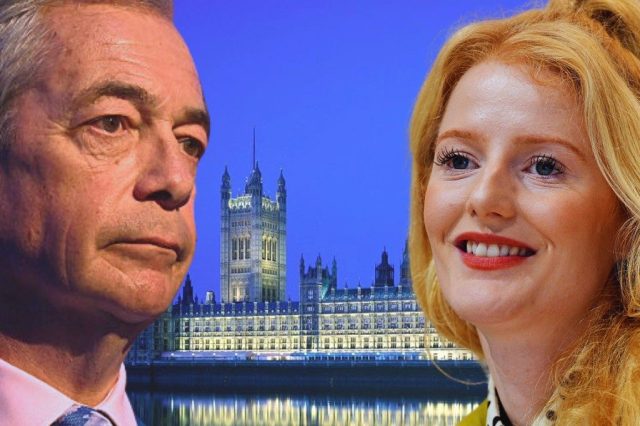
Spencer, right, joins Farage in the House of Commons. (Getty)





Nigel Farage was always different. I first watched his video, “You Just Can’t Barrage The Farage UKIP Wins”, almost a decade ago, months after Britain voted to leave the EU. And it was immediately clear that he wasn’t just an outstanding campaigner — he was also having a bloody good time. Whether he was threatening to blow the bloody doors off Brexit, bamboozling Eurocrats, or facetiously telling Russell Brand how Question Time worked, you got the feeling that Nige could spend his life arguing with a smile on his face.
In the intervening years, with his bombastic style, and even his body language, Farage contributed to a fundamental reordering of British politics. The Clacton MP is sharp and his enthusiasm for a pint conveys an everyman bonhomie. More profoundly, though, he channels something lying deep within the national psyche: merriment. It’s no surprise, then, that his personality has so easily translated into a huge following on TikTok.
And as his star has risen exponentially, so too has his party’s — on current form, it looks likely to form the next government. All the same, what fueled Farage’s rise may not last forever. Reform’s political brand — like UKIP and the Brexit Party before it — used to be all conviviality and connection, but as the party has expanded, that merriment is increasingly being replaced by something else: whinging.
If anything, Matt Goodwin’s campaign to win the Gorton and Denton by-election was characterized by a complaining doomerism, failing to say much — if anything — that was positive about the seat, let alone the country. This constant focus on national decline undoubtedly bears fruit when building a popular Substack or YouTube channel. But if you’re trying to win over voters who can’t name the Home Secretary, you need something more hopeful. And even four days after his defeat, Goodwin was still at it. Nicknamed “Badloss” by some of his critics, he was relentless in his complaints that Britain’s electoral system was just as bad as Lebanon and Sierra Leone. Not that many people noticed, though. Let’s face it, if you lose by more than 4,000 votes, and proceed to say you were cheated of a deserved win, people are bound to switch off.
Indeed Goodwin’s failure, and Reform’s immediate response — imagine Donald Trump’s conspiratorial “Stop the Steal” campaign delivered with the hamminess of a Carry On film — is all the stranger given the Gorton result was objectively strong for both man and party. Pushing Labour into third anywhere in the north west is no mean feat. Goodwin simply lost to a strong candidate, Hannah Spencer, in a difficult race. So as the smoke cleared in a testing by-election, Reform sounded like losers.
Spencer, on the other hand, couldn’t have been more different as she shrugged off the negativity thrown her way by both Labour and Reform. A Bolton-born plumber, she focused throughout on bread-and-butter issues: stopping fly-tipping, cleaning up litter, fixing the housing crisis and sprucing up high streets. During the campaign she even completed a plastering qualification. As she stood to deliver her victory speech, focusing less on ideology than daily hardships, Goodwin will have known that these were subjects that would appeal to his target voters: the Greens were no longer the po-faced identitarian liberals who like to tut at your package holiday. At that moment, Reform must have realised that its pitch as the only credible alternative to the uniparty was lost.
But what happened to Reform’s mojo? Whether you blame the veteran Tory influx, Goodwin’s performance anxiety, the outsourcing of strategy to consultants — it is clear that the party has lost its “aura”. This seemed pretty clear when I was canvassing in Gorton, and was repeatedly and politely told by party canvassers that they weren’t permitted to speak to journalists. Nor was Goodwin particularly keen on individual interviews. Yet this is a mass party and, managed correctly, its membership should be its greatest asset. Suddenly, the party machine feels preachy, with a very New Labour feel. Warm ale is out; a pint of control freakery, please.
This relinquishing of authenticity by Reform has started to be reflected in polling. At the weekend, as the Greens announced they had passed 200,000 members in England and Wales for the first time, FindOutNow placed them in second place; on Monday, Lord Ashcroft’s survey put them at third, just three points behind Reform, with almost 90 seats.
Then, on Tuesday morning, came the big one. YouGov — Britain’s most reputable pollster — put them on 21% of the vote and in second place, just behind Reform: five points ahead of both Labour and the Tories. In all likelihood, Reform and the Greens will have more members than Labour come the local elections in May. And, for those looking to dismiss the Greens as a party of students, bohemians and unemployed artists, think again. YouGov gives them a 6% lead over Reform among all Brits under 65.
Given the avalanche of attacks and negative campaigning against the Greens in recent weeks, from both the Right and the center, how is any of this possible? After all, similar attacks paralysed Jeremy Corbyn’s Labour after 2017, and led to a drubbing two years later. Yet Polanski seems to go from strength to strength, leading to panic among some on the Right, with much of Westminster struggling to understand exactly why the Greens are soaring so high.
Traditionally, many of the party’s would-be supporters figured a vote for the party would be a vote for environmentally friendly policies. When Caroline Lucas was the party’s sole representative at Westminster, the Greens were able to push climate-related issues into the political realm in a remarkable way, from fracking to net zero. It only took one MP.
As the party has increased its MPs to four, the modern Greens have made the political weather on everything from renationalization to Gaza. Today, its MPs function as committed campaigners on strongly held policies at a national level — as well as effective constituency representatives at a local one. This understandably appeals to many of those voters disappointed by the traditional parties.
It helps, too, that Green supporters care about such a range of issues — from electoral reform to rewilding beavers to rent caps to closer ties with Europe. Some simply want to exert pressure on the Labour Party to move further Left. This broad, semi-coherent theory of change sees the party as an expression of social movements as much as an electoral vehicle.
One downside is that the party risks becoming too successful. The uncomfortable truth is that too many first-place finishes mean the Greens will need to offer more than a grab-bag of progressive causes. For now, though, such problems remain in the future. My suspicion is that few Green voters expect Polanski to be the next prime minister. Many may not even want such an outcome, preferring the party to be a junior coalition member in a progressive government. Indeed, when I interviewed Polanski last week, soon after the Gorton and Denton result, he merely expressed an ambition to lead a party of several dozen difficult MPs in Parliament.
This, incidentally, is also why anti-Green scare tactics, from both Labour and the Right, will ultimately fail. It’s easy to make radicalism feel like an existential threat when it risks actually leading a government — as with Corbyn. That isn’t the case with Polanski. Certainly, comparing a by-election win in Manchester with Iran’s Islamic Revolution strikes most Britons as unhinged. In any case, it’s hard to present an organisation as much of a danger when all its MPs can fit in the back of a London cab.
Ironically, this anti-establishment vibe is also what is most winning about Polanski’s Greens. The party and its leader manage to couple radical purpose with fun — which, in a strange way, is reminiscent of Farage at his best. While I had to grab a few hours of sleep after Thursday’s result, Polanski stayed up all night. The following evening, he appeared on The Last Leg, full of verve and enthusiasm. This relentless energy is invaluable in politics.
Tramping around the sodden streets of Levenshulme a few weeks ago, with all those houses proudly displaying Green party placards in their front gardens, it was strikingly obvious that Reform’s success had opened the door to new possibilities for the Left. After all, if we are suddenly predicting that Nigel Farage can go from YouTube to No. 10, something previously viewed as impossible, then what’s so outlandish about the Greens overtaking Labour?
In terms of what is politically possible, Nigel Farage has — again — done more than blow the bloody doors off. Only this time it won’t all be to his own advantage.
Aaron Bastani is the co-founder of Novara Media, and the author of Fully Automated Luxury Communism.
 AaronBastani