




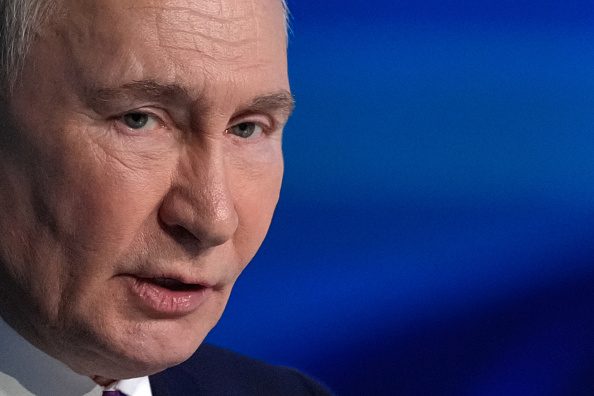
The multipolar world is marginalizing Putin. (Credit: Pavel Bednyakov / Getty Images)





As the Middle East lurches toward wider war, Vladimir Putin finds himself confronted by the terrifying reality of the world he has always demanded. For a quarter of a century, the Russian president has been demanding a “multipolar world order”, one that would overturn the hypocritical liberal consensus. Now, that order might have arrived, but the system taking shape is not creating a stronger Russia. Instead, it reveals an increasingly isolated and weakened state — one that, if the history of Putin’s rule is anything to go by, might see the Kremlin turn toward even further domestic repression and foreign confrontation.
When Putin first became the country’s president, back in 2000, Russian national security doctrine claimed that “multipolarity” meant “equal and equitable relations with all countries” and the “universal observance of human rights and freedoms and the impermissibility of dual standards in this respect”. Over the last 25 years, however, it’s become clear that “multipolarity” in practice doesn’t mean any of those things. Rather, it means the end of American dominance and the restoration of post-Soviet Russia as a great power. In this world, large states will set the rules within their own backyards — ignoring international boundaries and treaties — while weaker ones will have to suffer the consequences.
Putin has become increasingly obsessed with these ideas, pursuing them through his war against Ukraine, and his constant demands that Russia holds special rights over the political future of its neighbors’ “ethnic Russian” populations. Disruptive behavior at the United Nations fits into the same pattern. Amid speculation about peace deals in Ukraine and Donald Trump’s conspicuous performances alongside Putin — including the much-discussed Alaska meeting — commentators have suggested that the White House may be about to grant Moscow its sphere of influence, leaving it free to redraw borders and reorder the post-Soviet space.
Today, in the wake of the strikes on its strategic partner Iran — which has provided significant support for the war against Ukraine — and the violence spilling into Lebanon, Moscow is playing out a role at what it would call the top table of a “multipolar world order.” State media outlets speak with striking confidence. Commentators speculate about a potential American “defeat” in Iran that could trigger the “inexorable collapse” of the United States itself. Reports highlight Iran’s retaliatory strikes against regional targets, suggesting Tehran is undeterred even after the killing of Ayatollah Ali Khamenei. Meanwhile, Western allies and Western publics are purportedly gripped by total panic.
At the diplomatic level, Russian officials present themselves as guardians of stability and law — harking back to the familiar but hollow language of the “multipolar world order”. Russia’s Foreign Ministry has declared that “Russia, as always, stands ready to assist in advancing peaceful solutions grounded in international law, mutual respect and balance of interests” (a familiar line harking back to Putin’s violent war against Chechnya in the 2000s). The language, absurd given Moscow’s propensity for waging war and advocating brutally for its own interests, echoes the early formulations of “equal and equitable relations” and the rejection of “dual standards”. In the Kremlin’s strategic narrative, American power is brittle, Iranian resolve undamaged, and history is bending in Russia’s direction.
In reality, of course, the limits of Russian diplomatic and military capacity have been brutally exposed. There is no serious prospect of Moscow deterring the US or Israel. There is no realistic mechanism by which Russia can guarantee or even influence Iran’s security. Unlike in Syria a decade ago, when Russian airpower altered the balance on the ground, the Kremlin today lacks the capacity required to shape events in the Middle East. Its military resources are heavily committed elsewhere; its diplomatic leverage is negligible; its economic tools are non-existent.
Russia thus talks the talk of great power arbitration — while exercising no control over outcomes. Its media and diplomats read loudly from the Putinist script of sovereignty, balance, legality, even as more powerful actors decide the fate of the region. Donald Trump’s government is flaunting its global strike capacity in Iran and Venezuela. Putin’s old Syrian ally, Bashar al-Assad, is confined to a sordid exile in a Moscow apartment block.
Meanwhile, Russia is bleeding economically, militarily, and demographically from its war against Ukraine. Moscow’s security guarantees for Armenia proved unreliable when tested by Azerbaijan. China, for its part, is increasingly strident in Africa and Central Asia, where once Soviet and post-Soviet Kremlin governments were the undoubted military and economic top dogs. In an international free-for-all — and despite the pageantry of state visits to and from China, the United States, and Central Asian states — Vladimir Putin is ever weaker on the global stage.
Putin has got the world he asked for, but not the one he wanted. As Canada’s Prime Minister Mark Carney recently warned, countries now face “the end of a pleasant fiction and the beginning of a harsh reality, where geopolitics, where the large, main power, geopolitics, is submitted to no limits, no constraints.” But that reality has only revealed how weak Russian power really is. Putin can only watch on as the United States, China, and anybody else who chooses eliminate his erstwhile friends in South America and the Middle East.
The last time Putin was confronted with a moment of such global fragility was in the aftermath of the Arab Spring. As authoritarian regimes collapsed across the Middle East and mass protests filled Russian streets in 2011 and 2012 — this was the era of Boris Nemtsov and Alexei Navalny — the Kremlin briefly feared for its own survival. Gripped by paranoia, Putin openly feared that the revolutionary wave might reach Moscow. The response was swift and decisive. A sweeping security crackdown followed. Freedom in political life was extinguished. The language of nationalism and civilizational struggle hardened. Next came Crimea, war against Ukraine, and a foreign policy defined by aggressive confrontation.
Today, Putin and his coterie of hangers-on might be wondering what would happen if an opposing power or even an internal enemy — unlikely as it seems, even if Yevgeny Prigozhin’s ill-fated march on the Russian capital took place barely three years ago — decided to blitz Moscow and topple the Russian leadership. In the Putin regime’s eyes, weakness demands a response. If the multipolar disorder now taking shape continues to marginalize Moscow, Putin may again turn inwards to tighten repression and outwards to make the world pay attention to Russia through violence. The question is no longer whether the world has entered the harsher era of disorder Putin long desired. It may be how far he is prepared to go to avoid becoming one of its losers.
Dr. Ian Garner is assistant professor of totalitarian studies at the Pilecki Institute in Warsaw. His latest book is Z Generation: Russia’s Fascist Youth (Hurst).
 irgarner