




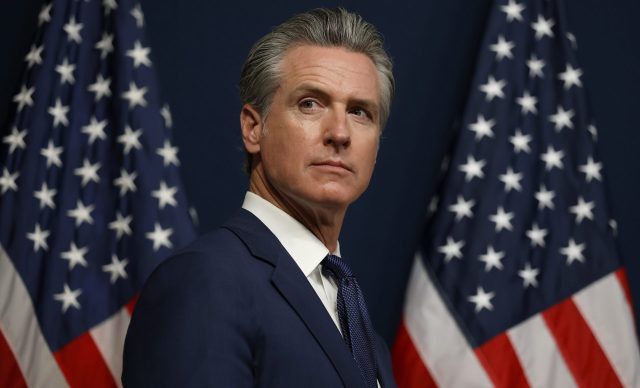
Guy's guy. (Credit: Justin Sullivan / Getty)





By chance I was reading the last few pages of Gavin Newsom’s new memoir, Young Man in a Hurry, when my wife called me in to watch American Olympian Alysa Liu perform her free skate routine. This was something for me to see, even though I’m not really a fan of figure skating, because Liu went to school in Oakland, the California city where my wife grew up and where I’ve lived for the last 21 years. Liu also trains at the Oakland Ice Center, where my children have skated many times, and she’d given several shout-outs to Oakland ahead of this big performance. Already beloved for her eccentric and carefree manner, Liu skated an exuberant, flawless routine that would win her the individual gold medal. As she glided happily from the ice, with the crowd screaming its delight behind her, she lowered her smiling face to a television camera, raised a hand like a rapper emphasizing a rhyme, and said, “That’s what I’m fuckin’ talkin’ about!”
Being stodgy and conservative, I might have grumbled at this breach of Olympic decorum, but instead I laughed, indeed proudly, partly because this was a stunning performance from a young American athlete, but mostly because that was a totally Oakland thing to say. Facing fancier San Francisco across the Bay, Oakland is a tough city with a defiant streak, whose history is filled with Black Panthers, Hell’s Angels, some semi-famous Nineties rappers, and several notorious sports teams. I dislike its Leftist politics and poor governance and occasional lapses into criminal disorder, and yet I love this city. Being stodgy and conservative, I love it because it’s a place. Oakland is its own thing, with its own identity. There’s something masculine and a little retrograde in how it tends and propagates this identity, which might be the real reason I love it as I do. This vaguely macho and implicitly black civic identity draws in people of all types, from white writers who dislike other sorts of identity politics to petite Chinese-American women who are world-famous figure-skaters.
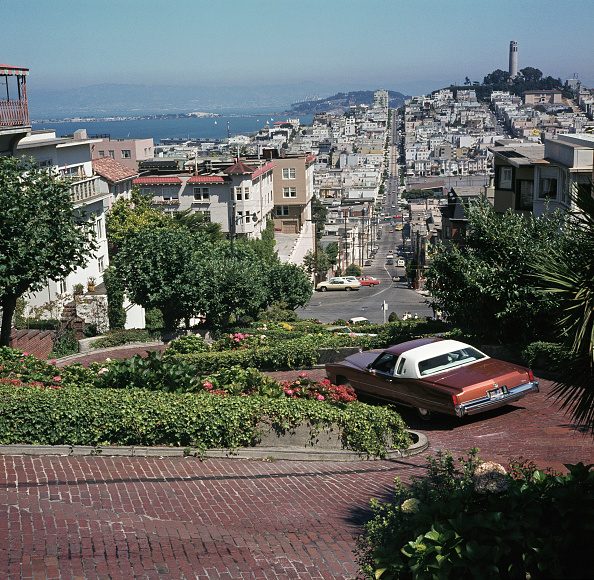
It’s easy to believe that our fancier cousin across the Bay is not such a place, not anymore. The history and civic identity of San Francisco often feel like they’ve been overrun and overwritten by the twin forces of tech money and homelessness. But maybe not entirely overrun, or overwritten. A notable feature of Young Man in a Hurry, Gavin Newsom’s surprisingly good new memoir, is the sense it conveys that San Francisco really is a real place, a great city with a real history, a vital lineage of contending groups and communal traits and great families. Whether one feels that sense when one visits or moves to San Francisco in the present day is an interesting question — I tend not to feel it myself, on my occasional visits across the Bay — but Newsom’s book brings the city and its brief history sufficiently alive to give the skeptical visitor a reason to look a little harder.
Newsom — one-time mayor of San Francisco, and current governor of California, as well as the betting favorite for the 2028 Democratic presidential nomination — spent much of the Seventies and Eighties youth not in San Francisco but in Marin County just north of the city, where his mother moved him and his sister after his father left the family. Still, as a Newsom, he is very much a child of the city. His paternal great-grandfather, an Irish immigrant from County Cork, “was a cop who walked a beat in San Francisco”. His paternal grandfather worked as the Irish arm of an Italian bank, extending loans to Irish immigrants in the city’s Mission District whose homes and businesses had been destroyed in the Great Earthquake of 1906.
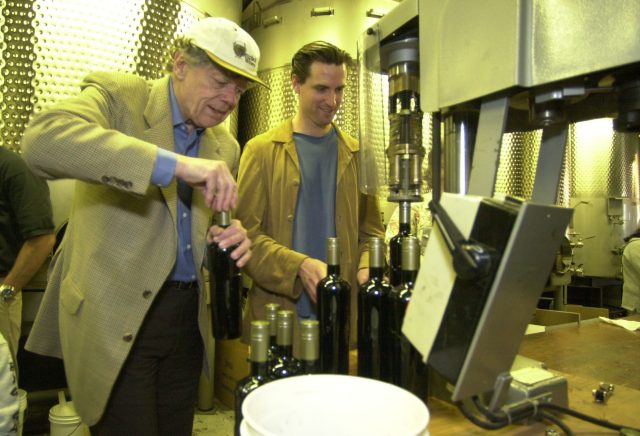
Gavin’s father William, a well-connected fixer, judge, and socialite, was something of a San Francisco institution, but he wasn’t just some wimpy aristocrat, his son would have you know. Yes, he was a cultured lawyer who quoted poetry and read in several languages, but he was also a guy’s guy, part of a loyal gang of bachelors and divorcés who wooed the ladies and drank together at a rotating selection of old-fashioned San Francisco bars. Gavin’s frequent stretches staying with his father in the city brought him in contact with these local characters, who often took a more paternal interest in him than his own distant and damaged father did, and gave him a child’s-eye view of the city’s power structure.
Perhaps the most winning aspect of Young Man in a Hurry is the interest it takes in these and other non-Gavin Newsom characters. Sure, the ambitious politician tells a mostly (but not entirely) flattering story about himself, but in much of the book he exhibits an almost compulsive desire to tell you about all his weird and remarkable friends and relatives, and the fascinating people these friends and relatives were related to and friends with. This tendency to narrate friendships and family relations as a heroic saga of sprawling breadth runs through my own family, so maybe I’m overly vulnerable to its charms. But there’s no denying it makes for an unusually readable campaign tract, not least because Newsom has known and been related to a lot of interesting people, who knew or were related to a lot of other interesting people, most of them San Francisco machers and celebrities and eccentrics.
His father’s roster of friends is colorful enough to fill a memoir with rich stories, but the stories from his mother’s side of the family, though perhaps fewer in number, are even richer and weirder. His maternal great-grandfather was a groundbreaking medical researcher, and also a communist, and, not-coincidentally, a friend of Robert Oppenheimer. His maternal grandmother was also a communist. She moved to Stalin’s Soviet Union in the Thirties and stayed long enough that the Soviets told her she had to either go back to America or become a Soviet Citizen. His maternal grandfather was imprisoned at the Battle of Corregidor and spent several years in a Japanese POW camp, which left his psyche sufficiently mangled that, back stateside, he once got drunk and lined up his three daughters in front of the family fireplace and, holding a shotgun, openly mused about shooting them. This kindly grandpa committed suicide in his fifties. One of those three girls became a well-known Hollywood producer and agent. Another, tall and beautiful Tessa, became William Newsom’s wife, and Gavin Newsom’s mother, and then, fairly quickly, William Newsom’s ex-wife.
Still, the Newsom story is more central to Gavin Newsom’s biography, because it’s more connected to San Francisco politics, and one name looms heavily — Getty. The Getty family is as embedded in San Francisco history as the Newsom family, and so it’s not surprising that the two families grew tangled together. It’s well-known, at least in San Francisco, that William Newsom was a close friend and advisor of Gordon Getty, the brilliant son of oil magnate J. Paul Getty, who for many years ranked as the richest man in the world. (Gordon was briefly ranked as the richest man in the world as well.) From the outside, the Newsom-Getty story looks like one in which a less affluent family enjoys huge advantages from its links with friendly billionaires, but in Young Man in a Hurry Gavin Newsom tells that story from the inside.
Here the younger Newsom makes a clever choice, in both narrative and political terms. Without coming off as resentful or ungrateful, he treats the story of his own relationship with the Gettys as a low-key struggle for respect and independence. As he tells it, his father simply didn’t have a lot of money, despite the Getty connection. His law practice and judgeship were not lucrative, and much of his advisory work for the Getty family was unpaid. So the many gifts the Newsoms received from the Gettys — including a lavish trip to Spain, where Gavin and his sister met the Spanish royal family — expressed a very unbalanced status economy. Early on, Gavin was made to feel this unbalance, the bruising fact that, in their relationship with the Gettys, his father and he were something like the help, denizens of the “downstairs” in the human architecture of the Getty empire. Given the overbearing presence of Gordon Getty in his father’s life, and his father’s own ambivalence in his paternal role, Gavin’s inner struggle against the Getty influence starts to look sort of Oedipal after a while, and this gives the personal-history parts of his book the not-uninteresting feel of a Bildungsroman.
What makes this approach politically clever is that it positions Gavin in the story as a young man, mindful of the insult to his manly status entailed in this Getty-Newsom arrangement. Young Man in a Hurry is thus, one might say, a very gendered book. Like any politician, Newsom wants to sell himself as several different people, to satisfy the many constituencies he’ll have to win over if he wants to become president. His fairly convincing efforts to sell himself as a figure of conventional masculinity thus make it a fun book to read if you keep in mind the many influential figures in his own party for whom “masculine” is the same as “macho”, and “macho” is synonymous with “toxic”. Along with his quiet Oedipal rebellion against the Gettys, he becomes a big fan of Rocky. He stages boxing matches with his friends, where he learns “how to snap a punch without telegraphing it”. He turns into a very good basketball player in high school, and he’s good enough as a baseball player to win an athletic scholarship to Santa Clara University. This scholarship feeds into another story that gilds his manly persona, that of his dyslexia, which seems pretty severe as he describes it.
Thanks to this affliction, he’s able to portray himself as smart but not effete or bookish. His is a practical intelligence. And his efforts to survive school and life as a dyslexic allow him to present himself as an everyman, a “grinder”. Without the baseball scholarship, he says, he was just going to try a two-year community college. He had no other college prospects. Not even Getty money could make the words stop swimming around when he tried to read.
When he graduated from Santa Clara and started his adult life in San Francisco, his first steps were likewise those of a grinder. Unlike the Stanford or Harvard graduates he is often lumped in with by partisan enemies, he was not a candidate for McKinsey or Goldman Sachs coming out of college. His father’s many connections in the city sufficed to get him a job with a gruff baron of commercial real estate, who put him to work overseeing the same bunch of janitors he’d worked with when he was a janitor. But this humble job only reminded him that he was, in fact, ambitious. He wanted something bigger, something that put him in the action.
It is at the stage of his life, the future governor and presidential favorite fresh out of college and badly in need of direction, where my favorite detail from his memoir appears. Newsom briefly falls under the spell of Tony Robbins, the unnaturally tall and tanned self-empowerment guru from the 1990s. Robbins became a laugh-line among the smart set almost as soon as he appeared on the scene, and Newson notes that his own father “scoffed” at Robbins’s “nonsense”, but Newsom, who could have simply skipped over this brief episode of his young manhood, relates it with an impressive lack of shame or regret. He seems to have learned a thing or two from this figure of elite mockery. Besides, it’s one more thing that burnishes the bro-ish side of his persona. It helps us see Gavin Newsom as a regular guy, with regular guy friends and regular guy interests and a regular guy’s disinclination to do girlish things like read books, who succeeded in the regular-guy way of starting a small business and working his ass off to make it grow.
The prominence of this manly storyline in his memoir makes me think Gavin Newsom is as confident as the betting markets are about that Democratic nomination for president, because this stuff is clearly pitched to swing voters, people who think the Republican Party under Donald Trump has gotten too extreme but who also think the Democratic Party of Kamala Harris and Alexandria Ocasio-Cortez and the progressive NGOs might be a little light in the loafers. For the progressive activists who vote in primaries and can’t abide toxic masculinity, and who might not find Gavin Newsom’s years as a high school jock and a manly capitalist super aligned with their social-justice values, he has only his whole political career to offer by way of reassurance.
It’s in the telling of this other story — Gavin Newsom fulfilling his family destiny and becoming a Democratic politician — that Young Man in a Hurry fulfills its own unfortunate destiny as campaign literature. These sections are animated by corny Hollywood scenes in which Gavin Newsom communes with the oppressed and stands up for what’s right against quailing backsliders and temporizers. Early in his term as mayor he goes to a basketball court in the San Francisco projects and gets into a game with the young black men who play here, where he’s told, “You still got it, old man.” Afterwards, he says, “Any time I lost my way, not sure why I was doing what I was doing, I’d head to the court at West Point and Middle Point and find my bearings.” My real-time response to this passage, recorded in the margin alongside it, was: “Ugh”.
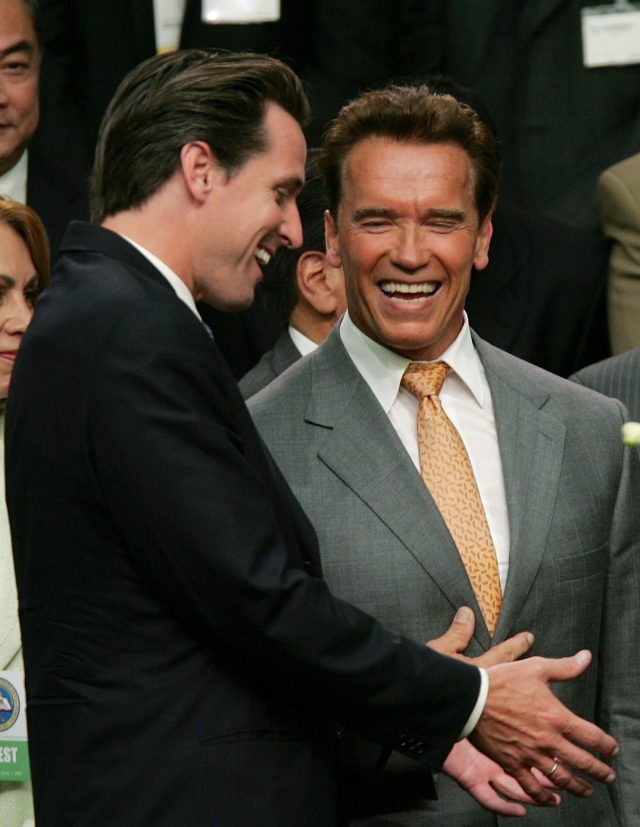
Newsom’s grandest and most famous political gesture as mayor was his 2004 decision to start issuing San Francisco marriage licenses for same-sex couples, even though such marriages were not recognized at either the state or national level. He describes his inspiration for this move with the debased melodrama traditional in campaign literature. Gay marriage was creeping into the national conversation, and President George W. Bush used his State of the Union address, which Newsom attended, to renew Republican opposition to it. Afterwards, an angry Gavin Newsom “needed a breath of fresh air”. He writes, “I kept walking and muttering to myself, ‘These are my people Bush is attacking. My constituents. My staff. My closest advisers’.” Later, when he’s on the cusp of this radical act of issuing marriage licenses to same-sex couples, he’s confronted by an old-time San Francisco Democrat who thinks he’s moving too fast. Then the following scene supposedly happens.
Joe got right in my face. “Why are you doing this, Gavin?”
“I’ll tell you why I’m doing this,” I said defiantly. “Because it’s the right thing to
do.”
“[This] seemed to hit Joe, who’d made a career out of representing the
underdog, right in the gut.”
You can’t blame Newsom for giving this episode a central place in his political story, and for using it as a chance to take a victory lap (though I can still blame him for his kitschy way of relating it). The Supreme Court made gay marriage a constitutional right in 2015, and public national opinion came around to his way of looking at the issue. And so Gavin Newsom’s bold gay-marriage gambit in 2004 looks visionary today.
But this issue also reveals Newsom’s political vision to be pretty narrow. That is, same-sex marriage is now broadly accepted, but it’s also the kind of lifestyle politicking that really matters to affluent California liberals like Gavin Newsom. It’s on other such issues that Newsom is most comfortable holding forth. When you read him touting his “proud work on climate change”, it takes a second for you to realize he’s talking about his time as mayor. What kind of “work on climate change” can the mayor of a city of under a million people possibly do? The symbolic kind. But even symbolic and performative climate policies cost money. It is, again, affluent liberals who both value such gestures and are able to pay the extra taxes and fees they bring.
Newsom has pushed expensive climate policies as governor as well, which give his affluent supporters a good feeling about themselves but have helped make the state unaffordable for working people, and he’s overseen a brutal regulatory environment that hobbles small businesses in the state, which those feel-good climate policies only worsen. This policy record reveals both Newsom’s challenges as a candidate and what he might make of them. He is obviously a distinctive political talent, but he’s also a creature of the political worlds in which he rose — all-Democrat San Francisco, Democrat-dominated California. The policy concerns he’s been able to indulge are largely the concerns of those ideologically incestuous worlds. So his policy portfolio may serve him well in Democratic primaries, but he’ll have to rely on something else if he wins the nomination and finds himself fighting a Republican candidate for president.
Young Man in a Hurry gives a hint of what that something else will be. Here and there in the book, Newsom tries to turn his thoroughly progressive surroundings to his political advantage, painting himself as a brave moderate resisting the powerful chorus of activists and fanatics who dominate politics in his city and state. Among other things, Newsom concedes something that is taboo even to mention among activists NGOs in San Francisco — that many of the homeless in the city are lifestyle tourists who came to the city from elsewhere, to make use of its generous public benefits and lax enforcement of various laws, as well as the non-profit and bureaucratic infrastructure that’s grown to make the lives of homeless people easier. He’s also angered anti-police activists by using state law enforcement to bolster police forces in, among other places, my town of Oakland, where they seem to have made a real difference. Newsom knows he’ll be striding onto the national stage as a California Democrat, with all the associations that come with that type, and he’ll embrace the few associations that might help him, and he’ll play theatrically against the many others that don’t.
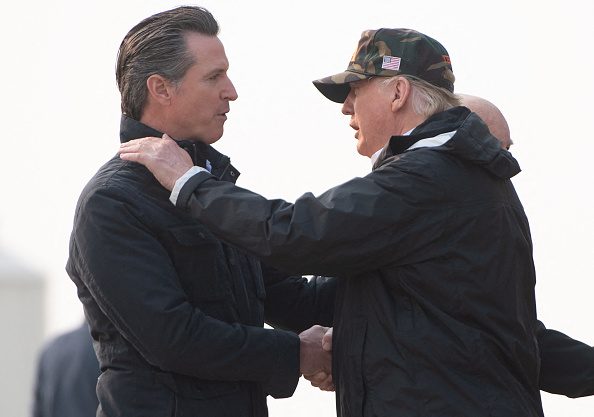
The last full chapter of Young Man in a Hurry contains an astonishing account of Newsom’s relationship with Donald Trump that seems designed to drive home the point that, just because he’s from decadent San Francisco, he’s not some squishy Leftist of indeterminate gender. The central episode in this account is a visit to California that Trump made in 2018 to address the state’s wildfire problem, when Newsom has been elected but not yet inaugurated as governor. Trump and Newsom were trading insults over social media in the days and weeks before the visit, but when the President finally finds himself face to face with Newsom, he no longer acts as a political enemy but as a babbling man-crusher. This Newsom fellow is tall and handsome and commanding, and it’s well known that Trump often strains to impress such men when he’s with them. Newsom thus describes Trump trying for macho talk about the military helicopter they’re riding in, and cruelly belittling Jared Kushner in front of Newsom, as if they might bond over the humiliation of this wimpy son-in-law. Later Trump shows Newsom around Air Force One, pointing out the nifty gadgets and repeatedly asking Newsom when they reached the president’s in-flight lavatory, “You need to go to the restroom?” Newsom coolly declines this exclusive invitation. Then Trump shows Newsom the bedroom he shares with Melania on Airforce One, and winks.
Six weeks later, Newsom describes Trump’s White House as corrupt and incompetent in his inaugural address as California Governor, and Trump calls him on the phone, wounded by the insults. In Newsom’s account Trump says, “Gavin, hey, you know, I had to explain to Melania because she asked me, ‘Did you hear this?’ I thought that was a little tough. I thought you and I had something.” “I know,” Newsom says. “It was a tough line.”
In all these scenes with Trump, Newsom is a cool, slightly detached, effortlessly masculine but humane and judicious figure, and Trump is a desperate try-hard who cares about two things: looking good on TV and looking good to cool masculine dudes like Gavin Newsom. It’s anyone’s guess whether these Trump-Newsom encounters happened as Newsom says they did. They do sound like the Trump I’ve been watching and reading about for the last decade, but they also unfold as a too-perfect chapter in the story Gavin Newsom is trying to write as he pursues the presidency.
Even if they’re not exactly true, they show how Newsom sees his strengths as a Democratic presidential candidate, and by inference how he sees his weakness. His strengths are that he’s got more manly mojo than people associate with the Democrats these days. His big weakness is that he’s a Democrat, and not only a Democrat but a California Democrat, and not only a California Democrat but a San Francisco Democrat. He’s a talented politician, but this might be more than even he can overcome.