




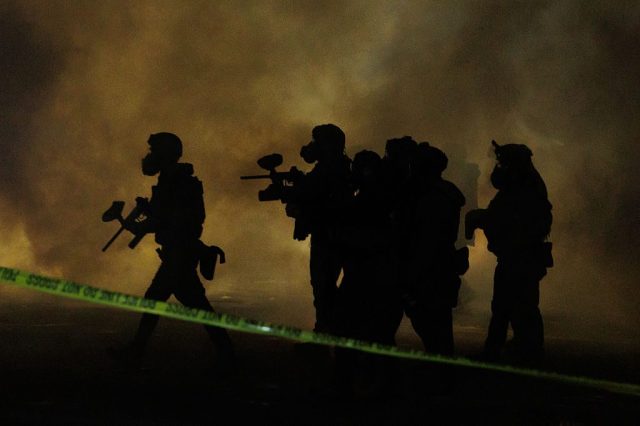
'You can play it safe, and say nothing at all.' (Madison Thorn/Anadolu/Getty)





In his book Nothing Is True and Everything Is Possible, about life in Vladimir Putin’s Russia, journalist Peter Pomerantsev tells the story of Yana Yakovleva, a successful entrepreneur who runs a company that sells industrial cleaning chemicals. She lives with her boyfriend, drives a Lexus and works out with a personal trainer. One day, at the gym, she’s arrested by some government agents in cheap suits. She has no idea why. And then her reality starts to unravel.
Having done nothing illegal, Yana is bewildered, but also confident that it’s a mistake that will be sorted out by the courts. With each passing day that assumption becomes more far-fetched. She’s informed that she’s a dangerous drug dealer, because the chemical she has sold legally for a decade has suddenly been deemed a narcotic, even though it isn’t one. She’s transferred from the police station to prison. Days become weeks. With every failed bail hearing, her sentence is extended. She serves seven months, until she is at last found innocent and released.
Behind her arrest were the machinations of bureaucrats. The head of the Russian security agency tasked with drug control was attempting to shake down the pharmaceutical and chemical industries. A tranche of formerly legal chemicals had been re-listed as narcotics. Veterinarians were being imprisoned for having prescribed ketamine to cats. The point was to terrorize the industries into submission to the gangster state.
Those same bureaucratic designs lurked behind her exoneration, too. The head of the agency that had targeted Yana coveted the job of the director of Russia’s premier spy agency, the FSB. The two administrators despised each other. So when the FSB chief heard Yana’s story, he engineered her very public release and exoneration to embarrass his rival.
This is a signature trait of Russian authoritarianism: laws exist as weapons to be wielded by politicians, bureaucrats and oligarchs in their conspiracies against one another. Ordinary Russians are routinely ensnared in these power games, their lives turned inside out for reasons they could never imagine. One day you’re living a normal life, following the rules, keeping your head down, making a living. The next moment you’re a high-value target of the state.
Earlier this month, after the shooting of Renee Good, American columnist David French suggested that the United States under President Donald Trump is being transformed into a similar regime. He relies on a different analogy — Nazi Germany — but the pattern is the same. Borrowing a concept from a Jewish refugee and lawyer, Ernst Fraenkel, French describes what is emerging in America today as a “dual state”. The dual state is made up of the “normative state”, which is the sovereign system of law and order we’re all taught to believe in, and the “prerogative state”, which is the parallel system of hazy and ephemeral laws and procedures that is entirely subordinate to the arbitrary will of those in power.
One might presume that tyranny depends upon the displacement of the former by the latter, but, in fact, it works best when the two systems operate in tandem. Under a dual state, most of the population carry out their lives within the ordinary framework of the normative state system. They know they can sustain a more or less normal existence if they keep their disagreements with the government largely to themselves — and don’t, like Yana, have a stroke of terribly bad luck. Things aren’t perfect but they don’t feel dystopian either. Should they step over an invisible line, however, they will find themselves in a topsy-turvy world in which the familiar old rules become twisted, amorphous and incomprehensible.
As French pointed out in his piece: “You can see the emerging dual state in action in Minneapolis right now. In much of the city, life is routine. People create new businesses, enter into contracts, file litigation and make deals as if life were completely normal and the rule of law exists, untainted by our deep political divide. But if you interact with ICE, suddenly you risk coming up against the full force of the prerogative state.”
Since French wrote, the intensive care nurse Alex Pretti was killed in Minneapolis, and that faint line between the two states has become much clearer. Pretti, like Good, was acting well within what were, just a few weeks ago, his rights. But, then, suddenly, he found himself face-to-face with the prerogative state.
His death is shocking, but the conditions have been ripe for weeks for such an incident to occur — again. In Minneapolis, ICE routinely pulls over American citizens who dare to follow them in their cars, film their activities, and blow whistles to alert neighbors of their presence. On an episode of the New York Times Daily podcast last week, an activist described having followed an ICE vehicle for about 40 seconds before the agents stopped the car, got out, surrounded her, pepper sprayed her vehicle’s ventilation system, smashed her front windows, pulled her and another activist out, handcuffed and arrested them, only to release them later with no charges. The activists are operating in a world straddling the two sides of the dual state. What are the rules now? Are you safe if you’re not blocking traffic? From what distance can you follow ICE? Is it OK to film from across the street, where you’re clearly not impeding? Is there even a policy to discern at all, or is it whatever the agent in front of you decides it is at a given moment?
If you’re an American citizen and you keep your nose out of ICE’s business, you can keep living a normal life in Minneapolis — albeit deprived of some of your former political freedoms. But not always. You might get questioned at the bus stop. You might have your door kicked in and be pulled out into the cold in your underwear. The van that takes your kids to school might get pulled over. You might choose to keep your kids at home, just in case.
A few weeks ago, it was pretty clear what counted as constitutionally protected activity. Documenting law enforcement actions fell squarely within that category. Now it’s contested terrain that could plausibly lead to your death. Until this month, if you were a US citizen in Minneapolis, it wouldn’t have crossed your mind to carry your passport with you to the grocery store. Today, it’s unclear whether agents are now allowed to stop you randomly and demand your papers. Minneapolis now exists in a purgatory in which neither regular people nor federal agents know what they are and are not allowed to do. But the agents have badges as well as guns. By default, they get to decide what the rules are at any given moment.
The new rules are inscrutable, because they’re dictated not by statutes or facts on the ground, but by the whims of sycophantic office holders competing for Trump’s ever-shifting favor. Like Yana’s imprisonment and release in Putin’s Russia, it’s all a show for others. One of the audiences is you: you and your neighbors need to be adequately intimidated in preparation for the day when the White House turns its attention to your state or city. The other audience is the President, who rewards those who humiliate his enemies in ways he can watch on TV.
So you have to just keep licking your finger and sticking it in the air, to see which way the breezes are blowing. You don’t quite know what you are and are not allowed to do anymore in protest of your government. You can only guess at what you’re still allowed to say. Or you can play it safe, and say nothing at all.
Leighton Woodhouse is a journalist and documentary filmmaker based in Oakland, California.
 lwoodhouse