




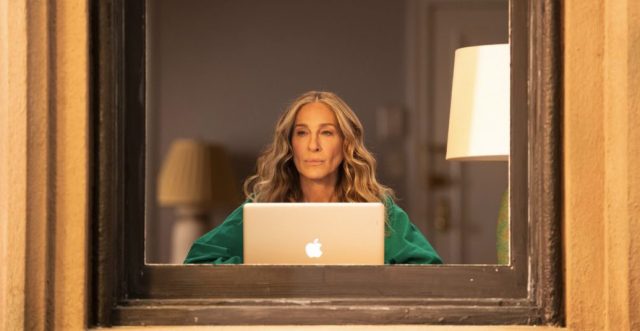
Carrie Bradshaw: party for one. (IMBD)





In the early 2000s, saying “table for one” was a form of heroism for young women. Every time you dared eat out alone, you were sticking it to patriarchal expectation, signaling a life of bold self-direction instead. Carrie Bradshaw sitting in a fancy New York restaurant was their icon-in-chief. Perky voiceover: “I decided that instead of running away from the idea of a life alone, I’d better take that fear to lunch.”
You weren’t one of those dieting puritans; you were a sensualist, and the steak in front of you proved it. You were also deeply self-contained and mysterious and could pretend to yourself you were in a film. Still, there would come a point in every such meal, half a bottle down, when the projected glamor of the occasion would wear off. Your hilarious wine-fueled thoughts would be wasted on an audience of one. The photos you were taking of your own food were no substitute for a second pair of eyes, looking at it — and you — from across the table.
The non-fiction book Two Women Living Together — a sensation in South Korea when first published in 2019, and now out in English — begins with a similar epiphany for one of its authors. Hwang Sunwoo, a 40-something fashion editor living in Seoul, has come to believe that “aloneness resemble[s] order — efficient, comfortable, beautiful”. But then, during a solitary surfing holiday with nobody to laugh or drink with, she is forced to face up to the fact that some experiences are “best enjoyed with other people around”. Meanwhile a new pal, blogger Kim Hana, has been “aware of the demands and efforts of living alone” for some time.
Feeling anxious in her too-quiet apartment, the thrill of exerting total control over where the bathmat is placed on the floor has rather worn off. Visiting her parents’ house and waking up to the relaxing sound of other people cooking, Hana determines to radically change her life. Against societal expectation, the women decide to buy a house together in the up-and-coming Magwon-dong area. Along with two cats apiece, these platonic heterosexual friends — once proud atoms — are now a “molecular family”, and the bonds that develop between them during co-habitation seem touchingly strong.
Indeed, a fascinating aspect of this jointly composed narrative, alternating between authors, is how much it resembles a romcom. First there is a courting period, though Hana is on the lookout for a housemate not a soulmate. Out drinking with Sunwoo for the first time à deux, and finding her “charismatic”, she starts to wonder — anticipatory italics —“What if it’s her?”. Sunwoo, for her part, is fascinated by this new friend: “I’ve discovered a new continent named Kim Hana; another world opens.” Once agreed on their plan of action, there are obstacles to overcome: will their cats get along? And even more important, can they afford it? Eventually they get the funds for an expensive family house, partly by asking their parents to “think of it as if we were getting married” and give them a loan.
There’s more jeopardy on the day of the move. Sunwoo is a disorganized hoarder, while Hana is intentional and orderly. Faced with her friend’s “egregious quantity of belongings”, Hana has a crisis. “[N]ow that her mountain of crap was eating into my space, reality hit me like a brick: I was looking at the topography of Sunwoo’s forty-year-old habits, and I’d have to live with this monstrous wave.” Every neat-freak who has ever lived with a chaos-merchant will be able to relate to her pain.
How the pair get through their subsequent fights and achieve mutually beneficial co-existence is the undramatic story arc of this charmingly lightweight book, but there are barely sketched sociological implications too. The falling marriage and birth-rates in South Korea are well-publicized. In its competitive economy, expectations of domestic labor still fall mainly upon women, both in their own homes and those of their in-laws. At various points in the book, Hana and Sunwoo each express relief that they can enjoy each other’s families without having to make the elaborate displays of filial piety that would be expected of daughters-in-law: cooking for the extended family during festivals, making regular visits, sending grateful gifts. As Sunwoo puts it, convincingly: “[i]n South Korea, going from the princess of the family, a competent worker or a carefree individual to a daughter-in-law is a significant drop in rank.”
Many women are apparently voting with their feet. Hana talks about the “lightness of being single”. Sunwoo says she is glad she isn’t married, though she once assumed she would be. But one result of all this lightness is a national loneliness epidemic: fewer spouses, children, grandchildren. A fifth of South Korean households are now single occupancy. One third of elderly people living alone reports having nobody to talk to.
Fed up with parental expectation and intense educational pressure, young people are apparently opting out too. One estimate says that 5% of them are “hikikomori” — originally a Japanese term — meaning socially withdrawn and economically inactive, “with little to no interaction with others”. In the past decade, various Korean neologisms have emerged to describe a lifestyle without need of friends or family; words like “honjok” (doing things alone), “honbab” (eating alone), and “honsul” (drinking alone).
In this desolate context, Hana and Sunwoo’s joyful sociability is something rebellious, the inverse of Carrie Bradshaw’s solo dining. They both love drinking and enjoy the marrying of their respective liquor cabinets. Hana, in particular, seems to be a genius at bringing people together. Her various neighborhood projects include the “Frivolous Knowledge Club” (members take turns “to share about a particular topic”); a ping pong club (“our thighs and friendships have firmed up”); and a “Catchball weekly” club (motto: “Let’s idle away the hours, friends!”). The idea of taking friendship so seriously will seem mockable to awkward British readers, though many of us would probably be the happier for a friend like her.
Some have criticized the authors for setting a bad example in a demographic crisis, yet they are unrepentant. Indeed, in an afterword about the book’s enthusiastic reception, Sunwoo writes that “Women in their twenties and thirties tell us we’ve given them the courage to live the lives they want”. She also writes appreciatively of ongoing attempts to recognize “kindred spirits” in Korean law, with tax breaks to match. But really what this book underlines is that you can’t reasonably expect women to keep playing the mothering game under harsh economic circumstances requiring dual incomes; and especially not when caring for your in-laws is presumed as much part of female biological destiny as caring for your infants.
Attempting to lessen the one-sided burden, the Korean government is now radically expanding free childcare; though whether that entices women away from contraception remains to be seen. Meanwhile, in response to the loneliness problem, technologists are leaping into the breach. For elderly people devoid of family care, thousands of Hyodol dolls have been distributed — “AI-based companion robots” with cartoonish children’s faces — which are supposed to provide “emotional comfort” while issuing prompts about medication. Trials are also being run on “AI-based eldercare services aimed at reducing the risk of solitary death”: automated check-in calls that analyze the respondent’s voice patterns, looking for signs of abnormality or distress. Some of these services also ask for daily health checks, and offer “audio-based mental stimulation activities such as quizzes and music”.
There are also inventions that target younger generations — and not just in South Korea. In China there has been a lot of fuss recently about a new app on the market called “Are You Dead?”, facilitating a way for singletons to establish that they have not yet been eaten by their pets. In the US, meanwhile, the “Friend” AI has been developed; a companion chatbot, residing in a pendant to be worn round the user’s neck. Yet even assuming such devices help to keep people alive and remembering to take their SSRIs regularly, it is hard to see how they can possibly solve the more basic issue. The cliché goes that you can feel lonely even in a crowd. Presumably all the more so, talking to a creepy doll or being emptily praised by an automated voice.
It would be better to notice from the enthusiastic response to Two Women Living Together that for most people, human companionship still appears to be part of an ideally satisfying life; perhaps even to openly acknowledge this fact in the quest to incentivize fruitful partnerships, in the biblical sense of the word. So much of contemporary discourse focuses only on the perils of domestic partnership: the daily misunderstandings and struggles for control, the resentment about chores, the foreclosing of other possibilities.
As sociologist Zymunt Bauman put it, writing in 1994 about our modern “privatised society”: “there is a point … at which people find it very hard to conceive of any benefit they could derive from joining forces: of any improvement which could come from managing a part of their resources jointly, rather than individually.” Yet it is striking how Hana and Sunwoo, well aware of the alternative, seem determined not to let the claustrophobic irritations of cohabitation sink their carefully constructed ship. Despite the lack of romance or sex gluing them together, they work through the frictions and the fights in order to reap the rewards of mutual care; to experience something that still sounds very much like love.
It-girl Carrie Bradshaw may have fearlessly embraced single lunches; but 26 years later, at the bitter end of her own story arc she was still waking alone in a massive apartment and talking a bit too much to the cat. Over in Mangwon-dong, things are sounding a lot more fun. In the words of Hana: “our little greetings (Did you sleep well? You’re home! I’ll be right back!) add a splash of color to our daily lives”. Sometimes the best way of ascertaining you are not dead yet is the presence of a well-known face across the breakfast table, making you feel alive.
