









January 16 2026 - 7:30pm
“You really thought that after carrying out a short, limited attack, we would accept your request for a ceasefire? Pull back, or none of your bases in the region will remain safe. Our finger is on the trigger.” So warned Mohsen Rezaei, a member of Iran’s Expediency Discernment Council and a senior Islamic Revolutionary Guard Corps (IRGC) figure, in an interview this week with Iranian state television. His remarks were a response to threats by US President Donald Trump, who had said that if the Islamic Republic continued the mass killing of protesters, the American military would confront the regime. Despite this bullish rhetoric, Trump told Reuters on Wednesday that he was unsure whether opposition figure Reza Pahlavi, Iran’s Crown Prince and son of the last shah, would be able to muster enough support to rule over the country if the current leadership were toppled.
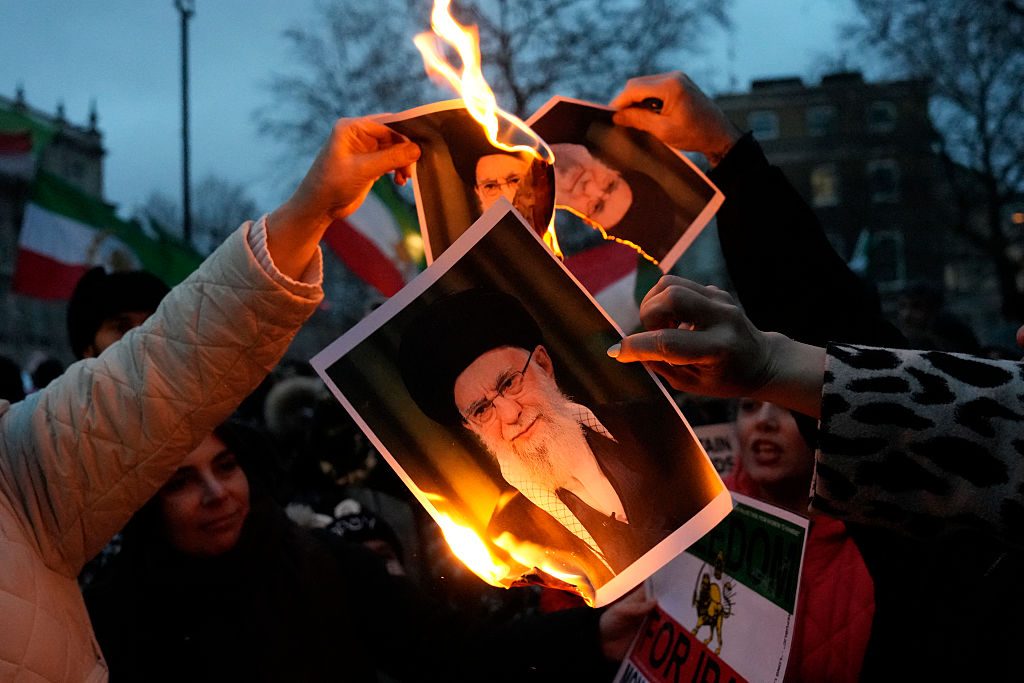
The Islamic Republic’s narrative about the protests which have gripped the country for the past two weeks is by now familiar. They are portrayed as a foreign plot orchestrated by American and Israeli intelligence services. Protesters are routinely labeled “CIA and Mossad agents”, or even “Isis members”, accused of terrorizing civilians to inflate the death toll. The head of Iran’s judiciary recently reinforced this line, declaring that since Trump had openly expressed support for the protesters, “this time no one will be shown leniency. Leniency is for those who have been deceived, but now the enemy’s plan is clear.”
Yet while Tehran uses Trump’s statements to justify an intensified crackdown, the message coming from Washington appears markedly different. On Tuesday, White House Press Secretary Karoline Leavitt told reporters the President had been informed that executions scheduled for earlier in the week had been halted. According to the White House, the regime had paused the killings following American pressure.
With Iran under a near-total internet shutdown and severe restrictions on telephone communications, verifying events on the ground is increasingly difficult. While exact numbers are practically impossible to verify, human rights organizations have said that more than 3,000 people were killed in just one week. But according to one protester who spoke to me from Tehran, demonstrators are attempting to hold the streets despite growing disillusionment with Washington’s mixed signals.
“One day Trump asks us to take over government offices and promises support,” said Babak (not his real name), a journalist who spoke to me via Starlink. “Then we see military movements across the country and start hoping the US might intervene. The next day, he says the regime has promised not to kill more people.” He added. “We can see with our own eyes that people are still being killed in the streets. They have unofficially declared martial law.”
Babak fears that Washington may be contemplating a Venezuela-style solution, replacing the supreme leader while leaving the rest of the system intact. “That will not work in Iran,” he said. “We want the entire regime gone, followed by a referendum so people can decide the country’s future.”
He was referring to a pledge made by Reza Pahlavi, whose father’s rule ended with the 1979 revolution. Pahlavi has said he is willing to lead a transitional period toward democracy and oversee a free referendum, while insisting that he does not necessarily seek a future governing role, depending on the outcome.
Trump, who has met Pahlavi at least once during a gala in Florida in 2023, struck a cautious tone when asked by Reuters about the opposition figure. “He seems very nice, but I do not know how he would play within his own country,” the US President said. “And we really are not up to that point yet. I do not know whether or not his country would accept his leadership, and certainly if they would, that would be fine with me.”
For Babak, the choice must ultimately rest with the Iranians themselves. “It is up to us to choose our future leader”, he said. “It is up to us to evaluate candidates and vote freely based on their record and capabilities.” He concluded that “Trump’s shift in tone is seen as an obstacle. We fear he may strike a deal with Tehran and leave Iranian protesters betrayed.”
Yet in the broader Iran story, one name is conspicuously absent: Benjamin Netanyahu. After the Iran-Israel confrontation last summer, Netanyahu publicly encouraged Iranians to rise up against the regime, promising that Israel stood with them. Today, however, he has fallen noticeably silent.