




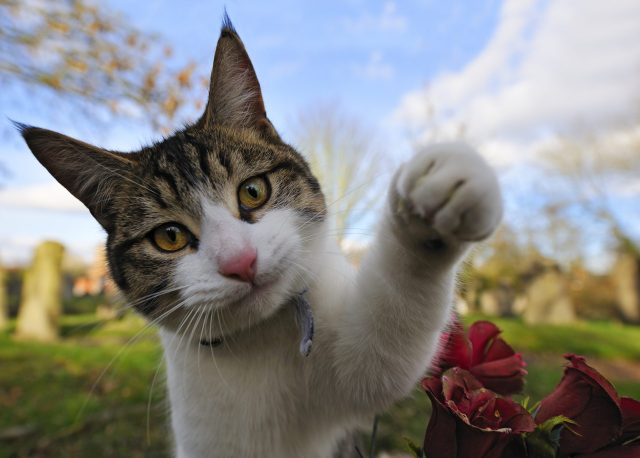
I still miss my cat. (Getty)





In November 1974, a philosopher called Rush Rhees took his Rottweiler, Danny, to the vet to have its teeth scraped. Ignoring misgivings, he allowed the dog to be doubly sedated, and Danny died. Over the following two years, Rhees poured his feelings of horror and incomprehension into a diary. One typical entry reads: “I have covered half my life with earth when I left him. The half that moves now — has no point but to pray and to call to him — Danny”.
Unable to work, the 69-year-old Rhees — a literary and personal executor of Wittgenstein’s estate — relates that he is tormented with guilt, and can make no sense of what has happened. The event becomes an all-consuming obsession: “I am where I am, staying where he is, and I cannot move from there.”
The philosopher goes to Crufts and stares longingly at the Rottweiler competition. He writes letters to friends, fondly recalling how “Danny used to pull me over and drag me at full length for three yards along the ground”. Eventually, he gets another of the same breed, called Tim, hoping this will distract him. Even so, he is unable to leave the dead one behind, and can’t stop calling out for him. “Sometimes when I call Danny, Tim thinks I’m calling him … And yet if I do not keep calling him my life will be a shell.”
These days, Rhees would doubtless be diagnosed with some kind of mental disorder: the question is, which? According to a recent report, something called “PGD” is a good candidate. Arriving in official diagnostic manuals a couple of years ago, Prolonged Grief Disorder is described as a “persistent grief response”, characterized by “intense yearning/longing” on a near-daily basis, and/or “preoccupation with thoughts or memories of the deceased person”. To count as dysfunctional, it has to last for more than a year, in a way that is “clinically significant” — in other words, causing impairment in day-to-day life.
Rhees’s mourning of Danny certainly seems to qualify, but the canonical account says that PGD can only be had in response to human deaths, not pets. This new study, however, protests that this should be extended to animals too, finding that “over one-in-five people who had lost a beloved pet and a person they were close to stated that the loss of their pet was most distressing”. It is indefensible, the study author concludes, to allow that a person might “satisfy all symptom and impairment requirements for PGD, yet be ineligible for diagnosis solely because the deceased was not a member of the homo sapiens sapiens species”.
There is no question that grief for pets can be intense or prolonged. With family dogs and cats, surely it is usually so. Thinking of myself as a dog person, I was blindsided by pain when our cat suddenly died a few years ago. I awkwardly embroidered her name onto a blanket and we wrapped her in it for cremation. I then spent weeks afterwards reading poems and memoirs about cats, trying to conjure her up. As I write this now, there is a void beside my laptop screen where there used to be a feline, aggressively headbutting the edge of it.
Still, the question is not whether strong grief for pets is ever experienced, but whether it should be. Is it somehow dysfunctional or even morally unacceptable to mourn the loss of animals intensely — perhaps more so than for departing humans? Many would agree, including some bereft pet-lovers, who report embarrassment about their own strength of feeling. And this new study about pet grief answers “sometimes” to the question about the depth of bereavement. It does so not because it presents Rhees-style devastation towards animals, in particular, as being illegitimate. Rather it conceives of any prolonged and life-interrupting grief as mental illness, irrespective of whether its object has two legs or four.
But this general pathologization of lingering grief, treated as something to be medicated or therapized away, looks like another step towards disastrous dehumanization. As so often, features of ordinary life are being made to seem alien and threatening — problems to be managed by supposedly cleverer experts, whom you have to pay. One imagines a therapist talking to Auden: “You seem to be saying that you feel like packing up the moon and dismantling the sun; pouring away the ocean and sweeping up the wood. Have you considered that you might just have PGD?”
In early scene-setting parts of the new study, there are further jargon-filled redescriptions of universal life experiences, treated as if they might well turn out to be apocryphal unless academic psychologists are able to confirm them as real. Though, we are told, “the causal processes” that underlie PGD generally — a.k.a. persistent grief — “are not yet fully understood”, “the end of a close attachment relationship is central to the process”. Moreover, “[t]he empirical evidence shows that the closer the attachment to the deceased person, the higher the risk of developing PGD”. Truly, this is fascinating stuff.
We are also informed that “the risk of developing PGD is highest following the death of a child and the death of a spouse”. The most obvious thing to yell at the screen here is “OF COURSE IT IS, YOU IDIOTS”. In that desperate scenario, you have just lost someone you loved beyond measure, without whom future life is inconceivable and will never be the same again. Why wouldn’t you be in mental hell for far longer than 365 days in a row? From the most important perspective — that of the person who is suffering the grievous loss — there is nothing dysfunctional about this whatsoever. Lying in bed weeping or staring at the wall may be exactly what the situation requires. It may in fact be a proper recognition of the event’s momentous import.
What this shows is that, despite what some psychologists think, whether or not grief counts as maladaptive cannot be assessed only by reference to its duration. Reference must also be made to the propriety of its object. Wildly lamenting the death of Princess Diana was not remotely dysfunctional for William and Harry, but it was for random strangers. And that brings us back to the earlier question: is there something wrong with feeling deep sorrow of this agonizing kind, not for the loss of your spouse or child but for that of your Rottweiler or Siamese?
Since the intensity of grief is a function of the intensity of love in the background, the answer here depends on a prior question: is it acceptable to love your dog or cat as much as a close family member? A quick answer is that it surely depends on what the pet is like — or indeed the family member. Generally, there is nothing necessarily maladaptive about it, though it is obviously unwise to love a pet in exactly the same way. A pet is not a good emotional substitute for a spouse or a child, despite what millennials and lesbians are said to believe. Thinking of a dog as a reasonable swap for a human relationship is like thinking of a pot-plant as a reasonable swap for a garden: better than nothing at all, but still nowhere near good enough for those who want the garden. A dog isn’t even a reasonable swap for a cat.
Your pet does not need you to celebrate its birthday, buy it cute outfits, or provide it with a memory foam mattress. But that doesn’t mean you can’t love it with the special sort of affection and care entirely appropriate to the sort of being it is. In fact, you may adore an animal precisely because it isn’t human, a welcome respite from all that byzantine interpersonal nonsense. For unlike most of your peers, it will accept love so easily. As Mary Gaitskill points out in Lost Cat — one of the books in which I immersed myself after our cat died — “people often choose pain … An animal will never choose pain; an animal can receive love far more easily than even a very young human.”
And, if you are lucky, your pet will also return it. Here, too, unwavering animals are gratifyingly different from annoyingly mercurial humans. Part of what tormented Rhees was the thought that he had let Danny down in allowing a second anesthetic: “If I imagine it the other way round — no, I am not being sentimental here — Danny would never have allowed anyone to do to me what I allowed them to do to him. I speak from what I’ve seen him do.”
Some reviewers have treated Rhees’ diary as an embarrassment, interesting only for the philosophical light it obliquely casts on grief generally, whether toward man or beast. But I disagree. After Danny’s death, what the philosopher missed so badly was a particular animal not a substitute human; a beloved being that, in life, had behaved very differently from any human he knew. And as his grief-stricken meditations demonstrate, this sort of attachment can be as intense as love ever gets — in which case death cannot dim it.
It is disarmingly moving to read tales of dogs loyally grieving their masters; so why not tales of masters loyally grieving for their dogs? There is no technical problem for experts to solve here, but there are definitely some lessons about how to be more human. And it seems to me the small ghost purring and nudging my laptop would agree.
