




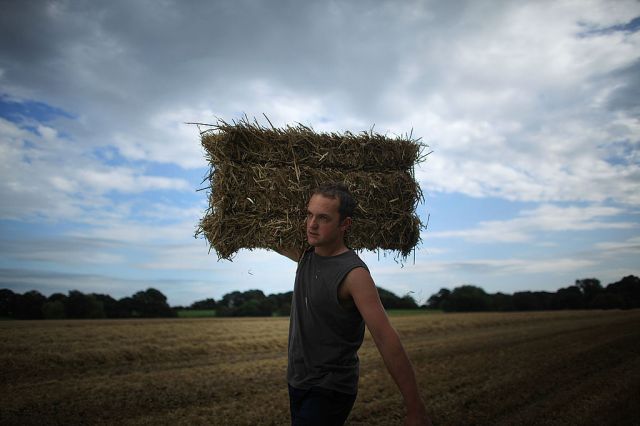
’A farm-free future is closer than you might think.’ (Christopher Furlong/Getty)





Britain’s food system is a remarkable exercise in trusting strangers. We hope that the people who produce, transport and sell our food ensure that it is clean, nutritious and safe. But increasingly, we can’t be sure that’s true.
As a farmer, I work hard to look after my land and my animals in a way that you, the consumer, would approve of. But in recent years, farmers have come to be seen as an unnecessary and archaic part of this food system, rather than its foundation. Whole foods make up only about half of the average Brit’s diet today; the other half is made up of ultra-processed food (UPFs) — these don’t come from farms, they come from factories, and even labs. A farm-free future is closer than you might think.
This shift from whole foods to UPFs is now being blamed for making our society sick. The evidence is mounting that some of the biggest players in the food system do not, in fact, have our best interests at heart, and that the “food” they produce may not be trustworthy. We’re being told that predatory companies producing harmful and addictive hyper-processed products have hijacked our food system and created an obesity crisis.
According to NHS doctor Chris van Tulleken, it all started to go wrong in the Seventies. That’s when the graphs begin to show diet-related health problems in the developed world swing wildly upwards. The problem: UPFs. Food manufacturers, van Tulleken explains, had invested billions of pounds in research to find ways to hack the human brain, encouraging us to gorge on their fatty, salty, sugary products without ever feeling full. They even used brain scanners to see which foods took us to a “bliss point” — and then left us craving more.
The result: a shocking rise in obesity and a direct effect on mortality. In the Sixties, obesity rates in America hovered at around 13%. Now, the figure is above 40%, with 10% severely obese. In England, meanwhile, 28% of adults are living with obesity. The number one cause of death in the developed world today, according to van Tulleken, is poor diet — specifically the overconsumption of UPFs. In the UK, 14% of early deaths could be linked to this.
Why would big business feed us stuff that makes us sick? The answer: profit. There is more money to be made from selling processed junk than real food, just as there was once more money to be made from selling cigarettes than admitting they caused cancer. The shocker in van Tulleken’s program is that cigarette money and taste and flavoring expertise moved across to foods as the tobacco market began to decline.
Massive corporations have made it their business to replace real foods in our diet with ersatz products they had created using cheaper ingredients. And in this new food dystopia, farmers and their produce are fairly marginal. The supermarkets and manufacturers want you to buy their crap from a packet way more than they want you to buy a carrot from a field. In fact, fresh vegetables have become almost a nuisance to be heavily discounted — often at the farmer’s cost, not the supermarket’s — to get people into the store. Just think of all those dirt-cheap potatoes and parsnips on sale over Christmas. The National Farmers’ Union (NFU) has warned that such discounts send the “wrong message”, devaluing fresh produce and making it even harder for farmers to earn a fair return.
Why do we put up with this warped food system? Because we’ve been misled for decades by incredible levels of food propaganda. Big Food has actively encouraged us through advertising to ditch the model of traditional home-cooked family meals, with healthy fasts between them. What they want instead is for us to graze all day long on their snacks, which never actually fill us. Breakfast shakes. Cookies. Cheese straws. Diet drinks. That is a terrible basis for a human diet.
We should all be very suspicious about narratives that downplay the importance of farmers in feeding us. Not only are such narratives encouraged by Big Food, but they are now a commonplace assertion in Whitehall. When Minette Batters was head of the NFU, she was regularly told by civil servants that farming was a trivial matter, a tiny share of the economy; the government had tacitly accepted that Britain was no longer being mostly fed by farmers, but by their corporate friends. As farmers have been squeezed to breaking point, Britain’s “food system” has become a giant concentrator of wealth and power.
It’s clear that our government is in bed with Big Food. There is a single farmer on DEFRA’s Food Strategy Advisory Board, but he is totally outnumbered by representatives of companies that produce, sell or distribute UPFs. Our government — and the last several if we’re being honest — is being advised by the very same companies that made this system so bad, and which have a huge vested interest in blocking structural change. It cannot continue to turn a blind eye. The scientific basis for concern about UPFs is growing by the week. And in America, the court cases have already started.
In December, San Francisco sued 10 of the largest manufacturers of UPFs — including Kraft Heinz, Coca-Cola, Pepsi, General Mills, Nestle USA, Kellogg, and Mars. “Our case is about companies who design food to be harmful and addictive and market their products to maximize profits,” said the City Attorney of San Francisco, David Chiu. “Like the tobacco industry, they know their products make people sick, but hide the truth from the public, profit from untold billions, and leave Americans to deal with the consequences.”
Many of these companies sell their products in Britain too — though it is important to note that US food regulations are different to those in Britain, and products change to reflect those rules. If Chiu’s accusations turn out to be correct, then Britain is way more screwed than most other nations, because for decades we have been copying America’s dystopian food system.
Our European neighbors made different political choices: French households spend less than 15% of their budget on UPFs, Italian households 13%, and Portuguese households just 10%. These nations defended their traditional food cultures, as a matter of pride. They never stopped believing that eating well remained an essential part of a good life. They also used planning laws and local government to make life more difficult for Big Food corporations, and encouraged their politicians to say no.
Meanwhile, Britain’s government has allowed food deserts to emerge across the country, where UPFs are often the only option available. Visit any run-down community in the UK, from Motherwell to Blackpool, and you will easily find food environments where many people — particularly those without cars to reach supermarkets at the edge of town — have almost no access to fresh fruit and veg, dairy or good meat. When we allowed our town centers to be gutted by competition from out-of-town supermarkets, we created a country where anyone without a car is trapped in a land of kebab shops, burger joints, frozen-food outlets, and small shops selling sweets and snacks.
Britain is paying the price: a recent study, “The False Economy of Big Food”, estimates that our bloated food system costs nearly £68 billion a year in healthcare bills alone. It costs the state £268 billion annually if you factor in welfare support, social care, lost productivity and human cost. It turns out cheap food isn’t cheap: it is so devastatingly unhealthy it is bankrupting the UK. Yet because food buying is a private affair, while ill health is nationalized through the NHS, most people don’t put two and two together.
The good news is that there are ways out of this mess. At the household level, it is as simple as a return to home cooking with fresh ingredients. This isn’t, of course, “simple” to solve because it now needs to happen in households where men and women both go out to work, when time is scarce, and in food environments where buying the right stuff is difficult. But, if you can, start today and switch as much as you can to whole real foods. The food writer Michael Pollan once wrote that if your great-grandmother wouldn’t have recognized the ingredients, then it probably isn’t food, and you should try to avoid eating it.
The state also has a massive role to play in regulating and improving our food system. For one thing, UPFs ought to be taxed, initially to pick up the social costs they are creating on a massive scale to the NHS. But we also need to make these products less cheap and encourage people to buy real foods once again. The state should also do more to educate people about food and help them make better choices; many UPF products ought to be draped in warning labels for a start. This is a game that is rigged against individuals — especially the poor.
We can rebuild a real whole food system, but first we need to admit there is a problem. There is something supremely messed up about a food system in which farmers, the producers of real whole foods, can barely make a living, while the companies who make fake food that makes us obese and sick get ever more powerful and wealthy.
James Rebanks is a fell farmer and the best-selling author of The Shepherd’s Life. His latest book is The Place of Tides.
 herdyshepherd1