




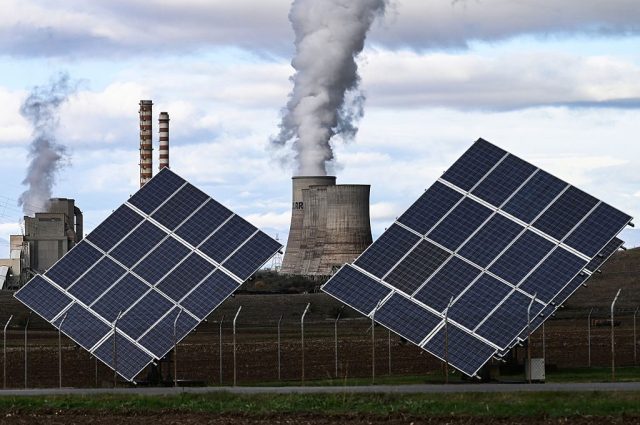
Green doomerism has failed to displace fossil fuels. Credit: Getty





Not long ago, all right-thinking liberals were sure that fossil fuels would soon become “stranded assets” as The Guardian once put it. Hydrocarbon-based energy sources, the thinking ran, would become ever more worthless as the world entered a bright renewable future. Yet as President Trump’s takeover of Venezuela demonstrates, there is, in fact, a lot of life left in those deposits; as the progressive American Prospect recently lamented, the “fossil-fuel empire” has struck back.
The takeover in Venezuela brings under US control the world’s largest proven oil reserves. Under Trump, Washington saw Venezuelan energy bolstering hostile countries, especially oil-import-dependent China. For now, the Venezuela coup deprives the Middle Kingdom of upwards of 800,000 daily barrels, while taking away a valuable customer as well as an intelligence asset for the Russians and their Islamist allies.
This naked neo-imperialism could prove beneficial, not least for the hard-pressed Venezuelans. American supermajors like Chevron are also natural beneficiaries, with huge resources being placed to modernize the country’s shambolic energy industry and thus to restore its once proud relative prosperity.
The larger point is that successful economies either have fossil fuels or need easy access to them. Gas reserves, and the revenues they generate, grant places the Persian Gulf monarchies far more influence than populous Arab states like Egypt, which lack oil and gas. Russia has been able to underwrite its invasion of eastern Ukraine and withstand severe Western sanctions thanks to its hydrocarbon reserves. China and India look to secure imports of the same wherever they can, especially at bargain prices. Core European powers like Britain, France, and Germany, meanwhile, could punch far above their weight if they would but tap their own plentiful supplies of shale gas, but their governments refuse to do so owing to irrational green phobias about hydraulic fracturing.
Beyond Europe, however, the recognition of fossil fuels as a key element of geopolitics puts a stopper on decades of green campaigns designed to instill fear of emissions and promote wishful thinking about how to reduce them. In academia and the media, dissenters from the narrative, even academics who accepted anthropogenic climate change, are hounded if they fail to submit to the green papacy’s encyclicals.
But the green doomerism has failed to meet the reality test. We now know that predictions of climate crises, some of which date back to the 1970s, have turned out to be exaggerated or even plain wrong. For example, both ABC and NBC boldly predicted in 2008 that New York would be under water by 2015; last time I visited my familial home town, however, it seemed very much on dry land. Extinction rates, often blamed on climate change, have slowed, with even the polar bears continuing to thrive in somewhat warmed temperatures.
A 2021 paper by Carnegie Mellon University researchers David Rode and Paul Fishbeck tracked apocalyptic predictions dating from the first Earth Day in 1970. Across half a century, 61% of the forecasts of planetary collapse have come and gone (and the planet is still here, chugging along). Even the committed climate sirens at Nature journal have been forced to retract a study that claimed the world economy would contract due to climate change.
The collapse of the worst-case scenario goes hand-in-hand with the continued strength of fossil fuels, which remain the dominant source of energy; even coal is ascendant. Despite billions spent by Western taxpayers to subsidize renewables, global hydrocarbon use is 30 times bigger than wind and solar combined, as the energy analyst Robert Bryce notes; in the last decade, the world added 9,000 terawatt-hours per year of energy consumption from wind and solar, but 13,000 from fossil fuels.
Fossil-fuel energy remains “the blood” that wins economic battles, including the drive to build data centers for artificial intelligence. For a while, China was catching all the upside from the fossil-fuel resurgence by going on a coal-plant building spree (this, even as the People’s Republic invested heavily in green technologies). Meanwhile, the West, including the United States under President Joe Biden, hamstrung itself.
Americans and Europeans suffered. Living standards in the de-industrializing West have already worsened, particularly for the middle class. Europe, especially, has endured a decade of stagnation. Americans laboring under the joint rule of green capital and green government likewise suffered.
In my adopted home state of California, electricity rates have surged a staggering 80% since 2008, compared with 28% nationwide. Once a major oil producer, the Golden State now suffers the nation’s highest energy prices and is utterly dependent on foreign sources in South America and Saudi Arabia.
High energy prices most hurt those in California’s less temperate, heavily Latino interior. The crisis has driven an erosion of industrial jobs; since 1990, one-third of California’s manufacturing jobs — 1.3 million of them — have disappeared. The disparate class impacts have been confirmed recently in a study by the California Air Resources Board, which projects that these policies will result in significant income declines for individuals earning less than $100,000 annually, while boosting incomes for those above this threshold.
If they stick to the climate agenda, the only way places like Europe and California can get to “net zero” by 2050 — a goal China put off for at least another decade — is by squelching future growth. Deutsche Bank’s Eric Heyman observes that such policies would have catastrophic effects on middle-class living standards in the West. But China’s leaders won’t sacrifice their population to lower living standards, whatever the environmental cost.
But America under President Trump is pulling in another, better direction. And even some Democrats are going along in recognition of geopolitical reality. In the United States, Axios recently reported, Democratic lawmakers have all but abandoned use of the Green New Deal, even amid their never-ending denunciations of all things Trump. “Today,” notes longtime Democratic policy expert Will Marshall, “the Green New Deal seems to have fallen to earth, borne down by the inexorable gravity of economic and political reality.” Among Democrats in Congress, mentions of the once-hyped program have fallen to a bare handful, down from more than 1,000 citations in 2020.
Only 6% of Americans rank climate as a top concern, a sliver of those who see inflation as their major problem. As these concerns have faded, even ultra-green California Gov. Gavin Newsom has been begging refiners to stay in the state.
The prospects for greens are even worse in the developing world. In Africa — the only continent whose population is growing strongly; also now home to five of the world’s 10 fastest-growing economies — governments generally recoil from adopting net-zero ideologies. Leaders choose to ignore the scolding of Greta Thunberg and the green nonprofits. Instead, they prioritize bringing electricity to the roughly 600 million in sub-Saharan Africa who do not have it now.
Former Nigerian President Muhammadu Buhari, for example, has warned that the climate policies favored by Western nonprofits and aid agencies could precipitate a continent-wide energy crisis. Uganda’s president, Yoweri Museveni, launched a scathing attack on European climate policies in November 2022, declaring it “morally bankrupt” for Europe to use African fossil fuels while denying Africa the same right. Museveni accused Western nations of imposing “one rule for them and another rule for us”, while expecting Africa to sacrifice development for climate goals Europe has failed to meet.
“The climate-industrial complex,” as Bjorn Lonborg has put it, is, well, running out of energy. Even before the return of Trump, many green companies, despite subsidies, were failing, the product of high costs and poor delivery.
Yet it is far too early to proclaim the permanent demise of the climatistas. They remain deeply entrenched in the universities and the mainstream media and are busy grifting in the massive nonprofit sector. A generation of children who have already been schooled in climate-change science, however exaggerated, may help them resurge. Also, those who have invested in “renewables” will be interested in recouping their losses under Trump.
Rather than ruin the basis of our prosperity and hopes for the developing world, humanity needs to adapt, much as our species has done during previous, and often more dramatic, climactic changes. In the coming years, the world must muddle through reducing emissions through practical steps like adopting natural gas over coal and restoring nuclear power. Trump’s successors may not fully embrace these realities. But for the immediate future, at least, fossil fuels are back, for better or worse, shaping history much as they have for the past century.
Joel Kotkin is a Presidential Fellow in Urban Futures at Chapman University and a Senior Research Fellow at the Civitas Institute, the University of Texas at Austin.
 joelkotkin