









January 12 2026 - 12:30pm
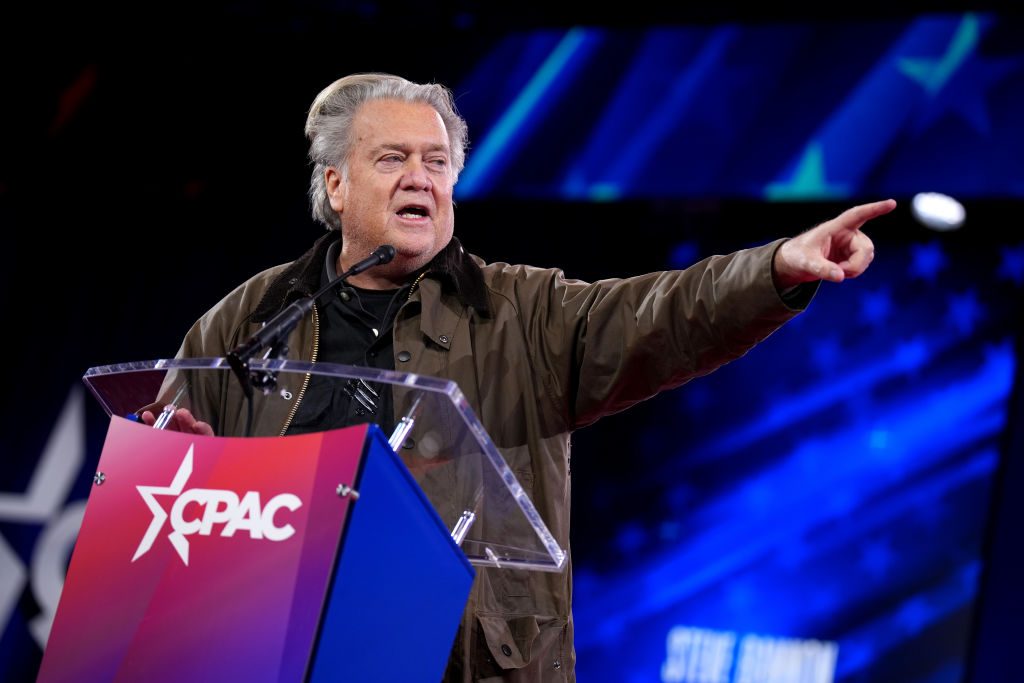
Steve Bannon is reportedly considering a run for the presidency in 2028. The ex-White House strategist and War Room podcast host has denied the rumor, claiming instead to be focused on enabling a third Trump term. However, allies have told Axios that he is quietly assembling the staff and campaign infrastructure needed to mount a bid for the top job.
Such a candidacy would have a strong revivifying effect for the MAGA movement — much more so than a quixotic movement to repeal the 22nd Amendment. Indeed, changing the Constitution is the longest of long shots, and Bannon is said to recognize this in private; he understands as well that his actual chances of winning the GOP nomination are thin. Yet he believes that his role could be to put pressure on other potential candidates like JD Vance or Marco Rubio and force them to stay true to the populist logic of Trumpism while resisting the snares of establishment conservatives and oligarchic elites in the tech sector.
Bannon is especially well positioned to become a kind of Right-populist conscience because, more than anyone else in Trumpworld, he has had a consistently heterodox instinct on various issues over the years. That being said, he’s also had to overlook Trump’s many compromises and breaches of populist logic out of personal loyalty to the President.
As a candidate, Bannon would be free to chart an alternative program on his own terms, helping to align the Republican Party more closely with its working-class base in governance. He would also be less likely to revert to either the neoliberal or neoconservative dogmas that still hold sway; Trump’s recent slate of redistributive ideas may have been bold from an aspirational point of view, but there is no evidence these will be translated into actual legislation with Congressional buy-in or accorded the same political capital as the regressive “One Big Beautiful Bill” (OBBB).
As Matt Gaetz, Trump’s short-lived attorney general, said on his podcast, a Bannon campaign would have “the foreign policy of Rand Paul” and “the tax policy of Elizabeth Warren”. Consider Bannon’s record. In 2017, when he still served at Trump’s side, he was a lone voice calling for tax hikes on the rich as a way to sap the momentum of the Left and punish liberal elites; instead, Trump went for gigantic tax cuts skewed to the rich and designed by Paul Ryan, foreshadowing the OBBB.
More recently, Bannon has also been far more friendly toward social programs than the average Republican congressman. He recognizes, for instance, that the Right needs to “be careful” about cutting Medicaid, since “a lot of MAGAs are on Medicaid”. On military adventurism, Bannon has outwardly supported Trump’s raid on Venezuela while urging maximum caution and avoiding “the mistakes […] that the neocons made in Iraq”. One gets the sense that he would not have authorized such an intervention had he been in charge.
Above all, Bannon would be a bulwark against further infiltration of the Right by Big Tech. He has often spoken out against Silicon Valley’s hegemony on his podcast, declaring “The admin, JD, Marco, are owned by the broligarchs”. He has made an enemy of Elon Musk and attacked H-1Bs as well as sympathized with antitrust tribune and Biden Federal Trade Commission (FTC) commissioner Lina Khan, whose actions have angered Meta and Amazon. Notably, Bannon has also sounded the alarm on AI, aligning with the likes of Barack Obama and the Pope calling attention to the vast job-killing potential of the technology which the administration’s laissez-faire positions seem to ignore.
Bannon stands out because in a Republican Party that too often treats populism as a rhetorical or performative ploy, he understands MAGA’s purpose as a countervailing force against elites. The “broligarchs” have proved to be the most malleable and manipulative class of elites across administrations of both parties; they have thus become the most powerful and difficult to dislodge. On the Right, only Bannon seems to treat them with the seriousness they deserve.
