




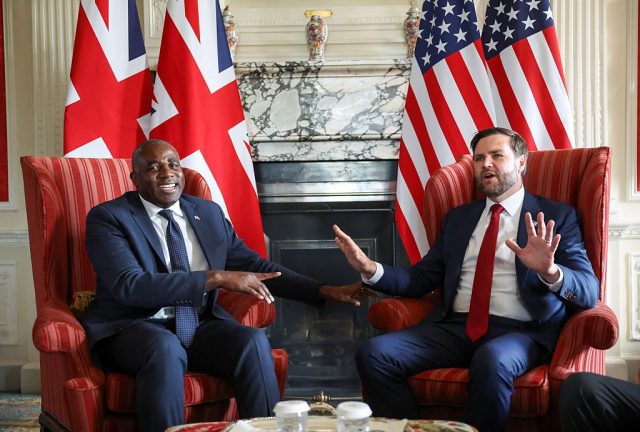
'Starmer may soon have to choose openly between the path of cynical realpolitik and that of dangerous conviction.' (Suzanne Plunkett/WPA Pool/Getty)





In 1933, the acclaimed Russian poet Osip Mandelstam composed a poem about Stalin, which he recited to an intimate group of friends. It was highly unflattering about the Soviet dictator, while also describing a climate of fear in which honest speech was fraught with danger. The poem itself exulted in stating the forbidden: it talked about the “thick worms” of Stalin’s fingers, his “cockroach whiskers”, the sycophantic “half-men” who surrounded him, and the decrees he was forging “like horseshoes”.
Even though the poem was never actually written down, it ended very badly for its author. One or more informants in Mandelstam’s trusted circle memorized the lines and passed them on to the secret police. The poet was arrested and sentenced to internal exile, and later — after being rearrested and consigned to forced labor — died of illness in a transit camp. One might ask why, in circumstances of such extreme danger, Mandelstam had decided to speak his criticism at all? It was because the unceasing performance of lies had become so exhausting and diminishing. To feel that he truly existed, as a poet and a human being — or even that reality itself existed — he needed to proclaim the truth in the hearing of at least a few others. His wife Nadezhda Yakovlevna later said that he “did not want to die without stating in unambiguous terms what he thought about the things around us”.
In the last year, an unfamiliar way of talking has fully established itself in UK Labour government circles, chiefly evident in its utterances on the actions of US president Donald Trump and his entourage. It goes well beyond the usual diplomatic courtesies practiced among democratic nations. Instead it involves the rigorous self-vetting of public speech of the kind once practiced by the citizenry of the former Soviet Union as they moved through daily life, acutely conscious that the wrong word could trigger catastrophic results. Few people in the UK can now be unaware of the syndrome: from the outset of Trump’s second presidency, our leaders have sought to skate over any of their previous public criticism of the US president and have stubbornly withheld fresh criticism even when it is obviously due. The result is now an unusually extreme gulf between what we all know they believe and what they feel able or willing to say.
The rest of Britain has watched this political performance with varying emotions, but mainly the weary tolerance born of the consciousness of impotence. Those who follow politics may well know, for example, that the justice secretary David Lammy, formerly foreign secretary, previously called Trump a “woman-hating, neo-Nazi sympathizing sociopath” and a “profound threat to the international order”. They may also recall that after the events of January 6, 2021, when a crowd of Trump supporters violently stormed the Capitol, Sir Keir Starmer told reporters that “President Trump has to take responsibility. What happened was appalling. It wasn’t protest — it was an attack on democracy. And responsibility lies with President Trump. No doubt about that. This is the culmination of years of the politics of hate and division, and this is where it leads.”
These were not controversial views at the time, nor were they confined to the left of politics in the UK or elsewhere. John F Kelly, the former Marine general who was Trump’s longest-serving chief of staff during his first term, unambiguously warned the world prior to Trump’s re-election in 2024 that his former boss met his definition of a fascist, would govern like a dictator if permitted, and had no concept of the Constitution. The thing that most worried him was Trump’s declared readiness to use the military against the “enemy within”, namely his fellow Americans. Even to say such a thing for political purposes, Kelly argued, was a “very, very bad thing, let alone actually doing it”. More than a dozen former Trump staffers, all self-described “lifelong Republicans”, came out in support of his remarks.
With Starmer’s entry to Downing Street and Trump’s subsequent return to the White House, however, the Labour leadership’s observations were consigned to the memory-hole. A decision was clearly taken to manage a uniquely tricky diplomatic situation not only by refraining from denouncing Trump, but by overtly flattering a man widely thought to be unusually susceptible to praise. Last February, Starmer flew into Washington for his first meeting as British prime minister with President Trump. Shifting a gear beyond civility and into effusiveness, he brandished a letter from “His Majesty the King” inviting Trump for a second state visit. “This is really special,” he said, as if himself astonished by the King’s depth of admiration. “This has never happened before. This is unprecedented.” The next day there followed a memorably depressing scene in which Trump and his vice-president JD Vance, primed by a sycophantic reporter, made a strikingly crass verbal attack in the Oval Office on the visiting Ukrainian president Volodymyr Zelensky.
The British press and public have watched this process, and even at times applauded its guile, without ever believing in it. They know that Starmer has been doing it in an effort to protect both the interests of the UK and democracy in Europe, on two pressing areas in particular: the British economy, in his quest for a lasting US trade deal, and the defense of Ukraine against Russian aggression, in which US military and intelligence assistance is essential. Beyond that sits the necessity of American support for maintenance of the UK’s nuclear deterrent, and the unique closeness of US-UK intelligence sharing. Onlookers therefore initially understood that the prime minister’s flattery of Trump was wholly tactical, like someone trying to placate a madman on the top deck of a crowded bus by complimenting him on his hat. Yet it was also impossible to watch without a frisson of national humiliation. When there is an explicit gulf between someone who is free to speak their mind, no matter how unfiltered its contents, and someone who must habitually mute, conceal and flatter, it is a raw demonstration of power, and all onlookers know it.
The intensity of the UK’s “Trump-whispering” strategy thus far has been underpinned by two assumptions. The first is that the US president has a strong and sentimental attachment to the UK and that — if only Britain remains sufficiently “on side” — it will predispose him to offer us significantly favorable treatment. The second is the Foreign Office’s belief that it is cleverer than the incumbent of the White House, and can effectively steer and “manage” his wilder tendencies internationally. Nearly a year into Trump’s second term, both are looking hollow. Even given the erratic nature of the US president’s pronouncements on Ukraine, the bulk of his approach has served to appease and embolden Vladimir Putin while weakening Nato. A recent shift to underpin a European “coalition of the willing” security force with US guarantees has yet to be nailed down. Meanwhile, Trump’s increasingly frequent outbursts on the necessity for the US to seize and “own” Greenland — currently a semi-autonomous territory of Denmark — whether by purchase or military force, have sent shock waves through Denmark and the rest of Nato. Back home, the president’s declared intention to use American cities as “training grounds” for the military is proceeding apace. Last September, he advocated just that as part of tackling an alleged “war from within”, the very process about which an alarmed Kelly warned in 2024.
Few would argue that Starmer is a natural politician, but he does show signs of a conscience. Within this increasingly uncomfortable diplomatic straitjacket, he has done his level best to shore up support for Ukraine and Denmark. But the domestic political price of “Trump-whispering” is growing steadily higher. As time goes on, and the US administration’s moves become more extreme, its muting and confusing effect on the Labour front bench is becoming ever more noticeable. Last week, David Lammy proudly posted pictures of his White House meeting with JD Vance on X, even as Vance himself was on X vigorously defending the masked ICE officer in Minneapolis who shot dead Renee Good, a 37-year-old mother of three and US citizen. Vance described the dead woman as a “deranged leftist”, deciding her culpability well in advance of any formal investigation. In the pages of the Spectator, the former Labour party éminence grise Peter Mandelson — recently recalled as Britain’s ambassador to the US over his links to the late sex offender Jeffrey Epstein — energetically praised Trump’s “decisive approach” to foreign policy while scolding Europe for its “histrionics about Greenland”. Whatever moral nuances the UK government’s Trump game originally contained, they are increasingly abandoned or irrelevant as the US presidential court exercises its dark magnetism: you’re either in or you’re out. And if one justification for sycophancy was to buy time to pivot away from Britain’s overdependence on the US — time which should rightly be spent on a heavy and accelerated investment in the UK’s military and industrial base — then the Treasury is notably failing to enact it.
A paradox lies at the heart of a looming electoral problem for Labour. In surveys, between 60 and 70% of the British public hold an unfavorable opinion of Trump. Yet Nigel Farage’s Reform UK party — the most Trumpian on offer, with explicit links to the MAGA movement — is currently leading by some distance in the polls. Voters appear to yearn above all for direction and definition: they often say things like “I might not like everything Farage says, but I know what he stands for” while signaling the opposite about Starmer. The difficulty for Labour is that the accusations it seeks to direct at Reform — dog-whistle racism, social divisiveness, ambivalence on Russia, unrealistic economics — are partly nullified by its tactical, smiling silences over similar, or far worse, manifestations in MAGA.
Compelled into a “special relationship” cage and trapped in a kind of moral paralysis, a muted Starmer steadily appears blurrier, grayer and more inauthentic as Trump explodes in lurid technicolor. And despite Trump’s occasional magnanimous word for Starmer in the Oval Office, he will shed no tears for his British counterpart’s political difficulties: it is one of the most time-honored tricks of the imperial tyrant to manipulate an ideological opponent into gradually erasing himself. Yet Starmer’s current strategy of transatlantic ambiguity cannot hold indefinitely. He, his fractious party, and the wider country may soon have to choose openly between the path of cynical realpolitik and that of dangerous conviction, between Mandelson and Mandelstam.
Jenny McCartney is a journalist, commentator and author of the novel The Ghost Factory.
 mccartney_jenny