




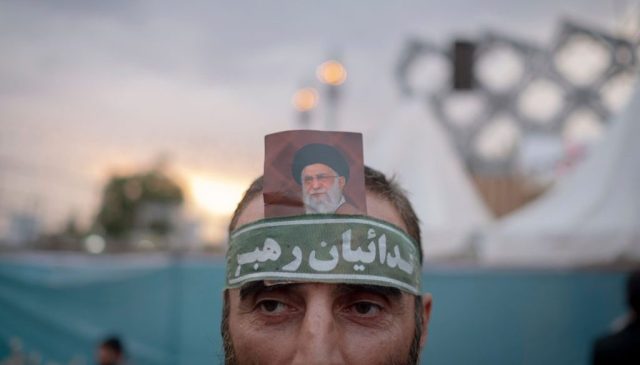
'Regimes are toppled because the men with guns are killed or lose their stomach for the fight.' (Morteza Nikoubazl/NurPhoto/ Getty)





Ever since he became Iran’s Supreme Leader in 1989, Ayatollah Ali Khamenei’s approach to domestic unrest has been defined by three assumptions. The first is that protesters can be discredited through accusations of collusion with the country’s Western foes. The second is that, having engineered the 1979 revolution that brought the mullahs to power in the first place — and suffered the consequences — Iranians will do anything to avoid another upheaval, the poor letting themselves be seduced by government handouts while judicious shows of force dissuade the middle class from taking to the streets. The third is that Iranians are incapable of uniting around a single opposition figure: whether a disaffected insider like Mir Hossein Mousavi, or Reza Pahlavi, exiled son of the deposed last Shah, easily caricatured as a creature of the Virginia suburbs and who hasn’t seen his homeland in almost half a century.
Such assumptions have seen Khamenei and his acolytes in the Revolutionary Guard, the clerical establishment and the Basij militia ride out crisis after crisis, starting with the Green Movement led by Mousavi in 2009, extending through the Woman, Life, Freedom movement of 2022-3 and climaxing in the battering that the country received last summer at the hands of Israeli and US aircraft. Then, calls by Benjamin Netanyahu and Pahlavi himself for ordinary citizens to take advantage of the regime’s military disarray, by going out and toppling it, went conspicuously unanswered.
Now all has changed. Initially sparked by economic collapse, two weeks of protests have coalesced into a national movement, one whose aim is nothing less than the destruction of the Islamic Republic. Along the way, the regime’s tenaciously-held assumptions have become obsolete. The authorities have been caught unawares, and seem unable or unwilling to change course. On the contrary, the Islamic Republic remains fatally wedded to the old assumptions while the country enters an unpredictable and explosive new phase.
The scene was set by a summer of chronic water shortages and electricity outages. In December, the riyal collapsed and inflation touched 50%, the consequence of mismanagement, corruption and sanctions that the revolutionary oligarchy has knowingly courted and in some cases profited from. Tellingly, the initial protests, on 28 December, were staged not by the hijab-discarding young women, the sort who spearheaded the Woman, Life, Freedom movement. Rather, the discontent was sparked by the revolution’s traditional supporters: grizzled, pious traders in the bazaar. They were soon joined by youthful members of the country’s dispossessed middle class: nouveaux pauvres with a Jacobin rage in their hearts and supportive compatriots by their side.
The solidarity that is currently being shown between Iranians of different ages, classes and ethnicities is a far cry from the scenes I observed during the 2009 agitation, when bystanders watched with studied neutrality as protesters were dragged away to police torture chambers. Gone, too, is the inviolability of public property. These days, bystanders wade in with fists and kicks to save protesters from the security forces, while police stations and police cars are torched and — according to the semi-official Tasnim news agency — officers are killed. From the province of Kurdistan in the west to Baluchistan in the east and as far south as the refinery town of Abadan, no part of Iran is untouched. At least one small town, in the western province of Kermanshah, has been seized by rebels.
The regime has responded by killing dozens of protesters before cutting the internet on Thursday night. Behind the blackout, as is clear from video and audio files that continue to trickle out, more protesters are dying, more public buildings are being attacked and more hospitals are becoming war zones as parents smash down mortuary doors and remove the bodies of their dead children before the authorities can surreptitiously bury them. Such confrontations are a throwback to the 1979 revolution, which advanced to the rhythm of Shia mourning ceremonies, each funeral being a magnet for more protests and more deaths.
Only a few government services — notably regime propaganda conducted through social media — have been exempted from the blackout. Card transactions, on which the economy depends, have not. With shops shuttered, the protests seem to be growing. In one video clip of a huge nocturnal gathering, a voice is heard: “They say they are going to come and kill us. Let them try to kill this crowd!”
On Friday, the Revolutionary Guard’s intelligence wing warned against “any refusal to act” on the part of other organs of the state, a rare public admission of concern on the subject of regime cohesion. The following day the regular army, which usually takes no role in maintaining law and order, announced that it would safeguard strategic infrastructure and public property, also urging Iranians to thwart “enemy plots”.
But such warnings, and Khamenei’s own denunciation of the protesters as “rioters” whose motivation is to curry favor with Donald Trump, derive from the old reasoning that equates any call by Iranians for foreign intervention with unpatriotic betrayal. The country has a long history of such interventions, not least the 1953 coup in which MI6 and the CIA overthrew Mohammad Mosaddegh, Iran’s legitimate prime minister. Yet judging by the protesters’ cheerful calls for further attacks by the US and Israel, it is clear that they have rejected their parents’ squeamishness. According to the logic on the streets, another Western aerial campaign would be welcome if it advances the goal of toppling the Islamic Republic.
The main political beneficiary of the growing appetite for outside action is Pahlavi, who on Friday exhorted Trump to “be prepared to intervene to help the people of Iran”. And, for the first time, the self-styled crown prince is regarded as a serious contender for leadership of a new regime whose main attribute would be its good relations with Tel Aviv and Washington.
It is a remarkable transformation for the diffident 65-year-old who left Iran for Lubbock, Texas as an air force cadet in 1978, and was for years dismissed by liberal and Leftist opponents of the regime as an embarrassing reminder of his father’s corrupt and authoritarian rule. Pahlavi’s support for the joint Israeli-US attack on Iran this summer, furthermore, in which more than 1,000 Iranians were killed, appeared to put him at odds with his compatriots. No longer. On the burning streets of Tehran calls of “Long live the Shah!” ring insistently while Pahlavi’s former Leftist critics, in the words of one veteran Iranian analyst, “have started treating him with respect”.
Pahlavi rises, Khamenei falls. As recently as three years ago, the Supreme Leader’s will was unchallenged and his authority total; since then, the so-called “Axis of Resistance” he had built up across the Middle East has been obliterated by Israel, with his own intelligence services clearly compromised. Most significant, the bombing of Iran’s nuclear facilities last summer removed any possibility of an Iranian bomb, in the short term at least.
“Rat Ali”, as Khamenei has been known since his scurrying departure for an underground bunker during the war last summer, looks every day of his 86 years. His death, preferably violent and painful, is being loudly petitioned. No one knows what conversations are going on between the Supreme Leader and his inner circle, which includes his son Mojtaba, for some time seen as a possible successor. But it is utterly implausible that Khamenei would, as The Times recently claimed, “flee to Moscow” if the regime looks close to falling.
Khamenei lost the use of an arm when he was blown up early in the revolution. He is not a quitter but a quietly stolid fanatic who will leave the Islamic Republic horizontally or not at all. And he has yet to turn the full force of his killing machine on the protesters. Observing all this, and fanning his tail feathers after his exfiltration of Nicolás Maduro from Venezuela, is the US president — who, by immediately reimposing his policy of “maximum pressure” on the Islamic Republic following his election last year, has, it is now clear, helped bring the Islamic Republic to its knees. “If they start killing people like they have in the past,” Trump declared on Saturday, “we’ll be hitting them very hard where it hurts.” By that time, of course, the slaughter of protesters was well underway.
Trump has so far avoided meeting Pahlavi, perhaps judging that the regime remains a long way from collapse, or because, if the time comes, he favors a Venezuela-style decapitation and Khamenei’s replacement from within the current set-up. Hassan Rouhani, a former president known both for his moderation and his toughness, might be a candidate.
As if by providential design, the ousting of Maduro lends an aura of inevitability to the demise of the Islamic Republic. And yet regimes are not toppled by auras. They are not toppled because Dara Khosrowshahi, the CEO of Uber, who was born into a good family in Iran in 1969, says that he is looking forward to “investing aggressively” in his homeland in the “first 100 days” after liberation. They are toppled because the men with guns are killed or lose their stomach for the fight. And of that, so far as we know, there is no sign.
A lot has happened since the summer. Iranians have got over their horror of foreign interventions and have adopted the closest figurehead to hand. A people out of time, they are fighting for a liberal democracy, or — quainter still — a constitutional monarchy, just as the brand seems defunct. Behind the penumbra of the communications blackout, a country of 90 million, an ancient culture dishonored by its leaders, goes to work on itself.