




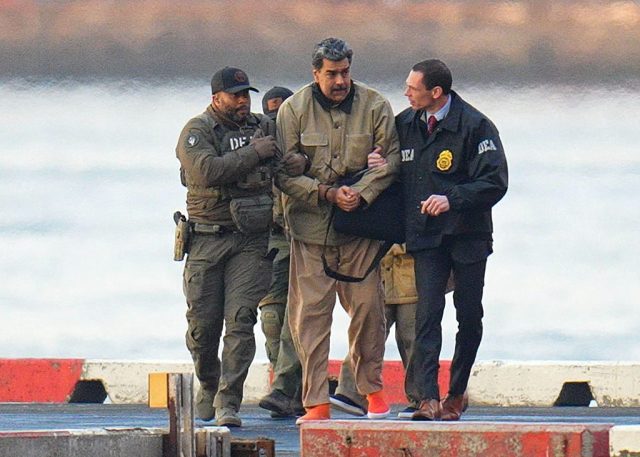
Nicolas Maduro landing on a helipad in Manhattan. Credit: Getty





In the 1956 Akira Kurosawa classic, The Seven Samurai, and its 1960 American remake, The Magnificent Seven, a group of masterless warriors take it upon themselves to protect townspeople from marauders. But there’s a catch: the samurai and Western gunslingers (respectively) insist on getting paid by the people they protect.
That about sums up the theory of international law under which President Trump extracted Venezuelan dictator Nicolás Maduro from his home at a military base in Caracas to put him on trial in New York City for drug trafficking. It’s law for a stateless space — which is to say, for our world.
There are, of course, other theories of international law. One view — call it the Hobbesian, after the 17th-century English philosopher Thomas Hobbes — holds that there is no such thing as international law. In this view, in the absence of a world government with its own police, law exists within states, but not among them, other than the law of the jungle, tempered by whatever restraints morality or prudence might support.
At the other extreme is what might be called the Wilsonian view, after President Woodrow Wilson. In the late 19th century and early 20th centuries, many idealists dreamed of world federalism, which would replace international affairs with the internal affairs of a world government.
Other reformers a century ago put their hopes in international agencies — leagues of nations, world courts and arbitration tribunals, international police forces, international agencies — that could create de-facto world governance in the absence of a world state by means of cooperation among independent states. Wilsonians put great weight on multilateral treaties and the rulings of transnational agencies and courts as definitive and compulsory international law.
But the most persuasive account is the one depicted in The Seven Samurai and The Magnificent Seven. It could be described as the vigilante theory of international law. Vigilantism is the practice by which members of a community or outsiders carry out rough justice in the absence of a functioning or legitimate state. In this view, international law is genuine law — but it is the customary law of a stateless society.
The bureaucratic state — in which legislators and judges and police and military officers are paid out of taxation to enact, judge, and enforce laws — is a recent development in human history. But law is much, much older. It has long existed in societies that have lacked modern states or anything resembling a state at all.
In stateless societies, laws are norms that rest upon a widespread social consensus but are enforced informally, voluntarily, and by interested parties. Lacking a salaried constabulary, the stateless society relies on enforcement by individuals and groups. But the enforcers can’t be compelled to enforce the norm against violators, and their decision to do so may be colored by self-interest of some kind.
The Viking-era Icelandic commonwealth that lasted from the 900s until its subordination to Norway in 1262 is an example of a stateless society. Customary law was recited by law-speakers at the Thing, the assembly of free Icelanders. Judges selected from among the attendees had the power to find criminals guilty. But lacking a professional constabulary or a professional army, the judges could only declare an alleged wrongdoer to be an outlaw. In the case of full outlawry, such a finding permitted anyone to kill the outlaw without legal repercussions. Usually, those who took on the risk of killing an outlaw had a personal interest in the case, like relatives of a murder victim.
Medieval Latin Christendom offers another example of law in a stateless society. The effective powerlessness of the Holy Roman Emperor meant there was no real government above the level of kings and other potentates. The pope could excommunicate a king, but the king’s overthrow had to be carried out by the king’s subjects or other monarchs, and in practice, they chose whether or not to do so.
The execution of justice in the absence of a functioning or non-corrupt state is a familiar theme of cinema. Hence, The Seven Samurai. In gangster movies like The Godfather, the mafia functions as an informal, extra-legal, parallel government, with its own customary rules and deliberative councils which can order murders. In Clint Eastwood’s 1992 Western classic, Unforgiven, prostitutes offer to pay bounty hunters to avenge one of their own in a town run by a tyrannical sheriff and his henchmen.
In a world without a world government — our world — the equivalent of masterless samurai, private gunslingers, and medieval knights-errant are the few great and middling powers that possess the military capacity to project power and intervene in other countries, in addition to defending themselves.
In a modern country with a functioning government, it would be an outrage if a salaried police officer personally decided whether or not to respond to a 911 call, and if salaried firefighters, after rescuing a family from their blazing home, insisted that they be paid by the victims in cash or took some of their possessions as a reward. But in a world that has law but lacks a world state, law enforcement can be both voluntary and self-interested.
The few military powers that can enforce customary international law have the right to choose when and where they intervene and can legitimately ask to be repaid by the nations whom they rescue in the form of cash, basing rights, or economic access for their own companies and investors.
What about the content of contemporary international law? Conventional accounts try to cover all bases, by saying that evidence of international law can be sought in treaties, domestic judicial decisions and laws, and the practice of states. But the practice of states — and of great military powers, in particular — is the main evidence of the existence of an international legal norm, because laws which aren’t enforced are just words on paper.
The practices that are legitimate according to the customary “tribal” law of our stateless international society change over time. Before World War I, it was widely accepted that countries could invade and occupy other countries to force them to repay debts to foreign nationals. This practice has fallen out of favor, as has the practice of hiring privateers to seize and loot enemy shipping in wartime, though a vestige remains in Congress’s power to authorize “letters of marque and reprisal” under the US Constitution.
In the 20th and 21st centuries, the rights of nations — usually defined as identifiable ethnocultural groups — have increasingly weakened or displaced older notions of state sovereignty and territorial integrity. There is a strong norm against genocide, the deliberate extermination of an ethnic nation or minority, which emerged following World War II and the Holocaust. More recently, following the Balkan Wars, a norm against ethnic cleansing or forcible transfers of an ethnic nation has taken hold. Such norms didn’t exist in the immediate aftermath of World War II, when the victorious Allies allowed population transfers involving millions of ethnic Germans, Poles, and Ukrainians.
Even the Trump administration, otherwise allied with the far Right in Israel, has backed away from Trump’s earlier horrifying endorsement of the permanent eviction of the people of Gaza from their homeland. In 2019, the first Trump administration declared that the annexation of the occupied West Bank and the slow-motion squeezing out of Arabs to make way for Jewish settlers were not “per se incompatible with international law.” Yet Trump last month restored the policy of previous presidents of both parties opposing the colonization and annexation of Palestinian land by Israel.
Thus, there is strong evidence of a norm against the dismemberment and annexation of foreign states and disputed territories: from global opposition to Israel’s annexation of the Occupied Territories, to broad international support for the US war to evict Saddam Hussein’s Iraq from Kuwait, to the widespread opposition to Russia’s annexation of Crimea and efforts to seize the Donbass region of Ukraine.
In today’s customary international law, however, state borders aren’t absolute, to judge from the practice of the great powers and other states. True, foreigners can’t invade a country, expel the inhabitants, and annex the territory. But the national right to self-determination has been allowed to alter the borders of existing states. German reunification after the Cold War is one example. And since 1945, many former colonial countries or breakaway nations have won recognition of their sovereignty. Following the Cold War, Czechoslovakia broke up into the Czech Republic and Slovakia in a bloodless “velvet divorce,” while Yugoslavia broke up in bloody conflict into seven countries, and the Soviet Union dissolved into 15 independent successor states in 1991.
Nations that have failed to obtain their own independence, like the Kurds and Igbo and others in Biafra in Nigeria, have lacked great-power support for their ambitions, a fact that illustrates the role of the great powers in choosing when and where to enforce a norm — in this case, the norm favoring national self-determination. The fact that norms are enforced selectively or hypocritically, however, doesn’t undermine their status as norms.
The flip side of national self-determination is popular sovereignty when it comes to choosing constitutions and leaders. Although it is far from universal, the custom of legitimating governments through free and fair popular elections is more widespread than ever. Elections and plebiscites are far from perfect, but the alternative is worse — allowing a supposed norm of “state sovereignty” to protect any tyrant or junta that seizes effective control in a country, no matter how much it abuses its power by executing, torturing, imprisoning, or exiling its opponents.
Which brings us back to Venezuela under Maduro. In that case, the United States and 10 Latin-American neighbors, along with Japan and most of the democracies of Europe, either refused to recognize Maduro’s legitimacy or raised questions about it, given his obvious theft of the 2024 election in Venezuela.
The Trump administration plausibly could have won widespread international support — outside of autocracies like China, Russia, Iran, and North Korea — by emphasizing enforcement of the international norm favoring democracy as the main purpose of its intervention in Venezuela, with US support for rebuilding the decayed Venezuelan oil industry subordinated to the decisions of Venezuela’s democratically elected leaders about what to do with their country’s oil.
But Team Trump chose not to emphasize democratic restoration, relying on other rationales. Trump and his deputies have claimed that the overthrow and imprisonment of Maduro was merely a case of extraterritorial American enforcement of domestic US anti-drug laws — an excuse as transparently dishonest in the case of Maduro as it was in the case of Manuel Noriega’s ouster from Panama in 1989. This pretext was made even more preposterous by Trump’s recent pardon of former Honduran President Juan Orlando Hernandez, who’d been sentenced to prison for 45 years in the United States for drug trafficking and violating US weapons laws.
Trump also claimed, falsely, that beginning in 2007, under former strongman Hugo Chavez, the Venezuelan government “unilaterally seized and stole American oil.” But the oil was never “American.” Under Venezuela’s democratic 1999 constitution, all oil and gas in the country belongs to the state, which can collaborate with private companies to extract it. Moreover, Saudi Arabia nationalized American oil company interests between 1973 and 1980, and Mexico did the same in the 1920s, without Washington regarding either as justification for a regime-change war.
Worst of all, Trump has implied that instead of handing over power to the winners of the 2024 election, the United States, either directly or through remnants of Maduro’s dictatorship, will govern Venezuela for an indefinite period, a strategy that appears to put the interest of US oil companies above the restoration of Venezuelan democracy. Such a policy is likely to galvanize nationalists and anti-imperialists throughout Latin America and around the world, and bolster the stereotype of US foreign policy as “capitalist imperialism.”
Given the importance of elections in legitimating governments in today’s world, it is hard to make a case from customary international law against a limited intervention by a foreign power that replaces a dictator and restores democracy in a country. But if the intervening power does not move quickly to support a transition to rule by the country’s own democratically elected leaders, it risks violating another strong norm of modern customary international law: the norm against conquest, annexation, and indefinite occupations.
Unfortunately, the efforts of Trump and his aides to explain why the United States overthrew Maduro have been as botched and counterproductive as the operation to capture and remove the Venezuelan dictator was tactically effective.
In a world without a world government and a world constabulary, vigilantism by major military powers is often the only way to bring about rough justice under customary international law. But when it comes to the norms they invoke, the enforcers aren’t judges in their own case. Others, including those whom the vigilantes claim to liberate, will decide whether justice has been done — as a matter of morality, if not enforcement. Audiences admire the protagonists of The Seven Samurai and The Magnificent Seven because, while self-interested, the justice they render is finally real justice. The Trump administration would be wise to follow suit.