




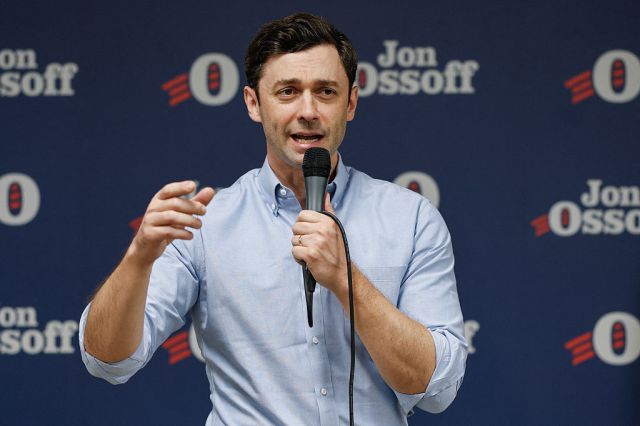
Sen. Jon Ossoff is one politician ushering in post-woke. Credit: Getty





After a stunning repudiation of the Republican Party in the midterms, the Left has something it had very little of just two years ago: hope. That counts for something. When Donald Trump was re-elected in 2024, it was demoralizing. For a while, my fellow progressives and I feared that the Right would dominate politics for the foreseeable future, and we despaired of ever achieving anything at the ballot box again. But in politics as in life, fortunes can change rather quickly.
That adage, however, cuts both ways: for progressives to make the most of their current spring — to make it last — they have to make good on their core material commitments on affordability, broadly shared prosperity, and a just and restrained foreign policy. And they have to eschew the boutique cultural causes and hectoring tone that turned voters against them the last time around. Otherwise, spring will turn to another winter before too long.
The midterms were a victory for the Democratic Party, of course. But more consequentially, the election was a triumph for the party’s Left flank. The biggest win on the ledger was that of Michigan’s Abdul El-Sayed, a standard-bearer of what Matthew Yglesias has called the “clean-living Muslim wing” of the Left. El-Sayed won despite the GOP’s relentless efforts to tar him as an Islamic extremist and the pro-Israel lobby’s expenditure of tens of millions of dollars on behalf of his opponents in both the Democratic primary and the general election. Perhaps more remarkably, even in a red state like Florida, Angie Nixon — a member of the Democratic Socialists of America — came within three percentage points of winning, despite receiving little support from the national Democratic Party.
The Left clearly has a winning message: a dogged focus on affordability and shared prosperity, and a strong stand against American complicity with Israel’s destructive wars. The atrocities in Gaza on their own might not have been enough to sway voters. But the Israeli government’s role in pushing for a US military intervention against Iran further soured on Americans, who (correctly) tied the war’s inflationary effects to their own struggles to make ends meet.
Vice President JD Vance, in a blistering postmortem, cited the war and his own administration’s close relationship to Israel as two of four key reasons a significant share of Trump-Vance voters shifted their support to Democrats. On Election Day, Trump himself seemed to acknowledge this when he said of US aid to Israel, “Why should we suffer the slings from lunatics like El-Sayed when [the Israelis] don’t need it? It’s a bad talking point.”
There is little downside, then, to Democrats criticizing Israel. Some centrist critics of El-Sayed worried that his focus on Israel’s misdeeds — they would call it something worse, an obsession — would ultimately hurt him. It didn’t. A majority of Michigan Jews voted for El-Sayed.
This isn’t to say that every progressive should make criticism of Israel a focal point of their politics. But they can and should at least make clear where they stand. While the Rev. Adam Hamilton of Kansas didn’t talk much about Gaza, his basic orientation in defense of Palestinians — in line with his neighbor-love vision of Christianity — was not in dispute. As early as Oct. 13, 2023, a week after the Oct. 7 terror attack on southern Israel, Hamilton issued a statement that: “I also stand with Palestinians who, for a variety of reasons, live as second-class citizens in the land where they have lived for hundreds of years.” Such statements didn’t stop Hamilton from turning Kansas — yes, deep-red Kansas — blue.
But being on what progressives call “the right side of history” is no substitute for governing well and wisely, something that Zohran Mamdani intuited from the start of his tenure as New York City mayor. You have to get things done and deliver tangible results for the citizens you serve.
Luckily, there is the “sewer-socialist” tradition — recalling unabashedly Leftist mayors in the previous century who won renown (and re-election) by focusing relentlessly on basic good government and the delivery of services to the working majority. That tradition, which Mamdani has sought to revive, teaches that ideological purity can only take you so far, which is to say, not very far.
It is here that the past must not be a prologue. Beginning in the mid-2010s through the early 2020s, progressivism came to be defined by “wokeness” — a puritanical approach to politics that divides the world into oppressed and oppressor according to racial and gender identity. In addition to grating on voters with its hectoring tone, woke politics undermined class-based solidarity — once the linchpin of Left and labor politics — by dividing populations along identitarian lines.
It’s telling, then, that in 2026 “wokeness” was no longer the animating issue it had been in previous elections. Here, the Republican Party became a victim of its own success. After Trump’s 2024 victory, wokeness receded in many progressive institutions, which made it harder for conservatives to evoke its specter to motivate voters.
A broad “vibe shift” was the result, with even the likes of Alexandria Ocasio-Cortez and the New York Times writer Nikole Hannah-Jones wondering out loud whether the whole enterprise had gone too far. The obsession with race and gender identity didn’t actually work: it alienated large swaths of the American public and led, at least in part, to Joe Biden’s catastrophic decision to elevate Kamala Harris as vice president.
Going forward, the Left must resist the temptation to re-entertain racial and gender-based identity politics. The danger is that, as enjoyable as power and success may be, they breed overconfidence as well as overreach. Whatever the midterm elections were, they were not a mandate for divisive cultural politics. The good news — for Democrats, at least — is that wokeness has been replaced by Israel-Palestine as the primary progressive litmus test. And unlike many woke causes, this one brings Democrats in line with the median voter. More Americans today sympathize with the Palestinians over Israel, a dramatic reversal from just a few years ago. Fact is, Israel-skepticism is now the majority, mainstream position in American political life — including among Republicans under age 50.
Some on the pro-Israel Right will no doubt counter that the criticism of Israel amounts to the latest iteration of wokeness. But that isn’t quite so. For one thing, this is an issue that implicates world-historic events, such as the Iran war and the stability of the Middle East, unlike pronoun preferences and so-called “microaggressions” at the workplace.
For the most part, Palestine’s advocates speak not the language of special pleading — “as a member of oppressed class X” — but that of universal rights. At stake aren’t the cultural preferences of the urban precariat, but the principle that Washington can’t underwrite and diplomatically back a permanent military occupation of a people who aspire to self-determination. That sort of Enlightenment-based moral universalism is a much more comfortable place to be for the Left, historically speaking. It also has the benefit of being intellectually coherent.
What the decline of wokeness means, in practice, is that progressives don’t have to be particularly “progressive” on hot-button issues like trans athletes participating in women’s sports, as long as they’re progressive on Palestine. The reason a relative moderate like Georgia’s Sen. Jon Ossoff is largely accepted by the Left is that he’s sufficiently critical of Israel. So he gets a pass. (Ossoff is also Jewish, and the fact that Democrats may very well nominate him for president belies the accusations that the party is in the grip of an anti-Semitic fever.)
But it’s not just a matter of resisting the siren call of woke. It is important for the Democrats to continue moderating on cultural issues in order to solidify their majorities and build as big a tent as possible in the years to come. Culture matters. People don’t vote solely on their material interests. With young men falling behind on a wide array of social and educational metrics, and amid a loneliness epidemic and a birth-rate crisis, Democrats need to be able to speak to America’s broader social malaise.
Fortunately, the midterms were a great day not only for democracy and Democrats — but for religion, too. In the post-Obama years, the Democratic Party became the secular party, with little space for outward expressions of faith. But that appears to be changing. Democrats are finally “getting” religion. Three of the most prominent Democratic candidates — El-Sayed, James Talarico, and Hamilton — were openly and unapologetically religious. They made their faith a central part of their pitch to voters. And they won, including (again) in red states.
Talarico and Hamilton are now standard-bearers of a new and emboldened Christian Left. It was less clear exactly how El-Sayed’s faith informed his specific policy positions, although he did occasionally sound more “conservative” notes on cultural issues like gambling and porn addiction. While critics tried to smear him with the Islamist label, if anything — as Yglesias amusingly noted — it might have helped him to be “a bit more ‘Islamist,’” in the sense of being broadly traditionalist on cultural values, which would have appealed to moderate voters.
But religion isn’t just, or even primarily, about being socially conservative. As the evangelical theologian Matthew Kaemingk and I argue in our new book Can Religion Save Democracy? (excerpted here in UnHerd), both the Christian and Islamic traditions lend themselves to pluralism, intellectual humility, and learning to live with deep difference. Final, definitive judgments about our fellow citizens are God’s alone. If God is the All-Knowing, then not knowing is part of what makes us human. This opens up space for a more generous and forgiving approach to politics.
This generosity has more direct political implications for Democrats. Another temptation — and this one will probably be harder to resist — is to interpret their electoral mandate as a license to punish Republicans, hearkening back to the endless Russiagate investigations and impeachment proceedings of the first Trump term. Retribution might feel good, but it will only narrow the tent and alienate independents and disaffected Trump voters.
Talarico’s and Hamilton’s “neighbor-love” Christianity offers a much more inclusive and affirmative vision, in stark contrast to the Christian Right’s apocalyptic preoccupation with vengeance and casting progressives as enemies of both God and the state. If vengeance is God’s alone, then we can be confident that God will sort it out, not necessarily now but in the next life. Adopting a posture of what Kaemingk and I call “delayed justice” can help relieve tension and minimize the existential tenor of our politics. Knowing that Trump will have to give account to a higher power — amusingly, Trump himself seems aware of this possibility — relieves the demand to punish him in the here and now.
The Left has always been animated by a utopian impulse. One might even call it a “religious” impulse in that it speaks to a yearning for transcendence as well as deliverance. To be a progressive, after all, is to believe in progress, that the arc of the moral universe “bends toward justice” — a phrase not coincidentally coined by a theologian. This faith in politics and in human nature has often served the Left well, spawning the great moral crusades of American history, including the abolitionist and civil-rights movements. But it must be tempered by a recognition of its limits. The arc of history may bend toward justice, but it is long and uneven. Politics can help us, but it won’t — and probably shouldn’t — save us.
Meanwhile, the Republicans’ political winter should be a lesson for Democrats: all it takes to lose a broad coalition is betraying a core pledge and becoming distant from voters’ real concerns. The roadmap for the Left, then, is clear enough: focus relentlessly on affordability, demonstrate competence at every level of government, and stay principled on Palestinian rights while reimagining the American relationship with Israel. Lastly, resist the twin temptations of cultural overreach and political retribution. Easier said than done, of course, but saying it would be a good start.
Shadi Hamid is a columnist for The Washington Post and co-author of Can Religion Save Democracy.
 shadihamid