




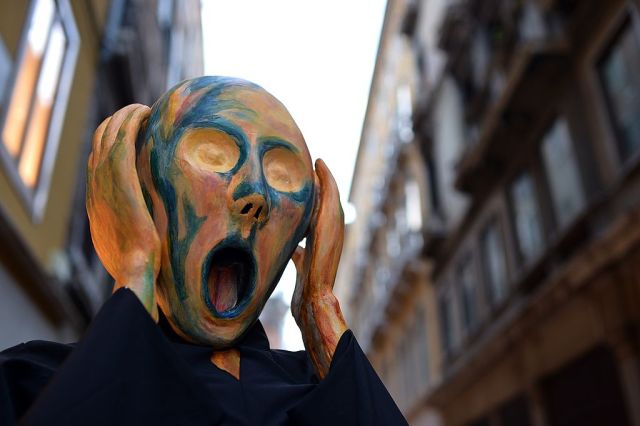
“There are more Jekylls around today than you might think.” (Gabriel Bouys/AFP/Getty)





According to Dr Jekyll, “man is not truly one, but truly two”. The unnamed celebrity in the news this week would perhaps agree. In the High Court judgment that ultimately rejected his injunction application, we were offered a fascinating portrait of two souls fighting it out in a single body: a sadly resigned victim (him), prophesying his own demise at the hands of a crazed and implacable killer (also him).
The goal of “PPT” — still his official name as this goes to press, pre-appeal — is to stifle allegations of inappropriate sexual activity, some of it potentially criminal. PPT asserts that publication of this material by the Guardian and ITN will very likely trigger a suicide attempt in him, thereby causing devastation to his son. “The claimant contends that publication would expose him to a real and immediate risk of serious harm or death,” the judge was told, as if the man were running from the mafia rather than his own demons.
Understandably, most of the interest in this case pertains to the identity of the claimant and the precise nature of the complaints against him, but there are other revealing angles too. To my mind, one of these is the way that PPT pictures the state’s failure to quash a juicy story about him as equivalent to leaving razors lying around a psychiatric ward. A crucial part of his legal argument pertains to pre-existing problems (bipolar, a trauma background, “personality-related vulnerabilities”), a recent suicide attempt, and a current restraint under the Mental Health Act. Given this background, lawyers acting on behalf of PPT argue that the state has responsibility for his welfare, and that curbing press freedom is a way of exercising this duty of care. Nothing other than stopping the media can save him from himself, apparently, not even hospitalization and appropriate psychiatric treatment.
Ultimately, the judge disagreed that PPT’s suicide was inevitable in the circumstances. Ironically, he did so on the grounds that the man was so miserable, he probably couldn’t see straight: “His prediction of his own future conduct is made in the context of depressive illness, hopelessness and catastrophic thinking … it is not a reliable basis for concluding that no future treatment or intervention could alter that risk.” This presents quite the dilemma for any litigants tempted along a similar path. Emphasize your intense mental disarray, and it will follow that you are an unreliable narrator of impending self-destruction. Play that aspect down, and it will no longer appear that the state has any enhanced duty to protect you.
This catch-22 speaks to a tension lurking within PPT’s arguments, as the judge presumably noticed. The claimant wanted the court to believe he had sufficient mental capacity to anticipate what he was going to do later, should publication go ahead; yet he also seemed to think that suicide was almost certain, as if rationality had nothing to do with it. At times, in the judge’s retelling, PPT appeared to picture his own mind as completely on automatic, with no space for spontaneous reasoning to get a grip. Show the greyhound the moving rabbit, and it will automatically chase it. Show the celebrity the newspaper scandal, and he will automatically end his life.
A more mundane, less tortuous interpretation of what is really going on here beckons, though the judge avoids naming it. In a covert sort of way, isn’t PPT just threatening to kill himself, if publication were to go ahead? Turning to the world of children’s literature for a completely random example, isn’t this just a much more hyperbolic version of the Violet Elizabeth Bott gambit: “I’ll thcream and thcream ’till I’m thick”? I suppose you could interpret Violet as simply describing a dispassionate hunch about what is likely to happen to her body, should she fail to get her way with William, but it seems more apt to say she is making a threat.
When it comes to talking about our own futures, we are rarely just dispassionate forecasters of certain bodily movements, given such-and-such prior causes. We have agency; we plan; we execute. If I announce that I am going to a party, it is an expression of commitment to that project, not an educated guess. If I don’t end up attending, it is not that my prediction failed due to inadequate evidence; I just changed my mind. To think of humans as black boxes, mechanically producing outputs in response to earlier inputs, is an attitude you can only really take to other people (and even then, not for long). As soon as you start to think about what you yourself are going to do, ardent desires, fears, hopes, and so forth start to bear upon the question from the inside.
I assume that part of what lured PPT’s team into ignoring this basic observation is that suicide is so often treated as something that overcomes you, rather than something you actively do. It hasn’t always been this way. For as long as the Christian taboo against suicide was still strong, successive societies could frame the effort to end one’s life both as an intentional choice and a bad piece of personal judgment. To prevent someone doing it was a way of saving his body — and perhaps his soul too. But once we lost the confidence to criticize the act on those traditional grounds, the only remaining option for justifying intervention seemed to be the conclusion that suicide was really no choice at all. These days, we default to the idea that it is a desperate and irrational act, born of mental illness, picturing the urge to do it as an abnormal interloping presence in someone’s mind. Only occasionally will we allow that someone might attempt it for reasons that are not radically disordered — and in that case, there will be those that seamlessly move from trying to stop you, to offering to help finish the job. Assisted death services are a case in point.
This narrative, that a suicide is rarely a genuine choice, makes a lot of grieving relatives feel better, and I can see why; it is hard to accept that a loved one decided to leave you. And in many, perhaps most cases, the person concerned did not decide; suicides took place in extreme states of agitation, paranoia, or psychosis. But it is one thing to consider a particular case sympathetically, and acknowledge that it looks like the ordinary requirements for rational choice were absent there. It is quite another to present the seductive idea that some mental illness or condition generally “causes” suicide, with scant room for individual agency and varying circumstances in the backstory too.
Increasingly, we hear this sort of thing. Large-scale studies correlate autism, or bipolar disorder, or gender dysphoria, or whatever it is, with a significantly increased risk of suicide. On the basis of such studies, authorities who should know better talk as if the particular mental condition in question is highly likely to directly produce the act. Sufferers receive the message that they are unusually prone to self-harm; a thought which can itself produce frightening emotions, and so put the idea more forcefully and apparently inevitably into their heads. This is not supposed to be a complete explanation of any given suicide either, but it is a baleful possible influence too often ignored.
And another problem with glib causal explanations of suicidal tendencies is that they offer cover for manipulative creeps. They allow wrongdoers to pretend to the world, and even perhaps to themselves, that some undeserved psychic pathology is aggressing them, rather than, say, appropriate feelings of shame or guilt. They can tell themselves that, thanks to the mental illness that allegedly puts them in danger, they are owed sympathy and care from others rather than disapproval; perhaps even that they are victims too. Whether any of this applies to PPT remains to be seen. But if the newly incarcerated Russell Brand conveniently brings up his bipolar and ADHD diagnosis in the next few days, I won’t be at all surprised. There are more Jekylls around than you might think.
***
If you are in need of support, you can contact the Samaritans on 116 123, or visit their website.
