




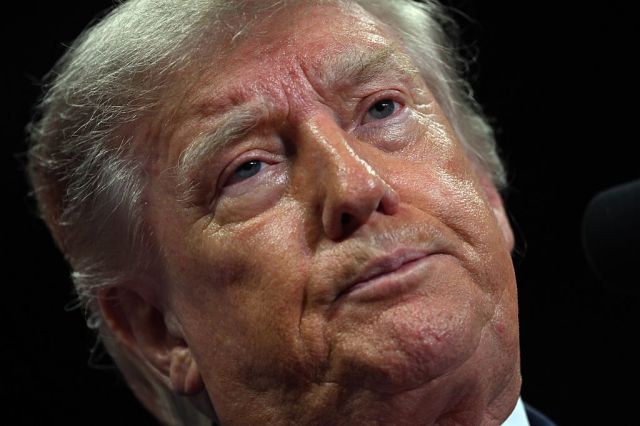
Voter polling is rarely this unambiguous...(Brendan SMIALOWSKI / AFP via Getty Images)





An all-too common analytic error is to reduce complex problems to simplistic causes (sancta simplicitas, “holy simplicity”, as Nietzsche mockingly referred to this tendency, particularly among religious believers). But there is also the reverse error: a deliberate seeking out of complexity when simple explanations suffice.
In the wake of the Democratic blowout in Tuesday’s midterms — South Carolina, Kansas, and Texas have gone blue — beware the preachers of holy complexity bent on obfuscating the obvious: President Trump and the GOP broke their pledge of peace, launched an ill-conceived war with Iran, and thus exacerbated an affordability crisis they’d been elected to solve.
To be sure, other failures marked the first two years of the Trump administration: the chaotic tariff regime, the grotesque corruption, the performative cruelty of ICE, Trump’s own descent from mere reality-TV vanity to ballroom-obsessed, Neronian caprice. But the Iran war — given both its inflationary effects and galling betrayal of one of Trump’s core pledges — looms largest.
The preachers of holy complexity have good reason to avoid this bare truth. Because it indicts their entire project: a hawkish foreign policy that sees US and Israeli interests as identical or nearly so. Its advocates have for years underwritten Israeli maximalism at great cost to American global prestige and domestic well-being. After the ballot-box shellacking wrought by the Iran war, that project faces a bleak future in mainstream American politics.
Voter polling — what actual voters tell pollsters upon leaving the precinct — is rarely this unambiguous. Nine of 10 voters identified the cost of living as a major concern as they headed to the polls. Only a quarter of voters described the condition of the US economy as “excellent” or “good”, while three-fourths described it as “not so good” or “poor”. And a staggering 87% of voters said they were very or somewhat concerned about the price of gas and diesel.
Most telling: about 60% of voters told the Associated Press that the Iran war was a mistake. Yes, fewer identified the Iran war as a “crucial” factor than did the cost of living. Then again, the war itself is a cost-of-living issue.
It’s also true that, as political economist Justin Vassallo noted in these pages, the current inflation is partly structural, having to do with the general trend toward de-globalization. But since energy prices ramify through the economy, the Islamic Republic’s (predictable) closure of the Strait of Hormuz in response to the US-Israeli invasion has unquestionably aggravated the affordability crisis.
As one senior Trump official told me recently, the administration shouldn’t have been “adding the short-term energy shock” of the Iran war to the structural inflationary trends.
Or take it from outgoing Florida Gov. Ron DeSantis, who recently said: “Some of these Republicans are saying, “Oh, well, the gas, don’t worry. It’s no big deal.” . . . No, no. Listen, we’ve just got to be honest. Gas is higher. It hurts people, working-class people, and it’s higher because of the Iran conflict. That’s just the fact. If you can’t admit that to voters, then you’re gaslighting them, and they’re not going to listen to you on other things.” Even Fox News pundits — yes, them — openly lamented the war’s baleful effects on GOP campaigns Tuesday night.
This matters because, ever since Jerusalem demanded that Washington join its 12-Day War, the hawks and neoconservatives insisted that a military intervention in Iran would be popular, or at least not unpopular. “There is no US downside to striking the Iranian regime,” counseled the former George W. Bush speechwriter Marc Thiessen in January, a month before the full invasion. A few weeks into the war, he cheered: “The Trump Doctrine is here. It ends forever wars” (the Iran quagmire has now entered its ninth month).
The hawks also went out of their way to pooh-pooh the economic downsides of the war. John Podhoretz of Commentary (where, full disclosure, I once served as senior writer) reassured a radio host that “I don’t think the American people care very much, they’re very uninvested in this. Unless gas prices go up to $250 a barrel, and suddenly it costs $9 a gallon at the pump, what cost is being inflicted on any individual American by this conflict? There is no cost. There is no cost!”
News Nation host Batya Ungar-Sargon said: “The markets seem to have … a kind of anti-Trump Derangement Syndrome, in which Trump can do no wrong. It seems that no matter what he does, the markets love it. … Even while the US blockade was on, the markets seemed totally oblivious.”
Never mind that the blockade is still on, and that Gulf oil is transiting with great difficulty and at high expense. Ungar-Sargon identifies as a populist of sorts, and thus knows well that what happens to equity prices often has very little to do with the economic conditions of ordinary people. Indeed, in March 2025, she wrote in praise of Trump’s plan to shift the US economy away from finance and toward manufacturing. The headline: “Trump vs. Wall Street”. (But when there’s an unpopular war to defend, one reaches for the nearest non sequitur.)
And when, over the summer, there was a chance at a negotiated settlement in time to extricate the GOP from the Persian Gulf mess, the hawks assailed the talks — relentlessly. “Mr. President, Give Up on a Nuclear Deal With Iran”, urged The Free Press. Which also published the following not-at-all-uniformly-hawkish opinions: “America Will Regret Withdrawing From Iraq”, “Houthi Defeat Is Closer Than We Think”, “The Dangerous Pause in Iran”, “Danger Lurks in JD Vance’s Negotiations With Iran”. You get the idea.
“Trump’s Iran strategy is working,” argued Thiessen. “His vice president isn’t.” (Why the opprobrium targeting JD Vance? Because the Vice President had taken the lead on negotiations with the Islamic Republic.) Ben Domenech slammed Vance as “Hillbilly Obama” for trying to clinch the deal. The hawkish elements of the religious Right dutifully stepped up to claim a just-war case for preemption and against diplomacy; papal teaching suggested otherwise.
These voices, to be clear, weren’t marginal or irrelevant to Trump’s decisionmaking. Far from it. Although many of them began as Never Trumpers, and even prayed that the Trumpian chalice might pass from them in 2024, these pundits and outlets rebranded themselves as MAGA true believers (or respectably Trumpian, in the case of The Free Press). More than that, they took it upon themselves to police the Right’s boundaries, framing the movement’s antiwar dissidents as unrepresentative at best and traitors at worst.
Trump listened. As several administration sources have told me — including both hawks and restrainers — the President in his second term ignored the usual executive-branch processes. The “deep state” had throttled him during his first term, in his view, and he now preferred to hear from loyalists only. He watched a lot of Fox News, and heard directly from pro-Israel mega-donors such as Miriam Adelson.
One consequence was the lack of foresight and lousy planning that marred the operation, not least Team Trump’s disregard of the Hormuz threat. The echo chamber of yes men and women also, paradoxically, led 2024’s “peace” candidate to realize a long-cherished goal of the more hawkish elements of the deep state he once denounced.
In the event, the results are disastrous. Trump is hemmed in at home, and while he will retain greater scope for action abroad, his ability to keep waging the Iran war will depend upon congressional Democrats’ power of the purse. The deeper tragedy is the collapse of the remarkable coalition he put together that, by 2024, encompassed the multiracial working class, including half of Hispanic men and a fifth of African-American men. The Iran war, as I warned in these pages in September, was driving a re-realignment favoring Democrats.
But the outcome is worse still for the hawks themselves, especially those who had come to treat American and Israeli interests as one and the same, and to take the aspirations and tone of Israel’s hard Right as an unimpeachable guide for US policy. It had gone too far. At one point last year, US State Department spokeswoman Tammy Bruce described the United States as “the greatest country on Earth” before pausing to correct herself: …next to Israel.” (Cleanliness, recall, is next to godliness, not the other way around.)
Where will they go now? The Middle East hawks still enjoy tremendous institutional power. But their worldview can no longer be considered to be in the American mainstream. Republican elected officials no less than Democratic ones can read polls, and foreign policy must enjoy some degree of domestic buy-in. Even before the GOP’s Iran-war rout, the polling was clear: Israel — at least, in its current, maximalist iteration — is massively unpopular among Democrats, Independents, and younger Republicans.
Probably, as a number of Trump World sources told me on Tuesday, the hawks will remain part of the broad conservative coalition. But it’s hard to imagine them in the cockpit of Republican governance going forward. Negotiating their long-overdue demotion, however, will prove far from simple.
Sohrab Ahmari is the US editor of UnHerd. His next book, on The Triumph of Normal, is forthcoming from HarperCollins.
 SohrabAhmari