




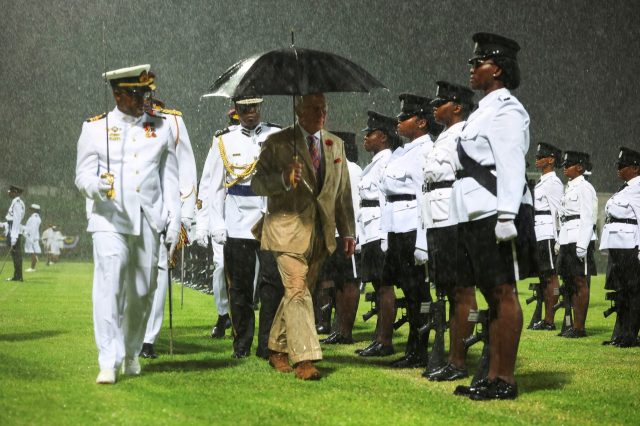
King Charles won't be singing in the rain. (Isabel Infantes/Getty)





The King is currently on tour across the Bahamas, Antigua and Barbuda, and Guyana. All three of these states have, over recent years, called for Britain to make some kind of reparation for the transatlantic slave trade.
So why, we might wonder, is His Maj choosing such a complicated form of winter sunshine break in the first place? Why can’t he just do two weeks all-inclusive in Bermuda like a normal person? Daiquiris by the pool would doubtless be more enjoyable than trundling around Caribbean states making speeches while people who don’t see the point of him demand apologies or money in recompense for events centuries in Britain’s past. The answer is of course that all three of Charles’ holiday destinations are Commonwealth states, and two retain Charles as titular monarch. All 34 African and Caribbean membership states have now joined the call for reparations.
But what is this Commonwealth for? In one corner of my living room stands a tea-trolley that used to belong to my grandmother. It’s a beautiful piece of furniture, which you can convert from a two-story conveyance into a handy fireside table by activating a hidden mechanism. But though it’s ingeniously made, it doesn’t have a role in our house, except storage. The floors are too uneven for it to be useful transporting things, and afternoon tea doesn’t happen.
The Commonwealth feels like that tea-trolley: evidence of something clearly once of social significance, whose context has disappeared. Along with that context, so too has much of the detail of how we got from there to here. And there’s a link between this fact and the ever more insistent demands that Britain atone for slavery: namely our loss of any account of British history that hasn’t been pre-filtered through a post-war internationalist perspective (which is to say, at least until recently, an American perspective).
This pre-filter is so habitual now as to be largely invisible. From Mumsnetter to senior politicos, people in Britain have absorbed the idea that the First World War was fought for “democracy” or “freedom”. But no such interpretation was offered for this conflict at the time. Rather, it was understood by the European belligerents as driven by balance-of-power concerns.
It was the American President Woodrow Wilson who conjured the notion of these conflicts being contests between abstract goodies and baddies, when he told Congress in 1917 that the world must be “made safe for democracy”. A similar dynamic is writ even larger in the historiography of the Second World War. And we’re all so used to this story now that the habits of mind within which the older balance-of-power mindset made sense are now as defunct as my grandmother’s tea trolley. Accordingly, too, the more utopian, internationalist one that replaced it has made the task of accounting for Britain’s imperial history exceptionally difficult. And the history of the Commonwealth itself illustrates this transition.
This entity began as a realist adaptation to changing geopolitical forces. It was conceived of in 1926 as a response to a shift in relations between Britain and important imperial holdings as a consequence of the First World War. The exigencies of imperial worldwide coordination in that conflict had forced a new degree of independence across dominions including Canada, South Africa, and New Zealand. Then, following the war, these states were understandably reluctant to relinquish this new autonomy. Matters came to a head in 1926, when the Canadian Prime Minister demanded that the British Governor-General, Julian Byng, dissolve the government and call an election. Byng refused, triggering a dispute over who was in charge.
The row prompted a conference, led by former Prime Minister Lord Arthur Balfour, which aimed to align existing imperial law with reality. The end of these discussions was the Balfour Report, which explicitly described the various British imperial dominions as not dominions at all. Rather, they were “autonomous Communities within the British Empire, equal in status, in no way subordinate one to another in any aspect of their domestic or external affairs, though united by a common allegiance to the Crown, and freely associated as members of the British Commonwealth of Nations”. This definition was formalized in 1931, along with an “imperial preference” policy which set advantageous trading terms among Commonwealth nations.
This settlement didn’t last long, though — and as it evolved, it grew gradually less pragmatic, and less concrete. This was with no small thanks to the American statesman Wendell Willkie, a close advisor of Roosevelt, who was a vocal critic of British imperialism. Willkie called for leadership of the world to pass instead to America. In time, and with Willkie’s encouragement, dismantling the European empires (and their trade clubs, such as the Commonwealth’s “imperial preference”) would become an explicit aim of American foreign policy.
When the Second World War broke out, the US made it a condition of the 1941 “lend lease” agreements, by which America supplied aid to Britain, that the latter would agree to work toward ending these preferential trade arrangements. Then, after the war, US loans to an effectively bankrupt Britain were again explicitly tied to economic liberalization, culminating in the General Agreement on Tariffs and Trade in 1949. This ended any meaningful economic role for the Commonwealth, leaving behind little save a ceremonial role, a vague do-gooding remit, and some ambivalent memories.
To be clear: it’s not exactly that the British Empire was alive and well until America dismantled it. The phrasing of the Balfour Report, all the way back in 1926, suggests that in some respects Britain had by then already begun decolonizing herself in favor of a pretense of being first among equals. But decolonization was certainly accelerated by other geopolitical factors and actors.
What emerged, then, was a self-effacing post-war Commonwealth of values and vibes, in which “British” was deliberately discarded. It always had its critics. Enoch Powell challenged it through the post-war decades, as a geopolitically incoherent bit of “make-believe”, comprising states without meaningful, real-world commonalities or obligations to one another, whose artificial agglomeration encouraged Britain to act against her own national interest while smuggling damaging alterations into Britain’s historic constitution.
But in the Commonwealth’s defense, it succeeded in one respect: it sustained some kind of continuity between the historic empire of Great Britain and the post-war state that succeeded it. Importantly, by not actually doing very much, it achieved this without challenging the anti-imperial internationalism that came to define the post-war “West”. This “West” was always understood to include, perhaps centrally, the now disarmed, post-imperial, post-war polities of Britain and Europe.
For decades these polities took full advantage, diverting erstwhile defense budgets toward welfare and other civic causes. The price was an obligation to internalize the Wendell Willkie account of their own past. And this of course also meant, for the same reasons, promoting a strictly post-imperial internationalism, as one component in (or perhaps more accurately, a sideshow to) the “rules-based international order”. To this end, the intergovernmental Commonwealth Secretariat was established in London in 1965. Looking down its contemporary page, it’s hard to see what distinguishes its program (youth, gender, climate change) from any other large international NGO. And what enabled so much of geopolitics to become, for a while, variations on the same NGO theme was of course the reigning pax Americana.
But now pax Americana is over. Whether installing Marco Rubio as de facto viceroy of Venezuela, or bombastically demanding Greenland, Trumpian geopolitics has departed sharply from the 20th-century rubric of values and moral leadership. Europe’s security umbrella feels correspondingly much less secure, and very much less proof against sudden downpours. Labour politicians are nervously mumbling about how we should stock up on canned food, and German youth are protesting at mandatory conscription for young men. The populations of Russia and Ukraine are being ground to paste in a horrifically futuristic mecha-war.
In this context, perhaps it’s no wonder that people are beginning to wonder what the Commonwealth is for. It worked well enough for decades as a kind of Rorschach institution: for the imperial governing class, a vehicle for international do-gooding, for the monarchy, a ready-made touring itinerary, and to others, a kind of ghost empire in a good or a bad way depending on where you stand. If this is now dissolving into ever more shrill demands for reparations, this suggests an intuition among those making the demands, that the crumbling of pax Americana is an existential threat to the whole Commonwealth project.
The evolution of the Commonwealth tracked the evolution of Britain from prosperous independent statehood to whatever it is we are now, governed chiefly by debt and wishful thinking. It began life as a realist adaptation to changing imperial dynamics, then devolved by degrees into a nostalgia-tinged way of duplicating the spreading US-led NGOcracy. But this all presupposed the persistence of a stable US-led international order. If that ends, so too does the game of International Values. No wonder there’s a rush to bounce Charles and our bankrupt British state into some kind of admission of liability before the music stops.
Will Burnham and the King cave to the pressure? It’s not impossible. Britain is desperately skint, but elite British self-delusion has sustained the Commonwealth for more than half a century now, and old habits dry hard. More generally, all indications are that America’s provinces will cling to the post-war moral vision long after the imperial core abandons it forever. Indeed the principal bulwark against meek acquiescence to the tin-rattling is the admixture of Commonwealth-heritage elites such as Kemi Badenoch into Britain’s leadership class: people able to see the game for what it is. Badenoch recently decried the latest calls for reparations as “navel-gazing” and a “distraction”.
Though equally, the Nigerian slave-owning ancestry of the Green Party’s Antoinette Fernandez hasn’t stopped her lending her voice to the call for reparations, presumably as long as her family isn’t the one paying. And perhaps this points to at least one significant long-term Commonwealth achievement: the ways its architectures and networks have afforded a launchpad for elites across its 56 states into the transnational overclass. The exclusive airport lounges of the 21st century are genuinely and amicably diverse, even if the pluralism common among the wealthy and influential doesn’t reliably replicate lower down the social hierarchy, either in Britain or overseas.
Could the existing Commonwealth ever evolve into the federation it long ago gave up trying to become? This has become so implausible that Canada has opted to cozy up to the EU instead. As for us, if we want closer union with polities that hate everything about Britain except the money we send, we might as well do the same. So perhaps before Our Andeh says something we all regret, on our affiliation with either of these august societies, we should start the campaign to de-colonize the Commonwealth by removing Britain from its ranks. If it really is a club of equals, it’ll be fine without us. As for Charles, we can club together and get him a package holiday for next year.
