




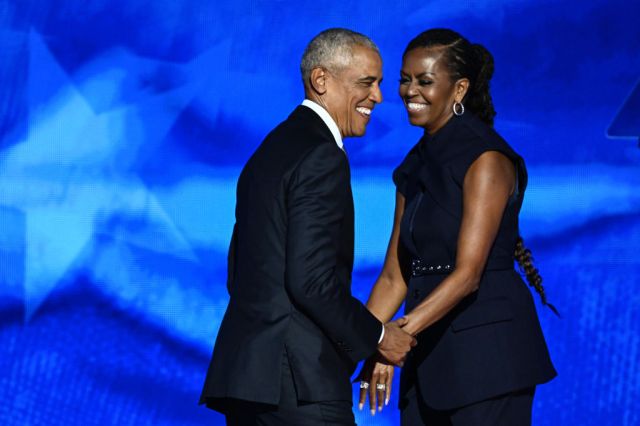
“If the Obamas have no vision of the future, the DSA has no vision of the past.” (Mandel Ngan/AFP/Getty)





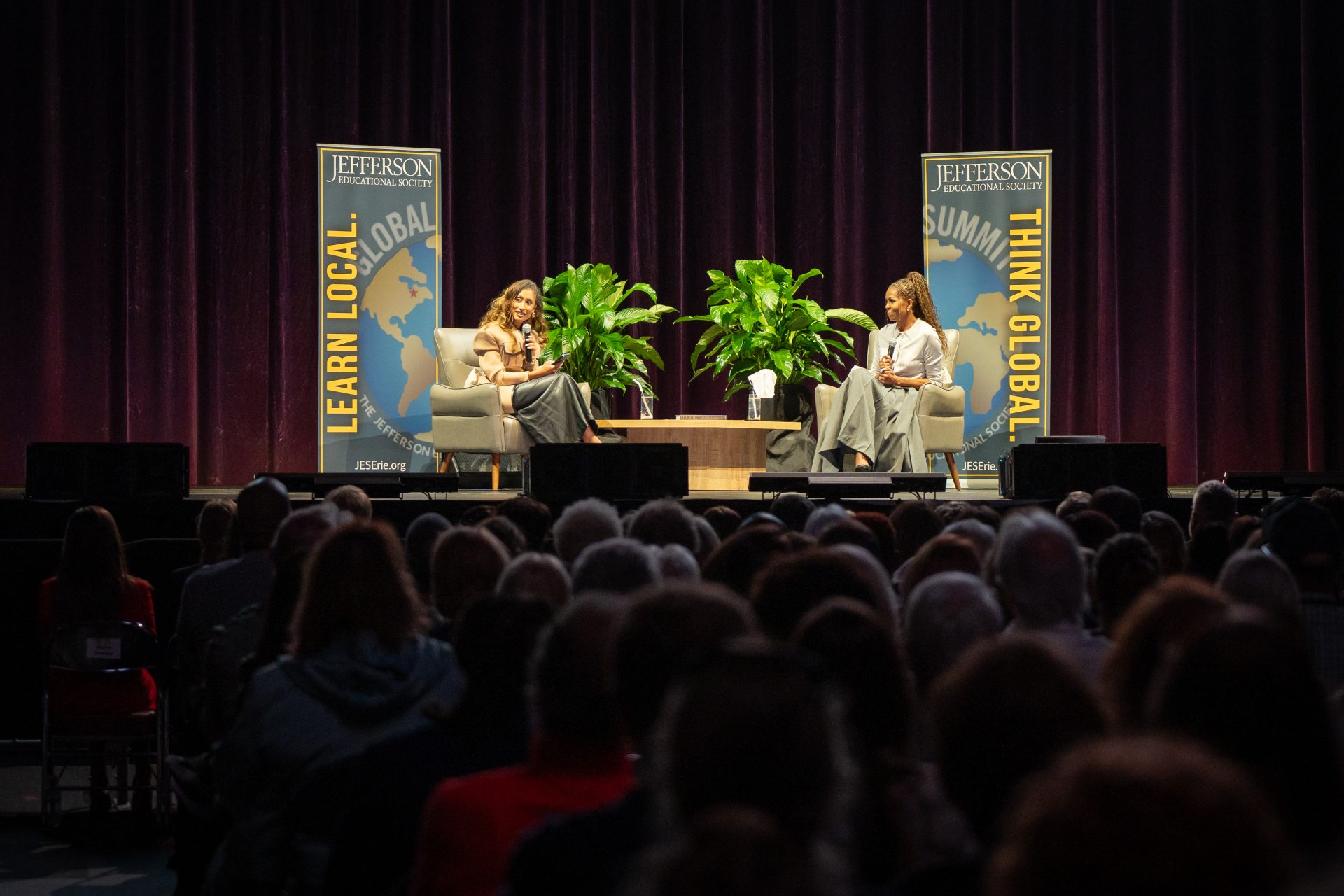
Why are they here, squeezed like Rust Belt herring into the Erie Insurance Arena? The sign above the door says “A Moderated Conversation with Michelle Obama”. And there she is, in a tea-length skirt and blouse, plain-spoken and funny as she palms out advice from a love seat. Telling teens to graduate high school, and their parents to teach self-reliance, Michelle has maxims, too, like “It’s not all about you” and “Change the lives of kids”.
Yet speak to the former First Lady’s fans — about 8,000 in the hall this crisp October night — and more than Obama herself, it’s what she represents that truly matters. She’s all about “working your way up, working hard, and following your dreams,” says Christine Galket, a Pennsylvania native, 45 and beaming. Latifa Ahmadi agrees. She first read Michelle’s memoir as a tween in her far-off Afghan village, devouring it in Farsi before translating it into pure American. “Obama’s story,” Ahmadi, now a Pennsylvania college student, tells me, “can be anybody’s story. Even if they’re not American.”
The descendant of slaves, and the daughter of a city water plant employee and a secretary, Michelle Obama’s journey to Princeton and the White House is, of course, impressive. But to blue-collar Erie, Michelle and her boot-strapping husband feel like nothing less than a Norman Rockwell painting made flesh. Blending Midwestern nice with Ivy League smarts, they exude the hustle-and-flow of their restless, striving country in a way this post-industrial corner of northern Pennsylvania can now only dream of. “It’s hard,” as Michelle’s moderator says at the start of the night, “not to be nostalgic.”
Coined by a doctor in 1688, “nostalgia” described the sad longing felt by Swiss mercenaries billeted abroad for their home. But there’s another kind of nostalgia too — not for a place, but for a time, when the grass was greener and life more full. That isn’t to say it’s a fantasy. For if Rust Belters speak nostalgia like a native tongue, there are reasons for their fluency.
In 1950, the region was home to nearly half of all American jobs. In 1975, a steel worker made $83,000 per year in today’s money. The Ohio Valley, home to Cleveland, Pittsburgh, Youngstown, boasted some of the highest home-ownership rates in the nation. Erie boomed too: half a century ago the “boiler and engine capital of the world” still belched grit and grime. Almost 20,000 labored at General Electric’s factory. And when people worked, neighborhoods did too. Each enclave had their own little gems: Rathskellars with the coldest beer, Bob & Midge’s Diner with the best beef-on-weck, a famous Rust Belt sandwich.
Those jobs and that world are gone. Today, the Ohio Valley is a champion in opioid addiction. In Erie, 24-hour vending machines dispense free Narcan right there in downtown. There are worse horrors too. Three days before Obama’s Erie visit, the town made national headlines for a grisly murder-suicide. Just off the 12th Street Corridor, all cracked sidewalks and sky-high poverty rates, a 45-year-old man murdered his wife, pregnant daughter, two sons, and one- and five-year-old grandchildren. The scene featured all the signs of post-industrial torment. Vehicles littered the yard; jugs of urine were stashed throughout. Neighbors reported drug abuse and a steady stream of domestic disputes. When the wife reportedly demanded a divorce, her husband perpetrated a crime that one veteran officer called the worst he’d ever seen.
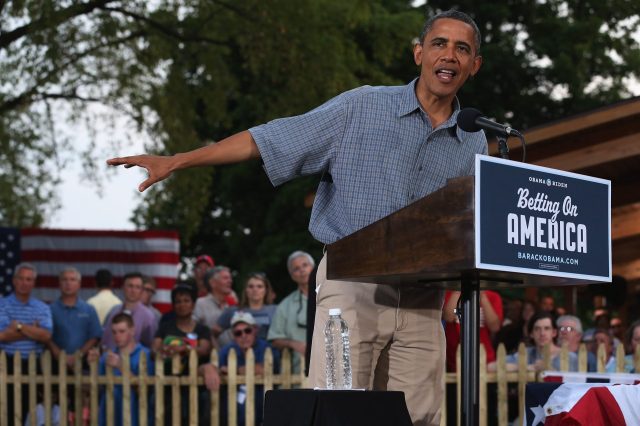
When, in January 2009, Barack Obama entered the Oval Office, he promised to change all this, to “bring manufacturing back” through the “audacity of hope”. He duly swept the Rust Belt, twice. And, to be fair, his White House did sometimes try, as Michelle Obama put it in her “Moderated Conversation”, to “represent” working-class interests. In 2009, for example, Barack authored a federal bailout of General Motors, saving 1.5 million auto jobs. An economic stimulus pulled the economy out of freefall. Forestalling catastrophe is an achievement.
As President, then, Obama was a steady hand, and, especially compared to his successor, personally virtuous. Yet whatever his wife might now claim about defending towns such as Erie, the numbers tell otherwise. After their eight years in the White House, the number of industrial jobs in the Rust Belt had dropped another million. Little wonder upper-income households got richer — and the poor more desperate. Little wonder, too, that by 2016 enthusiasm for the Obamas had begun to ebb away. “I remember being in Youngstown, Ohio,” recalls Chris Arnade, a chronicler of working-class America, “and I kept hearing effectively the same thing: ‘We all had great hopes for Obama, and it didn’t really go the way we wanted.’”
This isn’t surprising. Consummate showmen, the Obamas were happy to offer a diet of vibes to their hardscrabble backers, patrician gestures a stand-in for meaningful, structural change. At White House shindigs, Michelle donned shoes by unknown designers to send a message. “You, too,” she seemed to be saying, “can dress a First Lady”. Or else she sponsored South Lawn lunches for low-income kids, with much less to say about their crumbling schools or needle-strewn parks.
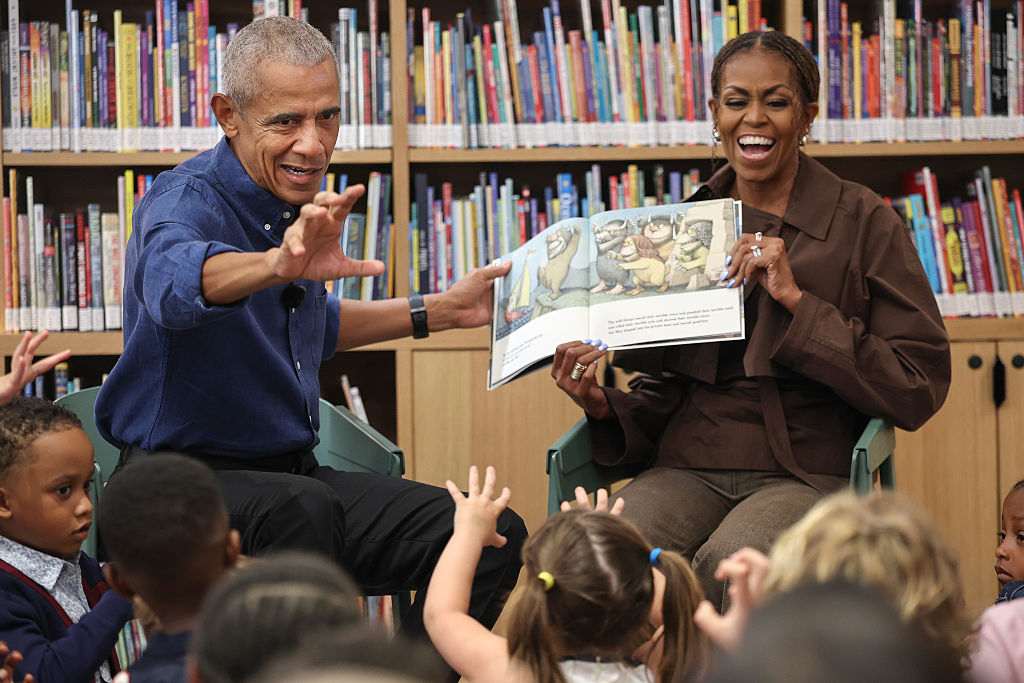
After leaving office, the Obamas practiced their own spin on the art of the deal, making $90 million from books and podcasts. Their Obama Foundation then spent $1 billion on a presidential library, choosing as its location a suitably salubrious corner of South Chicago. They remain as influential as any party donor: the couple’s endorsement will be a considerable prize for the party’s prospective presidential candidates. Staying relevant in Erie, the swing county of the nation’s swingiest state, boosts their brand. Even now, Michelle’s “Moderated Conversation” felt like just another psychological booster shot. As the moderator put it, she wanted “every single one of you to leave here feeling lighter, for all of you to feel uplifted and to feel more connected to each other”.
We know, by now, that all this left an opening for Donald Trump, who made the same Rust Belt pitch as Obama. Less “Yes, we can”, more a gigantic “Fuck you” — both sentiments nonetheless spoke to the same rage, the same sigh of nostalgia. “A large group of people who are now told that their world no longer exists because it was bad, outmoded, or unfashionable,” is how Lawrence Quill, who wrote the book on political nostalgia, describes their audience. “They feel disconnected and dispossessed. Into that vacuum, you say, ‘I hear your pain, I understand your loss. I speak for you. I represent your interests.’”
Neither Obama’s hope nor Trump’s carnage have stopped the Rust Belt’s spiral. Yet the pull of the past is revealing all the same. “When the nostalgia kicks in,” says Quill, “it’s usually a sign something’s off; something’s wrong; this isn’t the right trajectory.” The irony is that as Trump’s two terms have betrayed their promise, and as the man himself revels in cruelty and corruption, the Obamas in all their complacency have become another vessel for wistfulness.
Mood matters. And if you can’t eat inspiration, truly successful political programs must find some way of blending soaring rhetoric with a practical plan. For Democrats, as the midterms loom, that’s more urgent than ever. With Trump polling in the mid-30s, the party has a special opportunity to win the House, and likely the Senate, and build momentum for 2028. And, on the policy front, the party, especially its progressive wing, does genuinely seem to have answers. The Democratic Socialists of America (DSA) have seen their membership surge, with candidates from Florida to Michigan ousting establishment Democrats. The DSA offers energy, volunteers, and tangible policies from universal childcare to Medicare for All.
Ideas, then, are not the DSA’s problem. Cosmopolitan alienation is — something DSAers like Francesca Hong demonstrate with interest. When the Wisconsin DSAer said America should “cancel Thanksgiving”, she may have charmed the country’s well-educated elites. But as Hong’s primary defeat neatly proves, the best ideas in the world can’t outweigh a good story. And, whatever their flaws, Barack and Michelle are supremely comfortable with the tale America tells itself. “The Obamas believe in the myth of America,” says Nicci Page, a lawyer queueing to see Michelle in Erie. “Americans are great at myth-making. I think that’s our biggest export. We’ve made people believe that dreams come true and that they come true here.”
Page understands this in her blood. Like Michelle Obama, her forebears were bought and sold, yet inhabited a land where you could go from chattel slave to attorney in three or four generations. “That,” Page smiles, “says a lot about the promise that is still in America.” A pity so many progressive Democrats don’t seem to see that promise. For if the Obamas have no vision of the future, the DSA, too often, has no vision of the past. But voters, in the end, want both. This is their American way — one where the Obama mythos becomes tangible reality.
Jeff Bloodworth is a writer and professor of American political history at Gannon University
 jhueybloodworth