




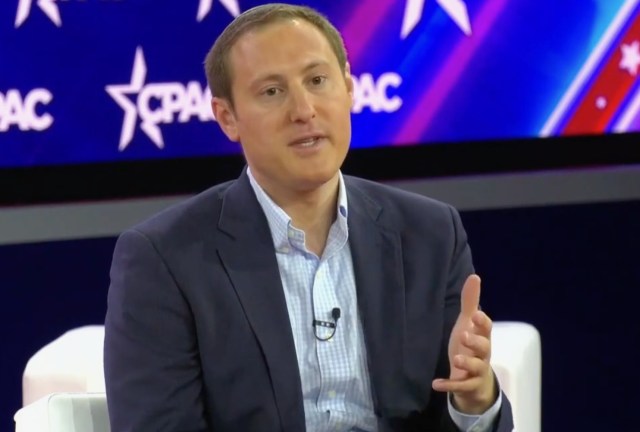
David Milstein reflects the general policy thrust of the administration, for good or ill. Credit: YouTube





Several months ago, while US officials were weighing America’s next defense Memorandum of Understanding with Israel, an American diplomat in Jerusalem made an unusual intervention. In a phone meeting, he proposed that the Department of War incorporate Rafael, the Israeli defense contractor, into the Golden Dome, President Trump’s signature missile-defense initiative for the US homeland. Others disagreed, arguing that Rafael’s systems didn’t complement American capabilities, and those skeptical voices won the day.
What made the diplomat’s intervention unusual was his reaction. He “got really upset and aggressive with people on the call over it,” according to a current US official with knowledge of the matter, who spoke on condition of anonymity to discuss highly sensitive internal deliberations. “He kind of does this thing where it’s an implied threat that certain people won’t be happy with this” decision — including “potentially his stepfather.”
The diplomat in question is David Milstein, a senior adviser to Mike Huckabee, the US ambassador to Jerusalem. His famous stepfather is Mark Levin, the Fox News anchor who over the past year or so has emerged as Trump’s favorite TV pundit. Another senior Trump World figure confirmed the outlines of what transpired, including “the threats regarding [Milstein’s] stepdad,” adding that it is “very unusual to do what [he] was doing for Israel.”
In recent weeks, Milstein has emerged as a lightning rod for critics of Team Trump’s policies on the Jewish state. Figures across the administration have also grown weary of his abrasive style and what they see as his cavalier attitude toward diplomatic security and the prerogatives of the US Intelligence Community and security apparatus.
His contentious tenure is a register of the dramatic changes roiling US-Israel relations. The briefings and counter-briefings — for and against Milstein — reveal the strains running through the heart of an administration otherwise marked by remarkable outward cohesion (by Trump GOP standards)
Milstein represents an older consensus that found few, if any, shades of difference between American and Israeli interests. That consensus is now coming under question, from the Left and the Right. Yet it still has the backing of one very important person, Donald J. Trump. And Milstein, his defenders contend, has passed the true test of a political appointee: serving his president loyally, at least by his own best lights.
To those defenders, Milstein has — unfairly — come to serve as a sort of stand-in for Israeli Prime Minister Benjamin Netanyahu, whom Trump World critics blame for maneuvering the president into waging an unpopular and strategically exhausting war with Iran. Yet the president makes his own decisions at the end of the day, the defenders argue, regardless of the sort of language Milstein inserts into State Department memos or what his famous stepdad says on TV.
As one former Foreign Service Officer told me, “Embassy communities can be incredibly unforgiving, especially toward a smart newcomer with strong beliefs. The largely anonymous effort to scapegoat David for the perceived failures of the bureaucracy is disturbing and absurd.”
Still, the missteps have been glaring. Take the dust-up over the proposed deal with Rafael. Several insiders characterized Milstein’s role as highly atypical. “Traditionally,” one former senior Senate foreign-policy aide told me, “diplomats representing the United States have focused on directing investments into American companies, not directing American taxpayer dollars into foreign companies.”
The current Trump official, meanwhile, questioned the utility of greater integration with Israeli contractors. “The thing about these companies,” the official said, “is that they rely a tremendous amount on US contractors for research, production, capacity, etc. Their innovation is usually just tweaking and incrementally improving our stuff, and sometimes [that] actually turns out not to be as effective as our systems.”
Defenders counter that the Israelis are, in fact, highly effective at certain kinds of frontier weapons development and testing that can redound to the benefit of the US military. And there is no denying that anyone who takes unorthodox stances in diplomatic and intelligence circles is likely to be met with the sort of shunning and gossip Americans normally associate with high-school mean girls. Even granting all this, however, doesn’t resolve questions about the way Milstein has gone about promoting his positions — not least what critics describe as an easy resort to pulling personal rank, given his family connection to Fox News.
Critics also point to Milstein’s clashes with others in the State Department. Milstein, The New York Times recently reported, has sought to quash or soften internal State Department reports that took Israel to task over settler violence in the occupied West Bank, for example.
Milstein has also butted heads with the Intelligence Community. The issues have included the IC’s assessment of the Iranian threat, as well as the goings-on in the West Bank. The biggest upset involved the July 2025 visit to the Jerusalem embassy by Jonathan Pollard, the former US naval intelligence officer imprisoned for spying for the Jewish state. “David was the primary driver of that,” said the current Trump official, who added that Milstein “hid [the Pollard visit] from the CIA’s station chief” in Jerusalem. The senior Trump World figure echoed this.
“It’s a big middle finger to them,” said the current Trump official, “because whatever you think of the CIA … these people devoted their lives to protecting and securing the United States, and they’re bringing in a guy that, in their mind, betrayed some of the most sacred oaths.” Another official, who has since left the administration, said, “Nobody was happy with that one.”
Then there is the question of information and diplomatic security. As Politico reported last month, Milstein sent out an online wedding invitation — including an illustration of the Temple Mount with the Al-Aqsa Mosque seemingly removed — that solicited cash gifts in either “US dollars or Israeli shekels.” To be fair, monetary gifts are routine in Israeli weddings, and Milstein’s action looked worse in theory than it was in practice. In theory, Milstein was putting himself at risk of falling in thrall to foreign nationals who’d give him money. This, in a country that poses an elevated counterintelligence risk to US officials, according to multiple sources familiar with the IC’s current assessment.
In practice, though, it’s hard to see a modest cash gift rendering Milstein more pro-Israel than he already is. The real problem, to his critics in Trump World, is double standards and the impression of impropriety. “The reaction has been,” the Trump official said, that “if this were any other government employee with a clearance who was soliciting money like this, they would have their clearance suspended. They would have likely been put on administrative leave.”
The State Department didn’t respond to UnHerd’s request for comment. The department’s apparent reluctance to vigorously defend Milstein — including in response to earlier queries from the Times and Politico — is itself evidence that “even they’ve had enough,” as the current Trump official put it. Direct messages to Milstein likewise went unanswered. As did a request submitted to the CIA.
Still, Trump continues to stand by Milstein, and the latter can’t be said to have acted against the directives of either the commander-in-chief or his immediate boss, Huckabee. Fact is, the second Trump administration has been the most pro-Israel in US history. Milstein reflects the general policy thrust of the administration, for good or ill. The direction of travel will almost certainly change in the near future, however, regardless of who wins the Oval Office in 2028. The divisions laid bare by the Milstein controversies are thus only a preview of what’s to come.
Sohrab Ahmari is the US editor of UnHerd. His next book, on The Triumph of Normal, is forthcoming from HarperCollins.
 SohrabAhmari