




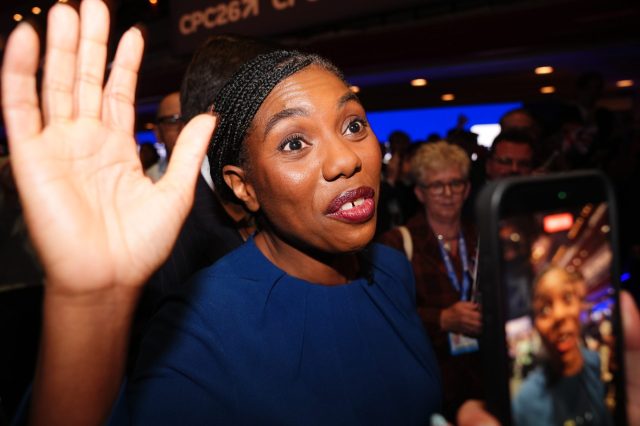
(Jacob King/Getty)





“Conference.” Even the bare noun suggests something of the rootless world into which you have entered. Part of the emotional appeal of Tory conference, I gather, is that, much like Jools Holland’s Hootenanny or Henley Royal Regatta, it is virtually the same every year, down to the arrangement of the furniture and location of the bogs.
The very familiarity of the situation provides a harmless holiday from political reality. Every autumn, politicians, their staffers and SpAds all rock up at one of the handful of provincial, fully disability-accessible convention centers within tolerable distance of London. Appropriately appalled by what they discover upon arrival, they quickly decamp to a heavily fortified conference zone. (Birmingham’s ICC has the reassuring further feature of being protected by an extremely confusing warren of canals that doubles as a kind of moat.)
If you play your cards right, you need never leave the militarized perimeter again. “Are you going to the GB News party later?” I ask one Kemi aide in passing. “That’s outside the secure zone, isn’t it? Feels a little risky” was his well-reasoned reply.
It is from behind these layers of police protection, airport-style metal detectors and assorted buffer zones that the members of His Majesty’s Most Loyal Opposition take up their annual opportunity to reflect on the question of how well they and their policies are being received by the public at large. In this task they are helped by perhaps the most unrepresentative sample of humanity imaginable: the Tory party delegates. If the ICC’s acoustics were less muffled, the building itself would be a physically-realized echo chamber of sorts. As an exercise in controlled, unbiased political thinking, it is a hopeless environment to work in. “I would rather take advice from my valet than from the Conservative Party Conference,” Arthur Balfour long ago complained. Little has changed. Political reality feels a long way off.
The job facing journalists is, if anything, more absurd. For many of the press pack, remember, this is the end of a long and desperate Odyssey: carried on a river of bad white wine from the Reform conference in early September, via the Lib Dems and Labour, they have finally washed up here in Birmingham. Pros that they are, they begrudgingly press their distended livers against yet another pre-fab countertop and clutch at the array of pre-poured drinks on offer.
The journalist’s job, as it is widely interpreted, is highly impressionistic: an art half-heartedly dressed up in the language of science. It is to “take the temperature” — or, in modern parlance, assess the “vibe” — of the party, using the motley self-selected crowd assembled as one’s meager evidential base. It doesn’t help that one is always in the process of recovering from, or contributing to, another day’s hangover. Nor is one’s sense of mental equilibrium much improved by the vaguely Lynchian tableaus that constantly meet the eye at Conference — the lurid confusions of props and personages that seem like stills from a nightmare. Turn the corner and you might see Michael Fabricant chowing down on a meat feast in the atrium of Pizza Express, while Nick Watt scampers around in your peripheral vision. Later, you walk into a Young Tory drinks and confront Kemi herself stiffly hitting the decks from behind pimped-out dark glasses as a handful of the more photogenic young Tories gyrate at her shoulders.
In this unsteadying environment, all kinds of mad theories and inferences are given an unwarranted free pass, many about the “Kemi bounce” the Tories are supposed to be enjoying. The “vibe” is said to be buoyant. Any positive development is alighted on as further confirmatory evidence. A flurry of distracted excitement meets the surprise arrival on day two of Jeremy Clarkson; but no sooner has he arrived than he punctures the mood. “A lot of people seem to have come dressed as seats,” he says, scanning the thinly populated upper echelons of the main hall.
In brazenly self-deceived mode, one CCHQ staffer speculates loudly that the visible improvement in the attractiveness of the young men in attendance, as compared with last year, is a surefire indicator of a coming recovery in the party’s electoral fortunes. I strain my eyes to see whether I can follow his reasoning. From what I see, I infer that the standalone mustache has finally made a fashion comeback (a long-awaited recovery, perhaps, in the face of the near-fatal countervailing influences on male grooming provided by AIDS and Adolf Hitler); but beyond that, little improvement is obvious.
Whether down on their luck or high on their own supply, when too many Tories gather in one place the behavioral default tends to be a kind of campy self-send-up that offers little opportunity for informative generalization to the country at large. In absurd homage to Jacob Rees-Mogg — who is in high demand following his triumphant YouTube confrontation with Tucker Carlson — young men scuttle about in oversized double-breasted suits and unflattering haircuts. They lark around next to a cardboard cutout of a warm-ale-swilling party chairman Kevin Hollinrake and his (presumably Right-wing) black Labrador. The widely-celebrated centerpiece of conference, and the cutting edge of CCHQ-inspired humor, is a mock British Museum exhibit that lampoons the previous two years of Labour government through the medium of tapestry.
Optimists remark that the “vibe” is more self-confident than last year’s. To others, the notable absence of the fractious troublemakers who now prefer to booze with Nigel at Reform conference is an unsettling sign that the Tories have become narrowly pedestrian, comfortably middle class and overwhelmingly Southern. That said, the Reform-coded fringe events seem notably fuller than their ploddingly centrist alternatives: turning up to one on the “Boriswave”, I find the venue full and operating a one-in-one-out policy much more discriminating than anything the Tories ever imposed at the country’s border.
The problem with trying to infer anything much on the basis of Tory conference is that for every pre-conceived theory, either exultant or pessimistic, there is an available metaphor. For the optimists, the bullishly pinstriped Thatcherite cosplay being indulged in and campily-named defense initiatives like the “Britannia shield” are taken as signs of renewed political vigor. For defeatists there is no shortage of equally potent material — for instance, the full-sized military drone that is suspended mid-tailspin from the ceiling of the main hall for “Defense day” and hangs there throughout the under-attended proceedings.
At one point, Sir John Curtice turns up to a fringe event (“Back in the Game?”) run by the cross-party think-tank Demos to remind the more extravagant vibe-detectorists in the audience that, their excitable theories notwithstanding, the Conservatives are currently averaging 20% in the polls. That is, they languish several points behind where they found themselves in 2024, when they suffered their worst defeat in history.
There may be no alternative but for political party conference season to incubate these sorts of escapist political fantasies. In this context, the fantasies are probably also fairly harmless. The greater danger seems to be when comparable distortions creep into policy, where the specific method of flight from reality that comes easiest to both main parties is to seek refuge in in-house nostalgia. In his continued railing against the past “40 years of neo-liberalism”, and in his insistence that the political clock must be cranked back, Andy Burnham is in the most literal sense anti-progressive: a rhetorically talented Left-wing sentimentalist. His proven ability to make the Cabinet applaud and weep like North Korean news announcers conveniently conceals the fact that his existing policy platform is a piecemeal array of petty redistributionist interventions dressed up as something more visionary: a resuscitated Help-to-Buy housing scheme, £2 bus fares, VAT off electricity bills, and a fanciful pledge to end rough sleeping. Even if considered well-intentioned rather than time-wasting distractions, the parochial scope of these policies hardly seems well proportioned to the priorities of a modern, national government.
As Badenoch took to the stage on Wednesday, the overwhelming strategic temptation was to accept the terms of Burnhamism’s backward-looking framework in the expectation of a victory on the same nostalgic terms. With Burnham invoking the pre-Thatcherite Seventies, the obvious reaction is to advocate for a return to the Eighties and the free-market-fueled Thatcherite boom it brought with it. Many, after all, if they visualize this Burnhamite Britain for even a moment, can imagine or recall how drab it actually was. In anticipating a “battle for the soul of this nation” of a kind not seen “for more than half a century”, Badenoch seemed at times to welcome an ideological contest litigated along these broad historical lines. Over the course of the conference, depending on their tolerance for party political theorizing, Tory delegates skimmed or studied “The Right Way”, Badenoch’s 100-page pamphlet produced in self-conscious imitation of Mrs Thatcher’s own 1976 mission statement.
It would be much better if the differences between Burnhamism and what, for the time being, is called “Kemistry” could be developed without so much recent historical allusion being projected onto the debate. Though there are real obstacles within her own party ranks to doing so — the eccentric shire traditionalists, veto-playing Nimbyists, and triple-lock-addicted pensioners — what Kemi Badenoch really needs to do is out herself in historically-unhedged terms as a genuine “progressive”.
That needn’t mean favoring the kind of progress that Tories of 50 years ago imagined; nor should it mean “progressive” in the moribund woke sense of that term; but a progressive in the only sense that counts — in the sense of someone who actually promotes cultural, political and economic progress. The manipulations and errors of gender ideology, which Badenoch opposes, are, after all, just as much a part of broadly anti-progressive politics, as are the impositions of the over-regulated administrative state advocated by Burnhamite Lefties. In both cases, it is part of their deeper deception to present as advances what are actually catastrophic regressions.
The phrase “Right-wing progressive” is of course incongruous enough to the modern ear that it strikes some as borderline infelicitous. Part of the rhetorical victory that the Left has won in recent decades is to establish an unearned but powerful monopoly on the very notion of progress. The act of reversing such a rhetorical power-grab is one Machiavelli famously argued might require an effort of “rhetorical redescription” on the part of a skillful leader. In the later chapters of The Prince — where he recalls the use of the Roman rhetoricians’ technique of paradiastole — Machiavelli alludes to the expedience of redescribing vices as virtues in the effort to take control of powerful concepts for one’s own advantage.
Though the practice can clearly be deployed to, as it were, “Machiavellian” ends, it is one no leader intent on remaking the political weather, for either good or ill, can easily do without. With backward-looking political nostalgics to their Right and Left in the form of Reform UK and Labour, the Tories might find that claiming to be Westminster’s true future-oriented “progressives” might be their best shot at political survival. But that kind of reimagining is difficult to achieve over the course of a few days in a heavily fortified echo chamber in Birmingham.
