









Once the French had sent troops, anti-aircraft missiles and fighter-bombers to help the Saudis fight the Houthis, it was inevitable that Britain’s Labour government would drop its anti-imperialist posturing and join the war. Ironically, however, this upsurge in European activism started in Washington. When the Saudis asked for US help, Donald Trump refused because he had been bitterly disappointed by the Saudi refusal to support his Iran war. That opened the way for Emmanuel Macron, the most entrepreneurial of Europe’s political leaders.
Macron would never do anything so crass as to present his bill before rendering a service, but he’s well aware that the traditional Saudi recompense for military support is a very large order for combat aircraft. The French desperately need such a sale to save their once-thriving Dassault firm, which has fallen on hard times because of its current offering — the non-stealthy and non-advanced Rafale fighter that nobody wants.
Back in 1985, it was British aircraft manufacturing that was in freefall. It was saved by the fabulous Al Yamamah contract, which supplied £40 billion of Saudi cash to both the British aviation industry for its mostly unwanted aircraft, and to an entire tribe of intermediaries. The latter successfully avoided scrutiny for decades, until Scotland Yard’s Serious Fraud Office belatedly launched an investigation so successful that it had to be shut down on national security ground by a remarkably unembarrassed Tony Blair in 2006.
Now, once again, the British aviation industry is trying to survive with a jet fighter program that nobody wants. It has a temporary partnership with the Italians, whose air-force will never be sent into combat, and who see building places as a way of keeping their factory workers employed; and with the Japanese, who see the tripartite deal as a bargaining chip in their negotiations with America’s Lockheed monopoly for Tokyo’s next fighter.
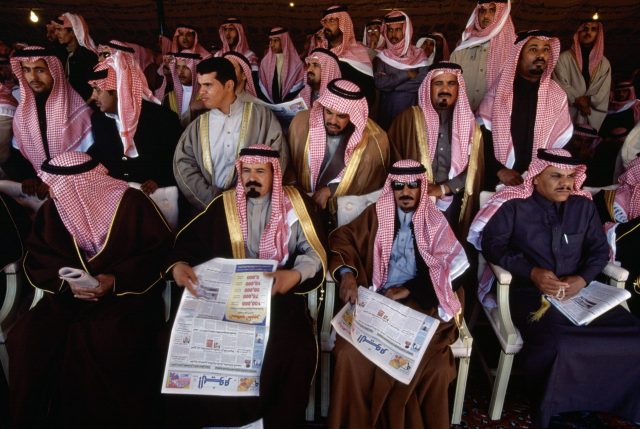
The fact that Saudi Arabia turned to the weakened French and the bashful maidens of the Labour Party for military support is a sharp reminder of one of the few constants in the ever-changing Middle East: the inability of the Saudi monarchy to defend itself. That requires some explanation because Saudi Arabia’s armed forces are both well armed and also very large as compared to the country’s native-born population of 18.8 million. There is a total of 280,000 active-duty career personnel in land, air and naval forces and another roughly 75,000 in the paramilitary national guard, which has evolved from a come-as-you-are Bedouin levy into an orderly paramilitary force like Italy’s Carabinieri, so that the Kingdom has a total of 350,000 in its armed forces. By way of comparison, Turkey’s population is more than four times as large as Saudi Arabia’s, but its military and paramilitary total of 680,000 is only twice as large. Moreover, Saudi forces have well-built bases, impressive headquarters, modern weapons, and have received excellent training from American, British, and other military instructors at all levels, including newly retired US generals.
But the one thing they cannot do is fight Saudi Arabia’s enemies, including the currently very dangerous Houthi rebels, most of whose combat personnel consists of visibly unwashed men in skirts and sandals toting old AK-47s, which also include teams trained by Iranian experts capable of launching ballistic missiles and anti-ship drones smuggled in by Iran. Wielding the latter, they have attacked Mecca and are now seriously impeding Saudi oil exports from the Red Sea terminal at Yambu.
Yet even now, there is still no sign of a Saudi offensive into Yemen to engage the Houthis in full force. The reason is that, for the Kingdom’s ruling family, the most deadly danger has long been a military coup d’état — such as the one which ended Iraq’s monarchy and killed every single member of its Husseini ruling family on 14 July 1958. On that day of explosive savagery across the center of Baghdad, none of the monarchy’s supposed friends and allies were of any help, and local British diplomats, who had until recently ruled the country via interposed Iraqi officials, barely made it out alive.
Against that danger, the successive heads of the Saudi ruling family have implemented the most effective remedy possible: divide and rule, not against foreign enemies, but within their own armed forces. For that reason, the different combat elements of the armed forces are geographically separated and commanded by different princes, in charge of various parts of the ministry of defense, all of which are subordinate to the minister himself, Prince Khalid bin Salman Al Saud. (Prince Khalid is the grandson of the House of Saud’s patriarch, King Abdulaziz, and a younger brother of the crown prince, prime minister, and real power in the land: Mohammed bin Salman.)
Even with all those royals in there to secure the House of Saud’s control, the ministry of defense is denied a monopoly of force in Riyadh and other urban centers, because the country’s cities are also garrisoned by the entirely separate Saudi Arabian National Guard which has more than 150,000 men, and is ultimately commanded by yet another grandson of the kingdom’s founding monarch. The smaller Border Guard with roughly 15,000 men plays a crucial role in emergencies because it strictly controls who enters and leaves the country by air or sea. The Border Guard is also controlled by a grandson of King Abdulaziz, as is the most closely watched and carefully controlled of all the kingdom’s forces: the Royal Guard, which protects Mohammed bin Salman. Finally, there is the elite Saudi Arabian Emergency Force, of some 35,000 men, which is under the control of yet another separate body.
In theory, there is nothing to prevent a combined offensive of all these different forces against the Houthis. For all the competing lineages of their chiefs, they are all Sunni Muslims of the vehemently anti-Shi’a Wahhabi creed. The Houthis, for their part, are not the much-loathed Twelver Shi’a of Iran and Saudi Arabia’s eastern province, but the distinctly more heterodox “Fivers”.
In practice, however, the careful differentiation of Saudi Arabia’s military and security forces that is meant to prevent them from ganging up to overthrow their rulers — the Royal family as a whole — has deprived them of an overall sense of cohesion, the most important of all attributes in facing enemies in combat. Military strength is total force multiplied by cohesion: if there is no cohesion, there is no strength.
Within the different armed forces there is a further impediment to cohesion because some of their officers are Royal family “inheritors”. This means they receive a stipend automatically as well as their salaries. Others, however, only have their salaries, which can be much lower than the royal family stipends, yet they are all supposed to serve and fight to protect their country.
The Saudi fear is that if they ever order some of their F-15s into action to bomb the Houthis, or indeed any other enemy, non-inheritor pilots might choose to attack one of the kingdom’s princely palaces instead as a prelude to an all-out military revolt. It would be an aerial version of the military insurrections that destroyed the Egyptian and Iraqi monarchies.
Because of this not illogical fear, the Saudis have long relied on the Americans to protect them, supplemented at times by the British and French. In recent years, they have even called on the Turks and Pakistanis, who have so far refused to send any troops to fight the Houthis, the most urgent threat faced by Saudi Arabia. That refusal suggests that they are even less likely to send forces to confront Iran’s much larger threat.
The Saudis’ Emirati neighbors have not given up on the Americans either, even if they have enlisted Israeli weapons to defend them — some of them operated by Israeli troops, at least initially. The Saudis might do something similar in the low-key manner of an industrial investment, to obtain anti-missile capabilities they can learn to operate for themselves. Ultimately, though, the inheritors must learn to share Saudi Arabia’s vast flow of oil revenues with everybody else, or else risk losing more than just their wealth.
Professor Edward Luttwak is a strategist and historian known for his works on grand strategy, geoeconomics, military history, and international relations.
 ELuttwak