




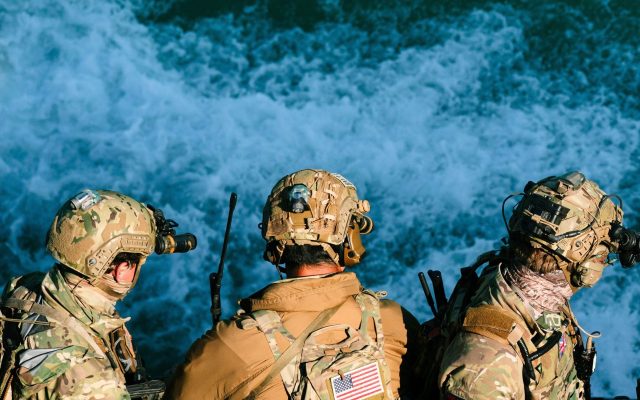
Nato special operations take part in the Trojan Footprint 2026 military exercise in Constanta, Romania. (Andrei Pungovschi/Getty)





Off the coast of Hiiumaa, history is about to be made. A combined fleet of Nato battleships — led by destroyers from the Royal Navy and involving five nations — steams toward this windswept island at the mouth of the Gulf of Finland. Just ahead: Russia’s Baltic Fleet, which for the past 36 hours has attempted to enforce a naval blockade of Estonia. Further east, 100,000 Russian troops have gathered, too, with Vladimir Putin demanding that Nato withdraw any assets posing “a threat to the security of the Russian Federation” from Estonian territory. More than that, Putin wants Tallinn to grant regional autonomy to the “Narva People’s Republic” — a breakaway statelet purportedly declared by Estonia’s Russian minority, but which in reality has been invented by the Kremlin, then mercilessly promoted on social media. No matter. Martial law has been declared, “separatist” drone attacks are underway, and Estonian forces have already engaged Russian warships anchored in Tallinn Bay.
Following a Russian strike on an air-defense system in Poland a week before, which Putin framed as retaliation for Nato involvement in the war in Ukraine, the alliance has sheepishly declared Article V. But, leaning on the North Atlantic Treaty’s legal technicalities, Donald Trump has refused to intervene, preferring to support European allies in “other ways”. Without American backing, only a handful of European states have deployed their armed forces to bolster Poland and Estonia. And with a second Russian army assembling in western Belarus, and the prospect of missiles flying at Warsaw from Kaliningrad, Poland’s large and robust military is mostly tied up at home. As American envoys arrive in Moscow to negotiate Putin’s terms on Estonia, and likely much of Nato’s east for that matter, British commanders aboard HMS Duncan train their guns on the Neustrashimy, a Russian frigate just appeared on their radar. With fighters screaming into action overhead, the Duncan’s crew hold their breath, as their ship enters the range of Russian guns.
I’m hardly the first observer to speculate on what war between Russia and Nato might look like — and, given the storm clouds gathering in Eastern Europe, I surely won’t be the last. After months of escalating Russian gray-zone attacks against Nato, ranging from drone incursions to stray missiles and attempted bombings at Leipzig airport, warnings about Putin’s plans for Europe have grown louder on both sides of the Atlantic. And now, just last week, Polish and Lithuanian leaders have both separately claimed to have intelligence that Russia is planning “accidental” rocket and drone strikes on pro-Ukrainian members of Nato, a conclusion corroborated by Emmanuel Macron. Together with CIA chief John Ratcliffe’s unannounced visit to Moscow last month, among other things to warn Putin off attacking Nato, the atmosphere feels worryingly similar to the months leading up to Russia’s invasion of Ukraine in February 2022.
Yet if a flashpoint on Nato’s borders appears increasingly likely, we equally shouldn’t expect a shooting war to start tomorrow. If he does indeed choose to throw his armies westward, Putin’s aim will first be to break the alliance’s internal cohesion, and to exploit its central weakness in an age of hybrid warfare: that the cost of actually honoring Nato’s self-defense clause is too much for most members to contemplate, until it’s too late anyway. It helps, here, that just like in Ukraine, Putin’s goal wouldn’t really be recovering lost territories. As always, rather, it’d be about control. Removing Nato as a cohesive bloc would allow Russia to once again dictate terms to its European neighbors, a generational shift in the balance of power on the continent, and marking the apotheosis of Putin’s decades-long political project. And, if all went to plan, the Russian premier could plausibly achieve all of this without triggering the world war many in the West have feared.
The first phase of any Russian provocation campaign would likely start with a strike on a border crossing between Poland and Ukraine. Polish Prime Minister Donald Tusk has already warned of just such an attack, claiming that one has already been foiled via a joint Polish-Ukrainian operation. Russian forces have already been striking targets mere kilometers from the Polish border, and attacked a civilian Warsaw-Kyiv train not long after European officials including Boris Johnson had traveled along the line. Hitting border crossings would benefit Russia from several standpoints: Putin could plausibly claim attacks were accident; could make weapons shipments to Ukraine via Poland more logistically difficult; and crucially, could broaden the “acceptable” field of operations of the Ukraine war.
Now is where things would start to get really dangerous, with drones of the sort that were shot down by Nato jets over Lithuania this week finally starting to find their targets, striking critical energy or security infrastructure close to the border with Belarus. Such strikes may start innocuously enough, with drones “accidentally” hitting unmanned border watchtower or rural power lines. But then, one might damage an oil pipeline in Latvia; or a critical LNG terminal in Lithuania; or even a section of Poland’s Rzeszów-Jasionka Airport, which serves as a logistics hub for transferring Western arms to Ukraine.
Ultimately, though, the real aim of such attacks would not be material damage — but instead making low-level air assaults a regular part of European life. Poles, Germans, and Lithuanians alike have already become inured to headlines about Russian-sponsored arson attacks or drone incursions, and it’s not a huge stretch to imagine they’d do the same with this new wave of provocations. That matters: for despite the alliance’s tough talk, no one, including Putin, realistically expects that Nato would go to war with Russia over a damaged pipeline, no matter how important it might be. We already have clear proof of this: Nato failed to act even after a Russian drone struck a residential building in the Romanian city of Galați in May, injuring two residents. The trouble with the alliance’s intentionally defensive framework is that there is no clearly stated middle ground; war and peace are the only two options available. And, within such binary parameters, Nato will almost always choose an insecure peace over a highly disruptive total war.
All the same, European Nato states would have to send a message to Moscow sooner or later. Rather than striking at Russian soil directly, however, they’re more likely to give Ukraine the intelligence and hardware to hit drone-launching sites on their behalf. In the end, though, politicians in Nato’s east would still have to signal to their citizens that they were willing to take decisive steps to protect them and their infrastructure, and would finally take a leap into the unknown: shooting down Russian projectiles heading toward their borders. This is something Polish leaders have been discussing for years, and within such a volatile threat environment, it would be the obvious next step for the alliance short of full-scale war.
At this point, for Putin, all the pieces would be in place for the final step in the escalation ladder. The Russian leader, and the Russian public for that matter, have considered themselves to be in a de facto state of war with Nato for quite some time now. Not only would all of these developments make this even clearer, but would also fit squarely within the foundational push of Putin’s national narrative. Russian aggression against Georgia in 2008, Ukraine in 2022, and the West in 2026 has always been justified by the politics of grievance — and, by becoming directly involved in Ukraine, Nato will have crossed a red line. Coming off the high of a record win in Russia’s latest State Duma elections, Putin’s party would gladly use these events as fuel for another, much-anticipated mass mobilization, adding some 300,000 new conscripts to his armed forces. Russian authorities would still face plenty of resistance, but much less than if the drive had been solely framed around the war in Ukraine.
With Europe besieged but complacent, Putin could then make his biggest gamble: a direct missile or drone strike against a Nato battery involved in aerial combat in Ukrainian airspace. Poland’s Small Narew surface-to-air missile system, stationed in the quaint city of Zamość near the Ukrainian border, would make a perfect target. And this time, there would be no beating around the bush: Russia would own the attack, framing it as a retaliation for Nato intrusion in Ukraine, and demanding that the alliance reverse course to safeguard Russia’s “legitimate security concerns”.
A tired Europe would finally consider Article V at Poland’s request. But the outcome would be a foregone conclusion: the appetite and social cohesion necessary for a war of this scale simply isn’t there, especially in Washington. What’s crucial to understand here is that, in a Nato-Russia shadow war, there wouldn’t be some single event, like the 1939 invasion of Poland, that suddenly snaps Europe from its lethargy. This is what lies at the core of Putin’s strategy: even if the frog finally realizes it’s being boiled, things will be too far-gone for it to gather the strength to jump out the pot.
Far from Nato’s frontline, meanwhile, publics in both Western Europe and the US would hardly be willing to leap headfirst into a conflict with Putin: the strike on Zamość would hardly be shocking at this point. More than that, Putin’s rhetoric of victimhood would play well with both MAGA and Left-wing campists, who’d probably see the circumstances of the Zamość strike as yet another reason to disengage from both Ukraine and Europe. With the Iran war still unresolved, meanwhile, Trump would see no reason to commit troops to a European theater he has long seen as marginal — especially if Pete Hegseth’s “force posture review” ends with the withdrawal of up to 25,000 American soldiers from Europe later this year.
Though the US might acquiesce to an Article V declaration, in short, it would likely also use the Treaty’s open-ended language around mutual-assistance obligations to weasel its way out of fighting. Slovakian Prime Minister Robert Fico has already stated he would do exactly that if Article V were ever invoked. Of course, no one will miss Slovak troops in the event of a conflict with Russia, but the lack of American involvement would surely dissuade many smaller countries from sending help. So Article V or not, make no mistake — American apathy would break the alliance, something Putin himself is well aware of.
Nato structures may remain strong on paper, in this scenario, but the organization would actually resemble a malleable “coalition of the willing” — far more than an all-encompassing defensive alliance. That would be a massive blow for the bloc’s frontline states, and with dramatically lower stakes and a broader field of movement, Putin would act accordingly. Any strike against Poland likely wouldn’t lead to an actual invasion, but it would keep its forces locked in a cross-border standoff. That leaves Estonia. Though Britain, France, Germany and Poland, perhaps alongside Denmark or Canada, are likely to send troops or ships to defend a threatened Tallinn government, US indifference precludes a broader campaign. Even nearby Sweden and Finland would likely be cautious about overextending themselves too early, mobilizing their populations but then remaining holed up for whatever comes next.
What would come next? Certainly, whatever the limitations of the Russian military machine, victory for the new anti-Putin coalition would be far from guaranteed. Yet even if, to borrow our scenario, the Neustrashimy’s commander relented off Hiiumaa, or else engaged HMS Duncan, lost, and rendered Russia unable to enforce a blockade, Putin might still hope to carve a new European order from the chaos — especially if he felt he still enjoyed Trump’s good graces.
Alongside what we might call the “Belarusification” of Ukraine, that would surely include attempts to disarm the Baltics, while keeping heavyweights like Poland contained and self-interested. To be clear, Putin would likely be unsuccessful in meeting all of his goals here. Indeed, surrounded by sycophantic generals, he may well stumble. But like in Ukraine, after suffering an initial loss in Estonia, the Russians could yet regroup, adjust their strategy, and lock Nato’s rump in a fresh quagmire, turning border cities like Narva into Bakhmuts on the Baltic. Whatever happens, Putin will understand that, without America, the old equation in Europe has gone, while his new opponents will hardly have time to react.
Some might see these hypotheticals and conclude that the only way out for Nato is to disengage completely from Ukraine. But this would simply kick the can further down the road — Russia at this stage sees Ukraine as merely one theater within a much greater war over the future of Europe. Even if Trump decides to unilaterally welcome Russia back into America’s embrace, Putin’s steadily escalating gray-zone war with European Nato would anyway likely continue, regardless of events in Washington or Kyiv. The choice facing the Europeans, then, is not simply between peace and war, but between accepting Russian hegemony over Eastern Europe — and opposing it. Exactly how they do that remains the challenge of our time.
 Michal_Kranz