




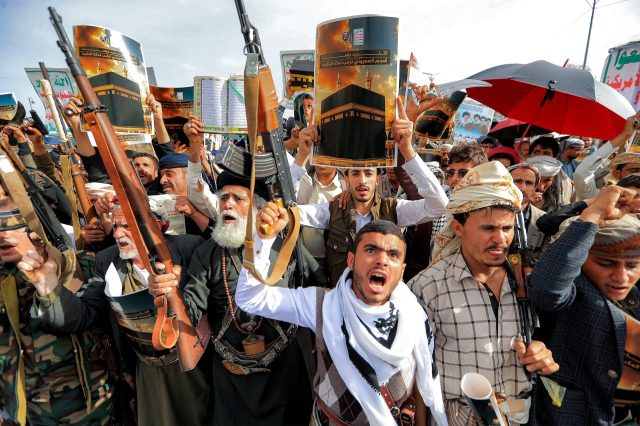
“The Houthis, who not long ago were mostly farmers and shepherds, have thrived in a primitive environment.” (Mohammed Huwais/Getty)





Yemen has always been defined by its topography. A landscape of narrow coastal plains, mountainous highlands, and a desert interior, has helped preserve tribal identities, blurring and softening sharp religious divisions. If a very modern, post-1979 battle between Sunnis and Shi’ites now defines the country’s politics, a rugged and inescapable geography continues to impose itself. This is clear enough with the Zaydi Shi’ites, now better known by the name of a martyred Islamist leader: Hussein al-Houthi. Combining a deep knowledge of their country’s landscape with revolutionary zeal, the Houthis have coalesced into an unrivaled fighting force, as well as Iran’s best allies in its war against America and Israel – costing Tehran surprisingly little money.
Indeed, the more you learn about the Houthis, the less surprising it becomes that the group should have embarrassed the US Navy in 2024 and 2025 (in a foretaste of the second Iran war, Washington simply gave up firing its expensive missiles at Houthi forces), and fought a large Sunni-Arab coalition to a standstill between 2015 and 2019. Despite intense bombardments, and serious battlefield defeats, the Houthis have retained Sana’a, Yemen’s capital which they conquered in 2014. Only the Israelis, who briefly got into a missile exchange with the Houthis in 2025, have managed to lay a finger on them: they went after the Houthis’ oil supplies, energy infrastructure, ports, airports, and, perhaps most important, senior personnel. Sure enough, the Houthis stopped firing at Israel. But either way, it’s little wonder that the Houthis are now back, seizing land along the Red Sea littoral and the islands of Perim and Greater and Lesser Hanish, thereby putting into jeopardy Saudi Arabia’s capacity to export oil via its east-west pipeline.
Without outside support, Sunni Yemenis would have had no chance on the battlefield against their Shi’ite countrymen. The Houthis have received some support from Hezbollah and Iran — but not nearly on the level that Sunnis have received from foreigners since the Sixties. Islamic history has occasionally seen fervent, martial highland peoples descend into conflict with more numerous lowland believers — and usually get the better of them. The Houthis are in this line: mountain Shi’ites who have managed to gain the upper hand over the cosmopolitan and fractious Sunnis.
During the North Yemen Civil War (1962–1970), the Zaydi royalists of the old Imamate survived a massive assault by the republican forces that had overthrown them. The Republicans included predominantly Sunni Yemenis, but also Zaydi Arab nationalists, and were backed by around 70,000 Egyptian troops equipped with Soviet tanks and aircraft. The Zaydi royalists, meanwhile, adopted highly effective guerrilla tactics. Again and again, they descended from their mountain strongholds, absorbing heavy losses. They were not able to capture Sana’a — but they were repeatedly able to regroup and return to the fight.
The war today is vastly more sectarian. Few Zaydis now fight alongside Sunnis, giving the more cohesive, dogged, and fit Houthi forces the advantage.
Still, since the Nineties, support from Shi’ites in the wider region has been crucial in shaping Houthi objectives. The Islamic Republic of Iran and Lebanon’s Hezbollah have actively sought to convert Zaydis, who follow a different creed and jurisprudence. These efforts have met some success: perhaps as many as 10% of Zaydis have accepted Iran’s “Twelver” branch of Shi’ism. These conversions are, however, just icing on the cake. Before the Lebanese and Iranians came calling, Zaydism as a faith had considerable revolutionary potential. Historically, Yemen’s Shi’ites have had activist imams: religious leaders who could also command troops. Where the Twelver Shi’ites of Iran, Iraq, and Lebanon could — before the Iranian Revolution in 1979 — sometimes look askance at clerics assuming political power, the Zaydis had no such reservations. Zaydi imams ruled as kings, more or less continuously, from 897 to 1962, when nationalist forces toppled the imamate. The main interruptions came during two periods of Ottoman rule, from 1538 to 1635 and from 1872 to 1918. Even then, the imams did not simply disappear: they retreated into the mountains, where they continued to exercise religious authority and, at times, lead armed resistance to the Ottomans.
Today, a spiritual alignment has unquestionably taken place — and a significant slice of the Zaydi community is now inside the Iranian orbit. The Houthis’ anthem — “God is the Greatest, Death to America, Death to Israel, Curse be upon the Jews, Victory to Islam” — would have seemed bizarre to most Zaydis before the radical revivalist movement of al-Houthi. Cursing distant America, or Jews as if they were a global menace, or even Israel as a part of a defining, individual creed would have been too modern.
More or less at war with the “official”, internationally-recognized government of Yemen since 2004, the country’s Shi’ites are on a winning streak. Indeed, since the Saudis, Emiratis, and a coalition of other Arab states tried to humble them from 2015 to 2018, the Houthis’ regional ambitions have grown. They have created their own supply and sanctions-resistant support networks in the Middle East, Africa, and Asia, sometimes piggybacking on the Iranians, sometimes moving independently. With Iranian assistance, they figured out how to defy a Saudi naval blockade and US satellite reconnaissance. Indeed, the Houthis have been able to incorporate Iranian strategic planning into their own ambitions as well as any Iranian proxy. They have proven sharp adopters of Iranian-supplied drones and missiles, learning quickly how to build projectiles from either clandestinely delivered parts or from scratch — indeed, they have proved enthusiastic adopters of AI.
It’s also a foregone conclusion that if Iran can gain control of the Strait of Hormuz and charge tolls, the Houthis will attempt to do the same through dominating the Bab al-Mandab, the chokepoint for all trade moving through the Suez Canal — as well as for Saudi oil via its pipeline. Even if Iran fails to dominate the Persian Gulf, indeed, the odds are that the Houthis will still try to curtail Saudi shipping. If successful, the Houthi’s ambitions – and greed — may direct them towards other commercial shipping.
Yemen is a very poor country, and the Zaydi mountain heartland now offers little of the trade that once made the Zaydi elite relatively rich within it. Enormous anger towards Saudis is common. When I was traveling among Yemeni Shi’ites before 9/11 and I needed a conversation starter, aspersing Saudis always worked. So targeting Saudi shipping is a given for the Houthis; and preying on others could become an irresistible financial temptation if they control the Bab al-Mandab. Raiding British and Indian trade in the Persian Gulf and Indian Ocean in the 18th century was very good business for pirates of the Arabian Peninsula until the Royal Navy and Marines convinced them otherwise.
The US maintains Camp Lemonnier, its only permanent military base in Africa and the operational hub of US Africa Command, just across the Bab al-Mandab in Djibouti. President Trump wasn’t persuaded of the merits of using it to deny the Houthis a partial victory against his Navy in 2025. It’s a good bet that Trump will default the responsibility for stopping Houthi extortion onto European navies, especially the French, who also have a naval base at Djibouti. Trump is perennially capricious — but also firm in his conviction that Europeans are freeloaders.
Nonetheless, the problem that the West has with the Houthis is also a microcosm of the problem that the United States has with Iran: there is no clever, low-cost way to neutralize the enemy’s power. When, in 2015, he was the Saudi defense minister, Crown Prince Muhammad bin Salman clearly understood the long-term threat that the Houthis posed to his kingdom. The prince’s execution of the subsequent war may have been abysmal, but his analysis wasn’t. Neither the Saudis, nor the Emiratis, nor the Egyptians, nor the Jordanians, nor the Americans, nor the Europeans have been willing to put boots on the ground to neutralize the Houthi war machine. Cairo’s unpleasant experience in Yemen in the Sixties — “Egypt’s Vietnam” — remains in the DNA of Middle Eastern military men. The combined Arab aerial assault on the Houthis from 2015 onwards revealed a wariness of replicating the approach the Egyptians had used — trying to take the Houthis on in their heartland.
The Houthis know this. So do the Iranians, who have seen the most independent of their proxies become their most consequential ally. The strategic potential of Yemen’s Shi’ites now dwarfs the contribution of the Levantine Hezbollah to Iran’s remarkably consistent goal of weakening the West and their allied Arab governments in the Middle East. The Houthis aren’t nearly as sophisticated as the Levantine Shi’ites, who rival the Iranians in their formative contribution to the development of radical Shi’ism, and have proved rather better than the Iranians in maintaining the crucial interpersonal relations between Arab militants.
Yet the Houthis, who not long ago were mostly farmers and shepherds, have thrived in a primitive environment. Their relations with Somalia’s Al-Shabaab — a Salafist jihadist outfit, which in 2012 pledged allegiance to Al-Qaeda and has often shown a savagery that rivals Islamic State’s — clearly show the Houthis have, like the Iranians, an ecumenical disposition toward anti-Shi’ite but anti-Western Sunni Muslim radicals. If left alone, the Houthis might well develop further, becoming emissaries of Iranian mischief far beyond the Gulf of Aden. Some Islamic militants — the Taliban in Afghanistan; Hamas in Gaza — keep their violence local. They don’t become members of the “global jihad” even though they may host or associate with Muslim radicals who do. But the Houthis’ creed certainly suggests an aspiration that could take them into a larger holy cause, especially if under the tutelage of more worldly Iranians and Levantines.
Regardless, the Houthis have offered Tehran the best bang for the buck of all its proxies. We don’t have reliable figures on what the Saudis and Emiratis spent on their multi-year war against Yemen’s Shi’ites, nor what the Iranian subventions were to their co-religionists, but Tehran’s costs were unquestionably a small fraction of those on the other side. The Islamic Republic is now in a deep financial crisis, but supporting low-maintenance, enterprising Yemenis may still be practicable. Strategically, it remains a steal.
If the United States, the Europeans, and most importantly the Arabs who border and depend on the Red Sea, are serious about thwarting the Houthis, then they should revisit the history of the Ottomans in the Arabian Peninsula. They checked the rebellious Zaydi imams with the patient application of brute force. (Even if, as soon as the Ottoman Empire collapsed in 1918, a Zaydi Imamate came right back). That won’t happen again, however, unless the United States leads the way.
Today, there are so far no volunteers for this mission. The experience of the Egyptians in Yemen in the Sixties, like the more recent sojourns led by the Saudis and the Emiratis, all were bitter failures. The treasure expended didn’t match the gains. The Middle East excels at forcing cost calculations. The Houthis and the Iranians are banking that the years since 9/11 have worn down their enemies. They know that in a contest of wills, they have the unassailable high ground.
Reuel Marc Gerecht is a Resident Scholar at the Foundation for Defense of Democracies and a former Iranian-targets officer in the Central Intelligence Agency.
 ReuelMGerecht