




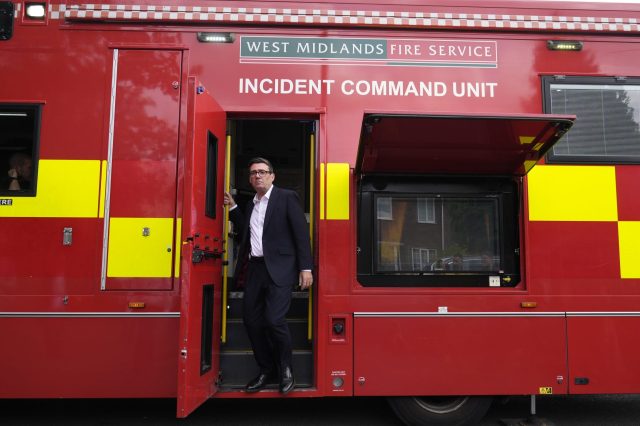
Can he take the heat? (Peter Byrne/WPA/Pool/Getty)





While some Scottish nationalists are eager to remind everyone else it has been raining in the Highlands, these past months have been unprecedented for much of the UK. Two-thirds of England is still experiencing drought, with places such as Wisley seeing no rain since the middle of June. The previous record for the Surrey village was 37 days, back in 1976. It has also been the hottest summer on record. So far, there have been 38 days where the mercury passed 30 degrees.
Even if it is about to rain, the damage has been done — with Britain’s arable harvest set to fall to a record low. No wonder the country’s most famous farmer, Jeremy Clarkson, has changed his mind on climate change. Wildfires offer a visceral intensity that other expressions of extreme weather do not. A hosepipe ban might be frustrating, but it isn’t potentially fatal (except for your much-loved begonias). In the South, an ongoing blaze in the New Forest has hammered local businesses, killed a great many ground-nesting birds, and is set to shut down the A31 for a fortnight. That’d kill businesses across the south if it extended to the bank holiday.
And while that fire was largely unnoticed by the rest of the country, what really grabbed people’s attention was the blaze that engulfed whole streets in Stourbridge, razing almost 40 homes. Well, that and the national emergency alert sent to millions of phones warning of a “very high risk of wildfires nationally”. A major fire, which could kill many people, looked entirely plausible. Contributing to that heightened sense of panic was the fact that that two separate trains — both in the south of England — were derailed, with 20 people injured in one. While neither incident is yet to be attributed to the weather, high temperatures seem the most likely explanation.
Water shortages, fires, critical infrastructure starting to buckle: it’s like a checklist for the early stages of climate-induced breakdown. Gradually, and then all at once, it has become clear we aren’t prepared for the world now coming into view. Least of all our politicians.
The politics of climate, for obvious reasons, dovetails with that of energy. In spite of their loathing for one another, deep greens and climate-skeptic capitalists agree on one thing: energy abundance cannot exist in a world without fossil fuels. In the short term, we can’t have both decarbonization while using more energy than ever. Thus, at the same time that Burnham is expected to respond to unprecedented heat and drought, others are saying he must grant licenses to the Jackdaw and Rosebank sites in the North Sea. The electorate wants competing things too: to respond to climate change — a recent YouGov poll showed 74% of the public care about the issue — but for that response to have a minimal impact on daily life.
In the long term, energy abundance and decarbonization could go hand-in-hand — certainly if you include nuclear energy and hydrogen — but even an optimist such as myself will acknowledge a rapid transition will inevitably include delays, gaffes and mistakes.
Burnham has to navigate all this, not least because here — perhaps uniquely — Reform and the Greens believe they can snatch votes away from him. Until recently, both Zack Polanski and Nigel Farage have been playing national politics on easy mode, given that with Keir Starmer, they were up against the very archetype of a machine politician. But Burnham is a far more able opponent: a specialist in parasocial relations and political guerrilla warfare. Nonetheless, on climate issues, when it come to the Greens, and on energy and the cost of living with Reform, Labour still appears unsteady. The Prime Minister’s tactics-first approach won’t suffice.
And the stakes are high. A key pillar of Burnham’s political project is to remove the Greens as a threat and make his party the electoral default for progressives once more. Should he fail, Reform would have a decent chance of winning a Westminster majority — a prospect that, owing to an embarrassing summer for Farage and his party, is currently underpriced. We should not forget that the reason Labour put forward Burnham for the Makerfield seat, where he won his fateful byelection, is that the Greens’ Hannah Spencer had won the Gorton and Denton by-election in February — from which Burnham had been barred from standing. A huge part of our now PM’s pitch was his ability to win back Green voters — a task that became existential for Labour after May’s local elections.
And yet, however canny Burnham might be — and no matter how far his approval ratings diverge from Polanski’s — further climate-related disruption could see the Greens bounce back. It’s even possible that the party could scale new heights if the issue were to continue to grow in salience: something which does not seem unlikely as another heatwave is predicted for September. While Polanski has successfully expanded his party’s political offer beyond the environment and social justice, championing Gaza and the cost of living crisis, climate remains its bread and butter. At the start of August, after all, Polanski declared that climate change is the biggest threat to the UK since the Second World War. Naturally, his critics responded with rolled eyes and snorts, but even if you don’t think such rhetoric matches the reality, there are people who do. And it’s those people — some of whom voted Labour in 2024 — that Polanski wants to reach.
Perhaps next time, borrowing from the social media-friendly tactics of the PM, Polanski will make a similar assertion, only in front of a smoldering woodland, or a fire-ravaged Dunwich Heath. And when the floods inevitably come in the winter, perhaps he’ll make like Farage and don a Barbour and Hunter wellies. Climate change — and the attendant increasingly chaotic weather patterns — means the Greens will remain a national political force. That undermines a central plank of Burnhamism: that Labour can re-hegemonize the Left vote.
The intensity of this summer’s weather also presents problems for Farage. Certainly, he’ll find it increasingly difficult to present “environmental issues” as a fringe obsession when Britain is literally burning. “This is just the weather now,” is how an electrician I recently spoke to put it, fresh from installing his own air-con. Farage’s outriders know there’s little upside in demonizing such people, even if the puritanical Greens may equally struggle to win over a public increasingly enthusiastic for the joys of air conditioning.
And as the weather changes, views on climate change will do too. Right now, Farage disputes the science, and Badenoch rejects Net Zero, but there could soon come a time when both feel they have no choice but to explore other emission-reduction policies, from electric cars to nuclear power stations. In any case, don’t be surprised if figures from both Reform and the Tories start to lean into conservation issues: a kind of Countryfile centrism where Reform wax lyrical about painted lady butterflies, and domestic food supply chains, as a stand-in for fossil-fuel emissions. Equally, expect the conversation around North Sea drilling to focus on granting a license to the Jackdaw site, rather than Rosebank, which is larger. Calls to open fracking sites, or re-open coal mines, could also abate.
Meanwhile, if things keep getting hotter, the next general election could be preceded by a catastrophic weather event. Imagine having to fight for votes with parts of the country beset by flame and drought.
Burnham is likable, and is perhaps the most normal prime minister in living memory, something discernible from his encyclopedic knowledge of Bristol City football club. His t-shirted, everyman bonhomie makes people feel good about themselves, an invaluable commodity for a politician. But can he also deliver strategic thinking on energy security and climate change? In a moment of great disruption, football-coach charm won’t be sufficient. In the long Nineties, politicians could get by on charisma and effective media management. But that moment has gone, and isn’t coming back.
Aaron Bastani is the co-founder of Novara Media, and the author of Fully Automated Luxury Communism.
 AaronBastani