




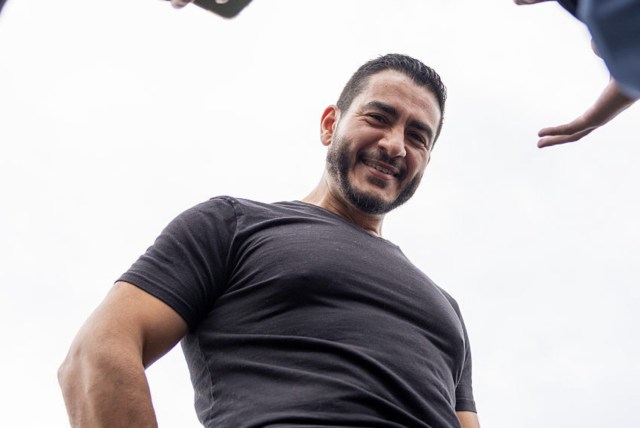
Abdul El-Sayed, running as an Israel-critical Leftist, has won the Senate Democratic primary in Michigan. Credit: Getty





Abdul El-Sayed’s victory in Michigan’s Senate Democratic primary isn’t just a triumph for the progressive Left, though it certainly is that. It must be understood, more broadly, as a rebuke to the Democratic establishment. Long delayed, the establishment’s reckoning has now fully arrived. Democratic elites — the incumbent politicos, corporate donors, the NGO-industrial complex, and aligned media — are on the back foot for the first time in decades. Even two years ago, the idea of candidates like El-Sayed and New York’s Zohran Mamdani winning Democratic primaries with large electorates was almost inconceivable.
El-Sayed, a former public-health official, managed it, clinching (as of this writing) 48.5% of ballots, against 47.5% for his centrist opponent, Rep. Haley Stevens. The narrow margin might prompt Democratic-establishment crowing about El-Sayed’s chances in the general. But consider that AIPAC and other outside groups poured some $60 million into Stevens’s campaign, with more than half of that amount coming from the political action committee of AIPAC, the pro-Israel lobby — making this the most expensive Democratic primary ever. Outside groups backing El-Sayed, by contrast, only managed fewer than $5 million.
Sixty million bucks couldn’t buy a Democratic primary. We have, in every sense, entered a new era.
Stevens was the sort of candidate who, not long ago, breezed to the nomination in a statewide contest. When Mallory McMorrow, the third Democrat in the running, dropped out, it was assumed Stevens could consolidate the anti-El-Sayed vote. This was how centrists almost always beat the Left, after all. In 2020, Bernie Sanders was doomed when Pete Buttigieg, Amy Klobuchar, and Beto O’Rourke dropped out of the primary, endorsing Joe Biden. Even when Leftists were strong, they were factional candidates, doomed to electoral ceilings. Sanders couldn’t get more votes than Biden or Hillary Clinton. The Left had to content itself with small-scale victories, like Alexandria Ocasio-Cortez knocking off Joe Crowley in a single New York House district.
But now we have a Left surge of a kind not seen since the late 1960s and early ’70s. Back then, Left-leaning Democrats won primaries on the strength of their full-throated opposition to the Vietnam War. Just so, today it’s Israel-critical Democrats who are being rewarded for aligning the party with popular sentiment. And popular sentiment is clear: the Jewish state is now viewed unfavorably by nearly all major demographic groups (save for Republicans over age 50).
El-Sayed, like Mamdani, is a fierce critic of Israel. Both shattered taboos around what could be said about the Jewish state. AIPAC knew what was at stake, hence its unprecedented spending. The state’s Democratic establishment, led by outgoing Gov. Gretchen Whitmer and outgoing Sen. Gary Peters, likewise lent its backing to Stevens. Before the mid-2020s, that sort of endorsement power alone would have just about ended any statewide primary.
Progressives, of course, can’t claim total victory. The margin was uncomfortably tight, and El-Sayed must survive the general election come November. But here, too, the deck is stacked. Moderates get to lose elections all the time, but if the Left blows a race to a Republican, the alarm bells are heard ringing all across the country. It’s the same way with governance: a centrist like Eric Adams, the former Gotham mayor, can depart City Hall in utter disgrace. But Mamdani, the democratic socialist, must run the city without a whiff of scandal; the slightest failure on his part (supposedly) indicts the entire American Left.
What makes El-Sayed’s victory over Stevens most intriguing, though, is that progressives will finally be able to test a thesis they’ve long entertained: namely, that their brand of politics — populist on economics but still socially liberal — can win in a battleground state. Progressives, typically, haven’t won primaries where a strong Republican is waiting in the wings. If El-Sayed can win Michigan, one of the most pivotal states in the country, he will be a true national star.
For now, at least, the progressive Left has been able to leave its cultural baggage behind. El-Sayed can’t be credibly called anti-woke, but he might be, like Mamdani, post-woke. Mamdani abandoned his earlier calls to defund the police. He does not, like the Democratic Socialists of America and 2010s progressives, support an open border.
El-Sayed has trod a similar path. With his bulging muscles and willingness to mix it up on the podcast circuit and alternative online channels, he codes as the sort of pol who might be able to solve the Democrats’ problem with woke-weary young men. He possesses a certain machismo that, for Leftists, is a more recent phenomenon. And he speaks forthrightly to the cultural crises of young men, telling UnHerd’s Sohrab Ahmari that Leftists should address the structural causes behind male malaise — issues like online gambling and porn addiction — rather than write off men as “toxic.” Whether this is enough to convince young men to vote Democratic again nationally remains to be seen.
The bigger story, though, is the pro-Palestine current running through the party, and the generational shift well under way that will eventually tug top Democrats away from Israel. Like all small-d democratic groups, they eventually respond to their voters, and this is clearly what their voters want. Social media were rife with videos mocking Stevens for her over-the-top devotion to the Jewish state — “Israel comes to me in my dreams” — and the AIPAC largesse floating her campaign.
There was her voice, too, almost a peculiar parody of the Michigander accent — I’ve spent a great amount of time in the state and never heard anyone speak that way — that had many online critics pulling up old clips of Chris Farley. Were these attacks sexist? Maybe. But they came from as many young women as young men. Swaggering El-Sayed was the one they wanted.
The pundit class contends that El-Sayed is a terrible bet in the general election against the Republican nominee, Mike Rogers. Whether they have a point or not, we will find out soon enough. What the Michigan primary proved was that Democratic voters are no longer compelled by that pitch. They once were; the entire premise of Biden’s 2020 campaign was his contention that only he could defeat Trump. Now the electorate is restless. They saw the Democratic failures of 2016 and 2024. They are weary and angry about living, again, under the yoke of Trump. When a Democratic politician or star operative lectures them about electability, they tune out. Wasn’t the failed reality-TV star supposed to be unelectable? Then he won — and won again. Stevens could talk all day and night about how she flipped a Republican seat. Very few people cared.
The harsh reality for the Democratic establishment is that they have, like Republicans in 2016, lost their grip on the party. They have no one but themselves to blame. In 2024, Michigan was the home of the Uncommitted movement: progressives who refused to fall behind Biden and Kamala Harris over the horrors unfolding in Gaza. Why would Stevens, AIPAC’s foot soldier, be the right candidate for 2026 in Michigan of all places, with its sizable Arab and Muslim population?
Now that it has been proved that AIPAC cannot buy a Democratic primary, the group’s influence on Democratic politics, already waning, will collapse sharply. Even if El-Sayed loses in November, there won’t be a lane for Israel hawks in future Democratic primaries, and they will migrate fully to the GOP (where, it must be noted, a warm embrace isn’t certain to greet them).
Organic support for Israel is vanishing, and the vast reserves of cash can’t bring it back. Stevens herself once won a House primary bludgeoning a progressive Jewish Democrat, Andy Levin, whom Israel hawks believed was insufficiently supportive of the Jewish state. Now she is finished. At best, she will be a footnote: one of the very last pure AIPAC Democrats. Like the Rockefeller Republicans of old, she and her cause will fade into history.
