




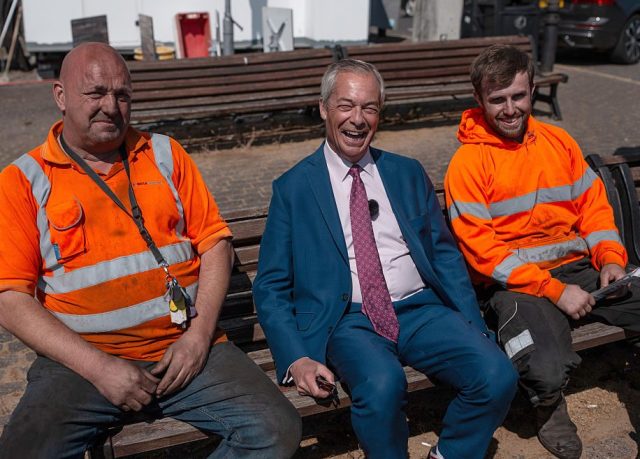
The new Wat Tyler? (Carl Court/Getty)





Nigel Farage is Kentish. Downe, the Bromley village where he grew up, was gobbled up by Greater London just two days before his first birthday. But the London Government Act could not stamp the Kentishness out of baby Nigel. He would never call himself a Londoner — and nor would anybody else in Downe. He has even suggested that the entire borough of Bromley should secede from Greater London. London is “the city”; it is for making money and having fun. But Kent is fishing, family, and freedom. Kent is home.
Kent always was deepest Farageland. It sums up Farage’s political vision and persona: close enough to London to understand it, far enough to be in touch with the provincial commonfolk. In this, Farage differs much from his rival on the Right, Rupert Lowe. Though both cut their teeth in the City, Farage still presents himself as a wheeler-dealer, the tribune of the petit-bourgeoisie. Lowe, on the other hand, has reinvented himself as a farmer. His concerns are basically rural, including his preoccupation with self-defense. Inveighing against “metropolitan attacks on rural Britain” in his gilet and wellies, always flanked by a flock of sheep, he claims the old mantle of the Countryside Alliance.
The contest between Reform and Restore has reached a stalemate. There are murmurings of a rapprochement. It seems probable that, if there is a general election soon, there will be some kind of pact. That would involve Restore standing down in places like Kent. It might also involve Reform leaving Lowe’s Great Yarmouth, and rural constituencies, to Restore. Farage, the “cheeky chappie”, can appeal to Kent and Essex’s Cockney diaspora. Lowe, meanwhile, can rattle off the farmers’ list of grievances.
It would be a natural division of territory. Farage is shaped by the South East, especially the Greater London periphery, at least as profoundly as Andy Burnham is by the North West. Kent was part of the South East England constituency that Farage spent 21 years representing in Strasbourg and Brussels. He spent just as long sniffing around for seats at Westminster, always favoring Kentish ones — even if they fell outside Kent proper. In 2001 he stood in Bexhill and Battle — a de facto Kentish constituency, since much of its electorate comprised pensioners from Bromley. In 2006 he contested a by-election in Bromley and Chislehurst. Twice he stood in South Thanet. Clacton, in Essex, was the most Reform-friendly seat in the country, so it’s only natural that Farage, after so many bruises, should have pitched his tent there in 2024. It has many similarities with Farage’s Kentish power-base, not least in its Reform-friendliness; but perhaps he would have been happier somewhere farther south.
It’s ironic, of course, that Kent is in some ways the most European part of Britain. On a clear day, you can see Calais from Dover. This has been known sometimes to stimulate a certain fellow-feeling with the people over in the distance. That might have been its effect on the Kentish prime minister who took us into Europe, Ted Heath. But, as so often, the closer one gets to a boundary, the more one fashions one’s identity against the other side. Where Heath saw in the Channel a European stream to be bridged, Farage finds proof of England’s insularity. In 2016, more people in Kent agreed with Farage than with Heath.
Kent’s long Channel coastline also leaves it exposed. It is both England’s watchtower and its soft underbelly. Wordsworth wrote “To the Men of Kent” amid the Napoleonic invasion scare:
Vanguard of Liberty, ye men of Kent,
Ye children of a Soil that does advance
Her haughty brow against the coast of France,
Now is the time to prove your hardiment.
In 1588 Philip II directed the Armada to land on Kent. It is no accident that Farage was one of the first to sound the alarm over the small boats crisis: he could witness it firsthand from the Kentish coast. “Another huge armada”, he tweeted in 2021, “has hit the Kent beaches”. Just this week, Reform has announced that it would deploy the Royal Navy to stop the small boats.
Like Farage, the South East has a radical streak. As far back as 2014, a young political scientist by the name of Matthew Goodwin was comparing Farage with the region’s most famous upstart, Wat Tyler. It is actually unknown whether Tyler came from Kent or Essex; both counties claim him as theirs. In a sense, though, it doesn’t matter: for here, in their rowdiness, Kent and Essex combine. The counties which gave UKIP its pair of MPs, Douglas Carswell and Mark Reckless; the county of Farage’s seat, and the one that is his home — these were, throughout English history, the most potent sites of insurrection. Other counties could gnash their teeth and cause trouble on occasion: the peasants of Norfolk also rose up in 1381. But, unlike Wat Tyler, they were too far from London to make any difference. It is difficult, as the Norfolk MP Lowe may discover, to make parochial rural concerns impress themselves on the metropole: the closer one gets to the centers of wealth and power in Britain, the less people care about farmers and guns. Only places like Kent and Essex can encircle the capital and exert deadly pressure on it.
The trailer for a forthcoming film about the Peasants’ Revolt presents it as one fought against the King. In reality, the ideology motivating Wat Tyler and his collaborators was a loyalist one. They wanted to rescue the king from his wicked counselors: Wat Tyler claimed to act on behalf of “King Richarde and the trew communes”. When the rebels demanded the heads of the Lord Chancellor and Archbishop of Canterbury, this was because they had been traitors to the crown. The Peasants’ Revolt also, of course, involved xenophobic violence against London’s Flemings and Lombards. In short, Kent and Essex look to London for their salvation. But they can also take it upon themselves to set things in London right.
The cause of revolt in 1381 was simple: the people of Kent and Essex were sick of paying so much tax. That spirit has never really gone away. Six centuries later, Kent and Essex were the heartlands of Thatcherism. Unlike much of the country, their proudly individualist, enterprising, and petit-bourgeois denizens welcomed Thatcher’s laissez-faire agenda. Farage, if not quite Essex Man, was at least a Kentish wide boy. Unlike Lowe’s farmers, they feel deeply that their fortunes are bundled together with London’s.
Farage was happy on the open-outcry trading floor of the London Metal Exchange after the “Big Bang”, fueled by adrenaline and a never-ending supply of drink. He always envisioned UKIP as a libertarian party cast in Thatcher’s image. The line separating it from the BNP was that “they’re authoritarian, we’re libertarian”. Farage is, indeed, a liberal at heart. His political awakening came when, aged 14, he picked up a copy of John Stuart Mill’s On Liberty in the Dulwich College library. He was inspired to join the Conservative Party as a teenager by a visit to the school by Thatcher’s libertarian guru, Sir Keith Joseph. Interviewed in the New Statesman in 2014, he was asked whether he was part of the “‘small c’ conservative family”. “God no!” was his answer.
Farage is, instead, a 19th-century liberal. Certainly, his libertarian instincts are at odds with Lowe’s new-found agrarian, protectionist ones. When Farage joined UKIP, it was called the Anti-Federalist League; its name evoked the Anti-Corn Law League, the 19th-century liberal campaign against Britain’s entrenched farmer class. The Anti-Corn Law League defeated the farmers, and the farmers, as a political force, never really recovered. Lowe’s efforts to champion them are unlikely to meet with much success. Lowe, the modern-day tribune of the class that the Anti-Corn Law League took on and defeated, was never involved in UKIP. Under Farage, UKIP continued to model itself on the 19th-century campaign for free trade. In a speech to the UKIP conference in 2013, Farage set out the 19th-century liberal case for Brexit: if Britain were to leave the EU, it would “get back the ability to strike free trade deals”. He even suggested “abolishing tariffs on African produce” to “do more to raise living standards there than any amount of aid”. Peace and prosperity through free trade: this was pure Manchester Liberalism, worthy of Richard Cobden.
These days, “Manchesterism” has acquired a rather different meaning. It is, we are told, the opposite of neoliberalism, the opposite of Thatcherism. The ascendancy of Andy Burnham may now put paid to Reform’s hopes of making inroads in the North. Burnham’s victory in Makerfield was held up as “proof of concept” that, with a Northerner in No. 10, and one willing to disavow Thatcherism altogether, Labour could keep the “Red Wall” standing.
Now, Patrick Maguire claims in The Times, Farage is inspired as much by “the Eurosceptic Labour minister Peter Shore’s vision of state control of strategic industry” as he is by his liberal and libertarian idols, Enoch Powell, Sir Keith Joseph, and John Stuart Mill. But one has to wonder: was his heart ever really in it? It was awfully expedient for Farage to move in a big-state direction at just the moment he wanted to curry favor in the post-industrial North, when talk of “realignment” was filling everyone’s ears. The rise of Burnham might therefore come to him as some relief. Now, he can revert to his true, Southern, Thatcherite self. In Clacton he can also, for good measure, defeat his only serious rival in the byelection: the Shoreite SDP.
Recently, as though anticipating the Burnham shift, Reform has dropped some of its more Shoreite posturing on nationalization. Having long fantasized about a union of “socially Right” with “economically Left”, Reform appears to have surreptitiously drifted back into Farage’s small-state comfort-zone. The Reform-adjacent think tank, the Centre for a Better Britain, is singing from this hymn sheet. Its first paper was published with the imprimatur of the Thatcherite Spartan John Redwood. “What to do if the UK faces a sovereign debt crisis?”, it asks. Its prescription is a classically liberal one: slash benefits, push for growth with supply-side reforms, cut red tape, trim the state. And, above all: “Do not raise taxes unless absolutely necessary”. There is not much room here for Lowe’s more agrarian vision. The next election is far more likely to be Burnham’s Manchesterism versus the 19th-century kind.
Reform may now be staking out a new path to victory, a “Southern strategy”. It probably would require some compliance from Lowe: he reaches a different kind of Southern voter (albeit a much less significant group) than Farage does. Either way, the strategy would look like this. Forget about Gorton and Denton; forget about Makerfield. Leave the North now to its “king”. Brush aside the ex-Labourite Lee Anderson, the “Red Wall” made flesh: Farage was never a likely tribune of the “left-behind” Northerners, anyway. Offer the South a kind of populist liberalism, with its recognizably Kentish precepts: sovereignty of the people, suspicion of the state, hostility to taxation, vigilance on the border. Throw some bones to Lowe’s band of angry farmers, while steering clear of full-scale protection. Do it well enough to force the Tories, the other Southern party, into a merger. And then, at the next general election, Farage can run the campaign he has always secretly wanted to, the kind of campaign that served Thatcher well enough on three occasions. The North never was Reform’s heartland. Farage’s heart always belonged to Kent.
