




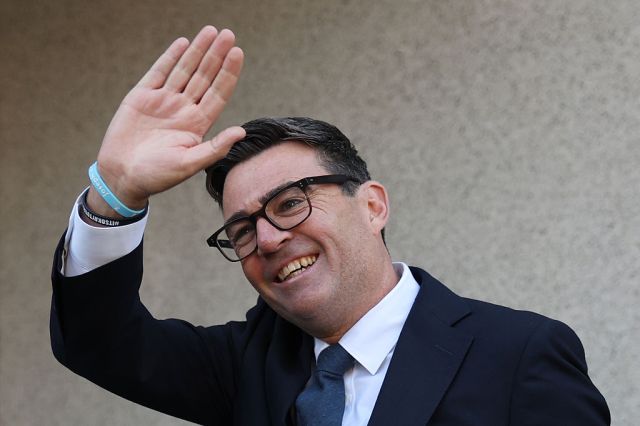
Andy Burnham's court is divided. (Ryan Jenkinson/Getty)





Last Monday, Andy Burnham delivered what was perhaps the most ambitious statement of economic intent since 1997. Standing outside Downing Street, the Prime Minister spoke of “a new political model and a new economic model”. The idea, he said, was to put “life’s essentials back under stronger public control” and to reindustrialize Britain “using public procurement to back British industry”.
This certainly sounds ambitious. But rhetoric is cheap and it has so far proven difficult to pin down Burnham on specific policies. He took a week to end speculation about scrapping council taxes and stamp duties and replacing them with a flat property value tax, clarifying that “nothing immediate” on the issue was in fact planned. This was just a day after he walked back an earlier suggestion about raising personal income tax allowances.
With this in mind, it is not clear how to interpret the Prime Minister’s announcement on Wednesday that the Government will look into financing a reform of Britain’s long-neglected social care system, potentially with tax hikes. But following the old adage that personnel is policy, perhaps one can infer Burnham’s actual priorities and preferences through his staffing choices.
On matters of economic policy, Burnham’s court of ministers, advisers and aides can be divided into roughly three camps: Brownites with a regionalist and national security bent who are broadly aligned with the Treasury orthodoxy; soft-Left mandarins and policy experts with a long paper trail of criticizing it; and progressive think-tankers with cautiously radical reform ambitions.
The Chancellor falls squarely into the first camp. John Healey’s resignation over his predecessor Rachel Reeves’s budget was not a sign of heterodoxy but of its opposite: a complaint that the Treasury would not fund rearmament, not that it ran the country by rulebook. His formation is the purest Brownism left in frontline politics. He came into Parliament from the campaigns directorship of the Trades Union Congress, co-wrote Labour’s first paper on regional economic policy with Ed Balls in 1998, and spent five years as a Treasury minister under Brown before the housing brief made him the party’s most persistent advocate of council house building.
Last week, Healey told Treasury staff in his first speech that “fiscal control must be the first duty” of the office and promised to meet the rules “in lockstep” with Burnham while “ensuring there’s a buffer also for uncertainty”, a sentence that commits him to running larger margins than Reeves ever enjoyed. The distinctive Healey move is to weld the doctrine to the flag: fiscal credibility, in his telling, is “the bedrock of economic stability and national security”. Tellingly, his new political team, drawn largely from his defense operation and chiefed by Will Straw (another product of the Brown Treasury), contains not a single economic adviser.
The intellectual warrant for this position comes from Richard Hughes, the former chairman of the Office for Budget Responsibility, whom Burnham included as one of his fiscal advisers ahead of the expected leadership challenge. Hughes is the nearest thing British fiscal policy has to an internal auditor: a career Treasury official who ran the 2007 spending review, did fiscal surveillance at the IMF, and at the Resolution Foundation wrote the case for rules that recognize the state’s assets as well as its debts, the intellectual ancestor of the net financial liabilities measure the government now targets. His verdict on the UK’s current fiscal framework inverts the common complaint: the rules are not too tight but “among the loosest the UK has had in its history”, he told the Lords in January; the British disease is “how frequently we abandon” them, and the gaming of targets that are met in letter and violated in spirit.
Ranged against Healey and Hughes, at least on paper, are the two most senior economists in Burnham’s orbit: Jim O’Neill and Andy Haldane. They are both Sheffield economics graduates of a certain vintage as well as long-standing critics of the framework their government has just re-embraced. O’Neill, tipped as chief economic adviser, took the scenic route to Manchester patriotism: after two decades at Goldman Sachs, where he coined the term BRICs and chaired the asset management arm, he oversaw the Royal Society of Arts’ City Growth Commission, making an agglomerationist case for metro devolution that George Osborne bought wholesale, hiring O’Neill to deliver the Northern Powerhouse. He has called the fiscal rules “petty and arbitrary”, dismissed Starmer’s welfare squeeze as “playing around with small amounts of savings” to satisfy them, wants council tax and stamp duty replaced outright, and confirms that devolving income tax is being examined “in a serious way”.
Haldane, the former Chief Economist of the Bank of England, arrived at similar conclusions from inside the state: after 32 years at the Bank — where his speeches on the financial sector’s mirage of measured productivity and the share buyback culture of the equity market remain the establishment’s best account of why profits stopped becoming investment — he chaired the Industrial Strategy Council and helped to write the Levelling-Up white paper. He has attacked the “fiscal straitjacket”, called the case for changing the rules “overwhelming”, and blamed last autumn’s “fiscal fandango” of tax speculation for flatlining growth.
Burnham’s talk of putting “life’s essentials back under stronger public control” bears the watermark of some of his more progressive advisers, including figures from influential think tanks, the New Economics Foundation, IPPR North and Common Wealth. Miatta Fahnbulleh, NEF former chief executive and now Secretary of State for Energy Security and Net Zero, is among Burnham’s closest confidantes. She describes her politics in the terms of the cooperative tradition of the Left, favors “common ownership of public goods and essential infrastructure”, and has explored taking water into public hands on the costless model Louise Haigh used for rail. IPPR North’s Zoë Billingham is a natural pick as the head of one of the institutional homes of the devolution and regional rebalancing agenda. Common Wealth’s founder, Mathew Lawrence, was the co-author of a recent paper, published through the Burnham-aligned Mainstream group, extending Manchesterism to British capitalism at large. It advocated public intervention wherever investment has dried up and rents inflate the price of primary needs.
This is the only wing of the Burnham court with a sophisticated theory of public ownership, one that is framed in terms of fiscal prudence too. Nonetheless, the current fiscal framework prices their program as ruinous, since rules that net off financial assets but not physical ones make renationalizing a water company look like fiscal incontinence and a minority stake look like prudence.
Indeed, the priorities of Burnham’s three different camps militate against each other: accepting the notion that the UK’s fiscal position necessitates an enforcing of the rules is ultimately not compatible with planning for industrial revival and renewed public control of key goods provision. These ambitions imply a decade of investment, public and private, in plant, grids, housing and skills before any of it returns a penny of revenue. The current rules that treat such outlays as identical to consumption ration precisely the spending on which future output depends. And reasserting public ownership compounds the offense: perversely, borrowing to acquire a controlling stake in a revenue-generating utility registers as pure fiscal deterioration, since consolidation extinguishes the offsetting financial asset and the physical estate counts for nothing against the debt incurred. Above all, persistent fiscal constraints depress the aggregate demand on which private investment decisions hinge, so productivity continues to stagnate, the growth rate and tax revenue disappoint, and the rules tighten again. This vicious circle that the UK has drawn since the financial crisis is not conducive to any program of economic transformation.
If this seeming contradiction has to be resolved one way or another, then Healey’s appointment, with Hughes lurking in the background, suggests it won’t be in favor of the progressives. Healey’s first speech as chancellor suggested that his quarrel with Reeves wasn’t doctrinal but specifically about the refusal to accommodate more defense spending. That’s why he named fiscal credibility as “the bedrock of economic stability and national security”. On the evidence of the Government’s first fortnight, Haldane and O’Neill, neither of whom hold confirmed posts, have already lost the argument.
Whatever his rhetoric, then, one might conclude that this signals Burnham’s revealed preference for continuity. More cynical tongues might suggest that any perception of a political sea change reflects the Prime Minister’s penchant for savvy social media stage management. But though his personnel and fiscal doctrine are Brownite, Burnham is distancing himself from Whitehall. While Brown’s model made the Treasury the strategic brain of government, Burnham’s “beefed-up No. 10” with a “malleable” Chancellor is built to do the opposite. The extent to which more transformative policy ideas have any purchase on his decision-making will depend on this new model actually working as intended. It is noteworthy, however, that it was Burnham and not Healey who sought Hughes’s council.
But what is more conspicuous about Burnham’s economic worldview are the elements that are absent. There is little to suggest that Britain’s new leader realizes how strange the country is, in macroeconomic terms. Though “Manchesterism” produced consistent above-national-average employment and output growth, income growth remained weak. That is because real wages have grown poorly everywhere, not just because cost-of-living pressures have persisted but because productivity growth has not budged, in no small part due to investment being consistently low. On these metrics the UK is a strange outlier among its peers.
But as some of the response to Burnham’s moderately ambitious proposals suggests, there is little appreciation for this fact. The reaction to his social care proposal this week was telling. He accurately pointed out that social care workers, often immigrants, live on “poverty pay”, while almost two million elderly Britons need to qualify for state aid given the low threshold, and often face having to sell their homes. But many commentators suggested that the UK can’t afford any more social spending and that middle-class households are already overtaxed. The Resolution Foundation had already taken to sounding the alarm based on Burnham’s proposals so far, claiming Burnham’s pledges had reduced the “fiscal headroom” to as little as £8 billion.
What is absent from the conversation is how UK spending measures up internationally. First and foremost: the UK is not a heavily taxed society by any standard. As of 2024, total tax revenue including social security contributions as a share of GDP was at 34.4%, only just above the OECD average and well below the EU average of 39.3%. And the tax wedge, that is how heavily the state taxes a full-time single worker on an average salary, was at 29.9%, placing Britain dead last in a group that includes all EU countries and the United States. When including average council taxes, the wedge increases by a few percentage points, keeping the UK well below the EU average of 44.1%. This reflects the fact that median income households in the UK are in fact less taxed than elsewhere, and significantly so.
Meanwhile, the most recent figure for the UK’s net social expenditure was at 22.8% of GDP, below both the EU and the United States. Any worry that the country’s welfare bill is too high seems misplaced. It is equally hard to understand why the much maligned triple-lock on Britain’s modest state pension attracts so much vitriol and media attention: precisely because of the reliance on capital income to fund pensions, the magnitude of gross old-age benefits is minimal, amounting to just over 7.6% of GDP in 2023. The same OECD data suggests that the UK relative position doesn’t change even if the triple-lock persists until 2040.
Whatever the reason the UK economy underperforms relative to its wealthy peers, it is hard to find fault in social programs whose public spending footprint pales in comparison. There is little to suggest that the senior government and its current crop of advisers and official appointees realize that the country’s economic policy discussions are profoundly insular and out-of-tune. Perhaps the biggest inference we can make about Burnham is that he lacks the ability to formulate a response to the opponents of his economic vision. This would go a long way to explaining why he has invited some of them into his government.
